
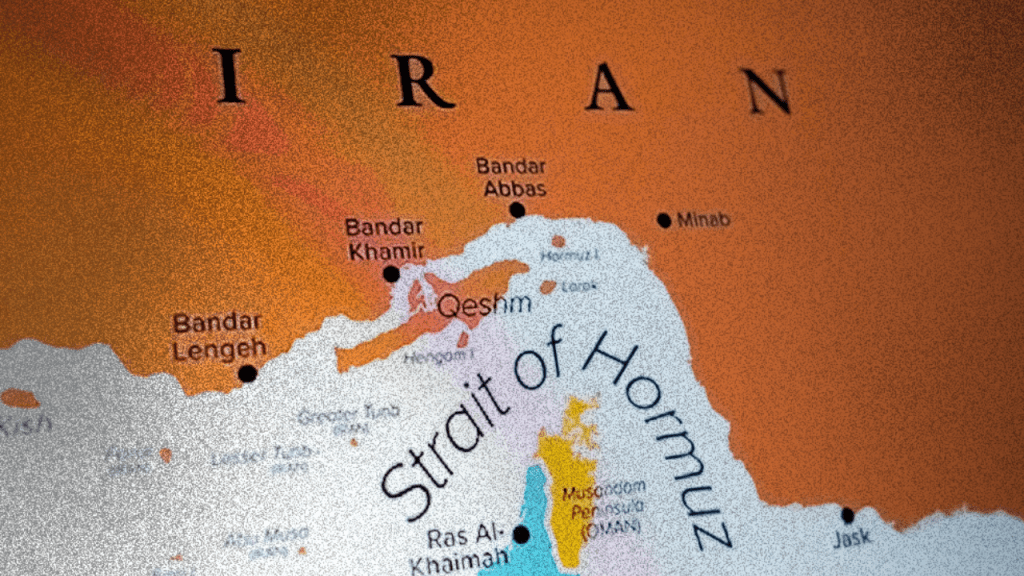
Strait of Hormuz disruption did not require physical closure — insurance withdrawal and rerouting shut the waterway before Iran fired another shot.
The Strait Is the War
By the second week of the U.S.-Israeli assault on Iran, the conflict’s decisive terrain had already shifted. Missiles, air defenses, and military targets remained the visible surface of the war. Underneath them, something larger was moving: the global systems that route energy, goods, and capital were absorbing the conflict’s force and beginning to transmit it outward. The Strait of Hormuz — 33 kilometers wide at its narrowest point, carrying roughly 20% of the world’s oil and liquefied natural gas — was the hinge on which this transmission turned. Understanding the Strait is not background to the analysis. It is the analysis. Everything that followed flowed through it.
The disruption that materialized there in the days after Iran’s sustained retaliation proved significantly more severe than early reporting suggested. Initial accounts described shipping slowdowns and route alterations. What actually occurred was closer to a functional shutdown. Maersk, MSC, Hapag-Lloyd, and CMA CGM — the dominant carriers in global container shipping — all suspended Hormuz operations. Lloyd’s List intelligence confirmed near-zero commercial traffic through the Strait by mid-March, against a normal daily figure of well over 100 transits. The waterway was not merely threatened — it was functionally closed. And the mechanism that closed it was not military force alone. It was the market’s response to the credible possibility of military force. That distinction is the article’s central argument.
Markets Closed the Strait Before the Navy Could
The Strait’s effective closure preceded any confirmed large-scale interdiction of vessels. This is not a minor technical point. It is the structural key to understanding how modern economic warfare operates. Before Iranian forces physically halted transit, the information environment had already done the work. Insurance underwriters at Lloyd’s — who set the terms under which global shipping operates — moved first. Typical Hormuz transit insurance rates ran between 0.15% and 0.25% of hull value for a one-week policy before the conflict began. Lloyd’s List confirmed that once the conflict began, quotes reached as high as 5% to 10% of hull value — adding several million euros in costs for a single transit of a very large crude carrier. At that price, most commercial operators made the same calculation: the route was not viable.
The result was closure by economic logic rather than by blockade. S&P Global quoted Bilal Bassiouni of Pangea-Risk describing the Strait as “de-facto closed given that a lot of insurance companies have stopped insuring transiting vessels.” No major carriers were moving through it. The physical waterway remained open in the military sense — Iran had not sunk a vessel across the channel — but it was functionally sealed by the withdrawal of the financial infrastructure that makes commercial shipping possible. This is how chokepoints operate in the twenty-first century. The threat does not need to be actualized. It needs only to be credible enough to make insurers act. Once insurers act, shipping companies follow. The the Strait closes. The mechanism does its work.
The Feedback Loop Needs No New Strikes to Accelerate
What the Hormuz situation produced was a self-reinforcing cascade. Perceived disruption risk prompted insurance rate increases. Insurance rate increases made transit economically prohibitive. Economically prohibitive transit prompted rerouting decisions. Rerouting decisions lengthened supply chains, raised costs, and confirmed to other market actors that the risk assessment was warranted. That confirmation fed back into risk pricing, which pushed insurance rates higher still. The Strait’s effective closure was not a discrete event — it was the output of a process that each market actor’s rational response accelerated.
Al Jazeera shipping analysis that even after the Strait eventually reopens, “the disruption to global supply chains will be felt long after ships have been cleared to pass en masse.” The World Economic Forum World Economic Forum concluded the conflict’s economic fallout is “reshaping markets and supply chains — potentially for years to come.” The feedback loop does not stop when the trigger stops. Supply chains reconfigured around longer routes do not snap back instantly. Contracts renegotiated under emergency conditions carry their new terms forward. The war extends its reach across time as well as geography — without a single additional strike required to sustain it.
Markets Stopped Pricing Oil and Started Pricing Uncertainty
The financial dimension of this process ran in parallel with the logistical one, and together they represent the article’s most important structural insight: the entire economic architecture — both the markets that price energy and the networks that physically move it — decoupled from confirmed supply data simultaneously. Goldman Sachs Research documented that by March 3, traders were demanding approximately $14 more per barrel than pre-conflict levels to compensate for anticipated risk — a premium that Goldman’s own analysts calculated corresponded to the effect of a full four-week halt in Hormuz flows, before any such halt was confirmed. Brent crude surged toward $120 per barrel as strategic chokepoint pressure deepened and markets began pricing sustained disruption rather than a temporary spike.
Oxford Economics stated directly that “volatility in Brent crude oil prices has been extreme because of the uncertainty surrounding what happens next in the conflict between US-Israel and Iran.” This framing is precise: the volatility was not a response to what had happened but to what might. Supply and demand fundamentals — actual production figures, confirmed export volumes, verified consumption data — became secondary inputs. The primary input was the probability distribution of future disruption. Energy markets are not irrational when they operate this way. They are responding correctly to the information available to them. The market is pricing the system’s structural vulnerability. That is the rational thing to do. It is also the thing that makes the conflict global.
When Geography Is Strategy, Economic Damage Is the Weapon
The convergence of logistical closure and financial decoupling produces a strategic consequence that extends well beyond this particular conflict. Military decisions in the Hormuz theater now carry a dual evaluation that commanders cannot separate. J.P. Morgan stated that the conflict “generates greater macroeconomic risk than recent military conflicts” and that “through its potential to disrupt global energy markets and supply chains, it looks likely to have material, lasting political and economic consequences at the regional level.” This assessment reflects something that Western strategic planning has systematically underweighted: the economic consequences of military action in chokepoint geography are not externalities. They are the action’s primary output.
Brookings analysts observed that Iran is “thinking about how to deter the next one. And part of the way you deter the next round is to teach more powerful adversaries that they don’t control when the dance stops, once the music starts.” The Al Jazeera Centre for Studies Al Jazeera concluded that “reopening the Strait of Hormuz may be militarily possible, but it would likely be costly and time-consuming for the United States. Even attempting it could trigger a global economic shock.” The strategic picture that emerges is one in which Iran holds a form of deterrence that does not depend on military parity. It depends on geography. Control over — or credible capacity to disrupt — a waterway through which one-fifth of global oil flows is a strategic asset that translates military vulnerability into economic leverage. The United States and Israel struck a state. That state can respond through a chokepoint that strikes the global economy. These are not equivalent capabilities. But they operate in different registers, and the second register is the one that determines whether the conflict remains regional or becomes a global event. By March 8, 2026, that question had already been answered. Why oil is this structurally central — political scarcity, not geology — is the underlying mechanism. And the effort to frame what followed as a stalemate rather than escalation was partly an attempt to deny that this register had already delivered a verdict.
Sources
- Wikipedia — 2026 Strait of Hormuz Crisis
- Euronews — Ships Seek Iranian Clearance to Cross Hormuz as Insurance Costs Surge
- S&P Global Market Intelligence — Marine War Insurance for Hormuz Dries Up
- Al Jazeera — Maritime Insurers Cancel War Risk Cover in Gulf
- Goldman Sachs Research — How Will the Iran Conflict Impact Oil Prices?
- Oxford Economics — Iran War Scenarios: The Oil Price That Breaks the Economy
- J.P. Morgan Global Research — US-Israel Military Operation Against Iran: Are Markets on Edge?
- Brookings Institution — Why Iran’s Disruption of the Strait of Hormuz Matters
- Al Jazeera Centre for Studies — Strait of Hormuz: Global Economic Shock and the Limits of Military Power
- Al Jazeera — After Strait of Hormuz Opens, Turmoil Would Still Last Months
- World Economic Forum — The Global Price Tag of War in the Middle East
- Wikipedia — Economic Impact of the 2026 Iran War
- Iran War Narrative Inverts Who Struck First — Spark Solidarity
- Trump on China and Panama Canal — Spark Solidarity
- China Is Not Imperialist — Spark Solidarity
- Oil rose 2% — Spark Solidarity
- Iran-U.S. war not stalemate — Spark Solidarity




 Spark Solidarity