
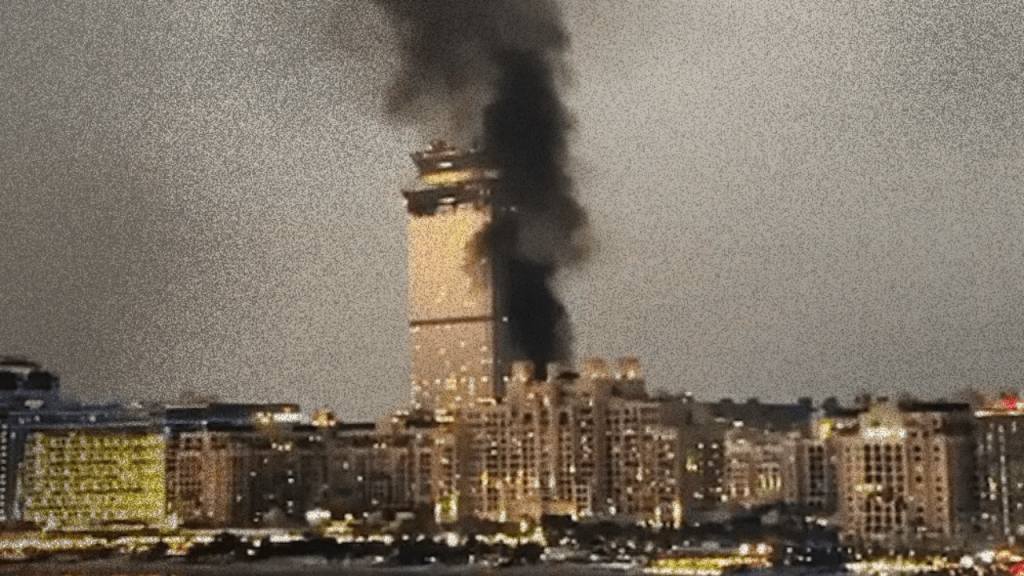
Iran strikes on Dubai exposed what Western media buried: the UAE is a node in the US military network, and blowback is structural, not random.
On February 28, 2026, Dubai International Airport — the world’s busiest airport for international passenger traffic — sustained damage to a terminal concourse after debris from intercepted Iranian missiles fell across the facility. Four staff members were injured. Drone debris struck near the Burj Al Arab hotel. A berth at Jebel Ali Port caught fire after interception fragments fell into the harbor. At Abu Dhabi’s Zayed International Airport, a Pakistani national was killed when debris from a downed drone landed inside the terminal.
Those events were not isolated incidents. They were part of a much larger retaliation wave that spread across the Gulf after the killing of Iran’s Supreme Leader in the opening hours of Operation Epic Fury. Iranian forces launched 189 ballistic missiles, 941 drones, and 3 cruise missiles at the UAE across multiple waves. UAE and allied air-defense systems intercepted the overwhelming majority, but falling debris caused damage across Dubai, Abu Dhabi, and surrounding districts. Four people were killed and 112 injured — the dead were foreign nationals from Pakistan, Nepal, and Bangladesh.
That sequence matters because it establishes cause before interpretation.
Western coverage immediately framed the strikes as escalation. That framing assumes a neutral baseline that does not exist. The conflict did not begin when Iranian drones entered Gulf airspace. It followed the joint US-Israeli strikes that killed Iran’s supreme leader and dozens of senior officials. Iranian missile launches were retaliation within an ongoing war whose opening phases had already been normalized by Western discourse. What occurred in Dubai was not a sudden expansion of violence. It was blowback reaching a place long assumed to be insulated from consequence.
Dubai is not neutral ground
Dubai is routinely described as a civilian, commercial, or apolitical space. That description obscures the city’s structural role in regional security architecture.
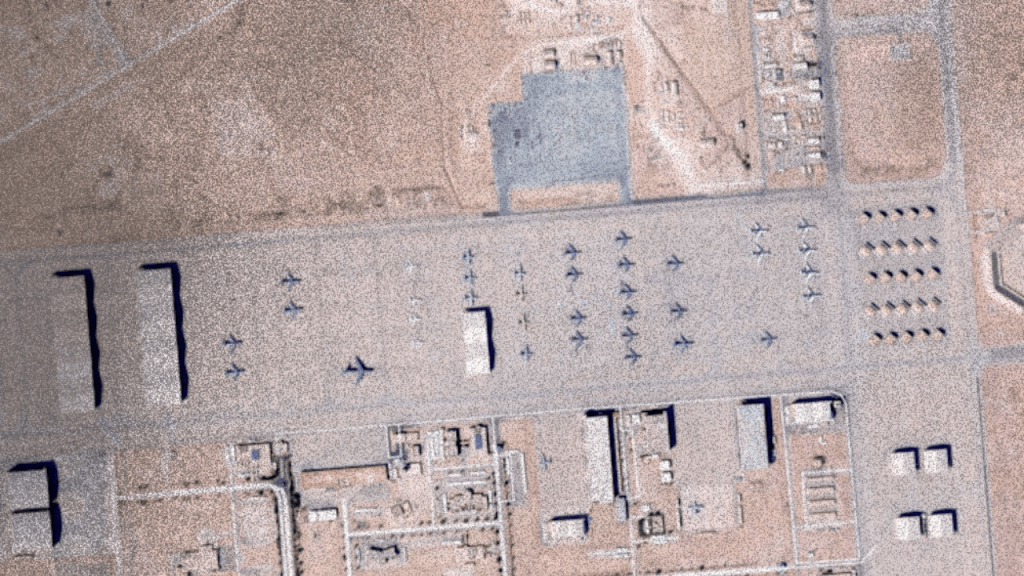
The United Arab Emirates hosts Al Dhafra Air Base, located roughly thirty kilometres south of Abu Dhabi. The installation houses the US Air Force’s 380th Air Expeditionary Wing along with Navy and Army personnel. It functions as a central node for US Central Command operations, supporting reconnaissance, aerial refuelling, and strike missions across the Middle East. Iranian missiles targeted Al Dhafra during the February 28 retaliation wave. The Al Minhad Air Base — operated jointly by the UAE Air Force, the Royal Air Force, and the Australian Defence Force — was also struck.
Jebel Ali Port plays an equally significant role. It is the primary logistics port for the US Navy in the region and the most frequent foreign port call for American warships, supporting naval resupply and maintenance operations that enable US power projection across the Persian Gulf, the Red Sea, and the western Indian Ocean. The Gulf states’ stability and security has been underwritten by the United States, which maintains military bases in every Gulf state apart from Oman.
The distinction between civilian and military space becomes unstable once military systems are embedded inside global commercial hubs. Airports, ports, and financial districts exist alongside bases and command centers. When war reaches those systems, the boundaries between them collapse.
Why the direct enemy is rarely touched
A predictable question follows: why strike the Gulf rather than the United States or Israel directly?
The answer lies in how power is organized. The US homeland is protected by geography and an escalation doctrine that deters direct attack. Israel is shielded by layered missile-defense systems and unconditional American military backing. Direct strikes on either would invite catastrophic retaliation without materially shifting the balance of power.
Iran’s campaign did include attacks on US bases across the region. Missile and drone strikes targeted Al Udeid Air Base in Qatar, Ali Al Salem Air Base in Kuwait, Al Dhafra in the UAE, and the US Fifth Fleet headquarters in Bahrain. Most were intercepted by integrated American and allied air-defense systems. In asymmetric warfare, pressure is applied where systems are vulnerable rather than where symbols are strongest. Disrupting the logistics nodes that sustain US military operations — Jebel Ali’s naval access, Al Dhafra’s reconnaissance and strike capabilities — introduces uncertainty into networks that rely on predictable flows of finance, logistics, and security. That uncertainty is the point.
Empire’s risk model
American power functions by exporting risk while importing stability. US civilians rarely experience retaliation for the wars conducted in their name. Airports in Washington or Los Angeles do not close because of strikes ordered in the Middle East. Instead, the exposure is displaced outward.
Regional allies host the bases. Migrant workers staff the infrastructure. Populations living near ports, airports, and air-defense sites absorb the consequences when conflict spills across those systems. The Pakistani worker killed at Zayed International Airport was not a combatant. He was part of the labor force that keeps the Gulf’s logistics economy running, in a state that hosts American military installations and participates in the regional order that makes those installations possible.
This distribution of risk is structural. When the first Iranian drones penetrated Gulf air defenses, they shattered the facade of regional security. The United States had instigated a war that undermined the security of its own partners and remained unable to protect them from the blowback. When a global hub like Dubai experiences missile alerts, airspace closures, and falling debris, that arrangement briefly becomes visible.
How media framing buried the cause
Coverage of the strikes emphasized flight cancellations, damaged hotels, and disruption to tourism. Thousands of flights were canceled across the region as Gulf states closed their airspace. Causality was consistently backgrounded.
Iranian missiles were presented as the beginning of the crisis rather than the response to earlier US-Israeli strikes. The triggering event — the killing of Iran’s supreme leader — appeared in many reports only as brief context before the narrative returned to the spectacle of airport evacuations and stranded tourists. This pattern does not emerge accidentally. Language choices shape interpretation. They train audiences to see retaliation as aggression while treating earlier acts of force as environmental background. The result is a public that witnesses disruption without its origins — which is precisely how perception management works.
What the strikes on Dubai actually reveal
The events in Dubai were not the result of random chaos. They were the product of a networked system of modern warfare. Contemporary conflicts rarely occur along clean front lines. They operate through interconnected infrastructures: military bases, shipping ports, airspace corridors, intelligence facilities, and financial centers. When those systems are attacked or defended, effects ripple outward across every node that makes them function.
Dubai was affected because it sits inside that network. This is the first conflict since the Second World War to directly impact cities and facilities that serve as hubs in the globalized economy. The deeper implication is not limited to the UAE. It concerns the fragility of a global order that depends on distance to maintain legitimacy. Empire functions most smoothly when war appears geographically contained — when violence remains far from the commercial hubs that benefit from the security it provides.
When that distance collapses, even briefly, the costs of that system become visible to those who have long been shielded from them. And visibility is precisely what power works hardest to prevent.
Sources
- 2026 UAE strikes — Wikipedia
- Dubai and Abu Dhabi strikes — Euronews, March 1, 2026
- Iran targets US Gulf assets — Al Jazeera, March 1, 2026
- Iran expands Gulf attacks — Al Jazeera, March 3, 2026
- UAE considers Iran strike — Axios, March 3, 2026
- Iran war and global economy — Foreign Policy, March 4, 2026
- UAE markets reopen — CNBC, March 4, 2026






 Spark Solidarity