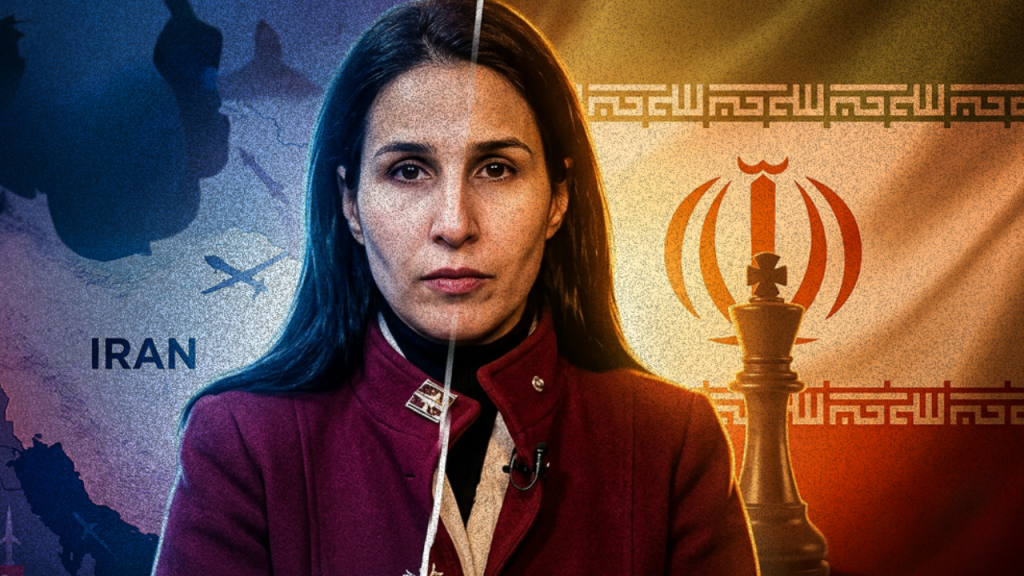
Leila Hatoum on Press TV named the system Western outlets won’t. The outlet tells you who suppresses accurate analysis — not whether the analysis is true.
Operation Epic Fury opened on February 28 with US and Israeli airstrikes killing Khamenei and hitting nuclear infrastructure across Tehran, Isfahan, and Qom. Every Western outlet ran security-framing wall-to-wall. Press TV’s Beirut bureau had Leila Hatoum calmly describing the conflict as a chapter in a longer contest over who controls the region’s political and economic order.
Hatoum is a Lebanese political economist and journalist — MENA Uncensored editor-in-chief, former macroeconomist at Dow Jones and the Wall Street Journal, former managing editor at Newsweek MENA, former Al-Arabiya reporter, a decade covering Lebanon’s southern front. She did not arrive at her analysis of empire through a European theory textbook. She arrived at it through the material conditions of living and working in a country that has been a target of Israeli bombardment, US proxy war, and imperial resource extraction for her entire adult life. That is not a different path to the same conclusions. That is the same analysis, rooted in the same reality, expressed through the tradition that actually produced it.
The Analysis Itself
Hatoum laid out a coherent theory of asymmetric endurance. Survive the initial shock: advanced militaries dominate opening phases through firepower, but the objective is not to match that firepower — it is to absorb it and remain organizationally intact. Impose time costs: wars are politically and economically demanding, Western governments face accountability and fatigue that resistance networks do not share in the same form, and if the conflict persists, domestic pressure in attacking countries accumulates faster than in defending ones. Target economic infrastructure: shipping lanes, energy supply chains, and trade routes are force multipliers for actors who cannot compete conventionally. The Houthi campaign against Red Sea shipping illustrated the point — a small military force imposed massive rerouting costs on global trade.
She described Lebanese civilians remaining in damaged communities as evidence of a depth of political commitment that wealthier societies struggle to replicate — not as a romantic observation but as a structural one. She pointed at elite leverage networks — the Epstein example — as a way of explaining why major geopolitical decisions do not track their stated rationales. She named Operation Epic Fury as a contest for regional control, not a response to a nuclear threat. None of this is propaganda. It is the observable record. For how the material consequences of that analysis played out in Dubai and the Gulf, see the Dubai strikes piece.
Where the Analysis Comes From
Historical materialism — the method of understanding political events through the material conditions that produce them — is not a European invention that the rest of the world borrows. It is a description of how power actually operates, and people living under the boot of that power have always understood it more precisely than those theorizing it from a distance. The Lebanese intellectual and resistance tradition, the Arab left, the broader Global South analysis of imperialism that runs from Fanon through Samir Amin through the Non-Aligned Movement — this body of thought developed its materialist critique of empire from direct experience of what empire does, not from reading about it.
Hatoum is not applying a framework borrowed from somewhere else. She is working from inside the political reality the framework describes. When she explains that the United States maintains military dominance through forward-deployed infrastructure, distributes the risk of war outward onto host populations, uses financial systems as weapons against states that resist, and prosecutes regime change through proxy networks and exile politics — she is describing conditions she has reported from the ground for twenty years. The convergence with Marxist analysis is not a coincidence. It is what happens when you look at the same system honestly, from any starting point.
The forces that have refused to accept imperial order in the region — Iran, Hezbollah, Palestinian resistance forces, the Houthis — are not identical in program or politics. What they share is a material refusal of the conditions Washington has enforced by violence. That refusal is the same political act whether it is theorized in European categories or not. The struggle is one. The analysis is one.
What the Outlet Tells You
The question is not whether Hatoum’s analysis is credible despite appearing on Press TV. The question is why this analysis appears on Press TV and not on the outlets where she previously worked. The Wall Street Journal does not run pieces describing US military operations as contests for regional control. Newsweek MENA does not commission analysis naming elite leverage networks as a mechanism of foreign policy. Al-Arabiya does not air the asymmetric endurance framework applied to Iranian resistance. The outlet is not the problem. The outlet is the evidence.
Western media structures do not suppress accurate analysis of empire because it is inaccurate. They suppress it because it is accurate — and because their institutional position within the same financial and political networks Hatoum is describing makes that accuracy incompatible with their function. The fact that her credentials span the full range of those institutions and she is now doing her clearest work outside them is not ironic. It is the argument. The same escalatory logic that built since the 2024 Beirut strikes and produced this war is the logic that determines which analysis gets institutional backing and which gets pushed to the margins.
On the Epstein Observation
Hatoum’s point about elite leverage networks deserves to be named precisely rather than treated as a rhetorical flourish. She is correct that major geopolitical decisions are shaped by informal power networks as much as by stated policy — that the decision to join Israel in Operation Epic Fury was not made by Congress but through an executive apparatus operating through relationships largely invisible to the publics bearing the costs. That is not a conspiracy theory. It is how power operates, and it is what materialist political economy has always said about the relationship between capital, state, and military force.
The individual leverage dimension and the structural dimension are not competing explanations. They are the same explanation at different levels of abstraction. The war reflects the interests of specific fractions of capital, military-industrial networks, and an Israeli state project with a decades-long escalatory trajectory. The informal networks that accelerate those decisions are not an alternative explanation for the war — they are the mechanism through which structural interests become operational. Hatoum naming Epstein and Hatoum naming arms contracts are both describing the same system. The scale is different. The logic is identical.
Watch It
The left does not need to approach resistance media with caution or caveats. Hatoum’s analysis of asymmetric endurance, economic targeting, and the gap between the war’s stated rationale and its actual stakes is accurate. The historical record of Vietnam, Afghanistan, Iraq, and Lebanon confirms it. The fact that Western institutional media suppresses this analysis does not make it suspect — it makes the suppression the story.
The standard is accuracy. On that standard, Hatoum is right. The broader political framework within which this analysis sits — the question of what it means to oppose this war from within the imperial core — is in the principal contradiction piece.
Sources
- Leila Hatoum (@Leila1H) — MENA Uncensored editor-in-chief, political economist
- Press TV — Live broadcast coverage, Operation Epic Fury, March 9, 2026
- Iran war live: Mojtaba Khamenei named supreme leader — Al Jazeera, March 9, 2026
- Yahya Sinwar’s Life and Death — Spark Solidarity, October 2024
- Beirut Airstrikes and Nasrallah’s Death — Spark Solidarity, September 2024
- Iran and the Principal Contradiction in the Imperial Core — Spark Solidarity
- Iran Strikes Dubai: How Empire’s Risk Model Became Visible — Spark Solidarity