
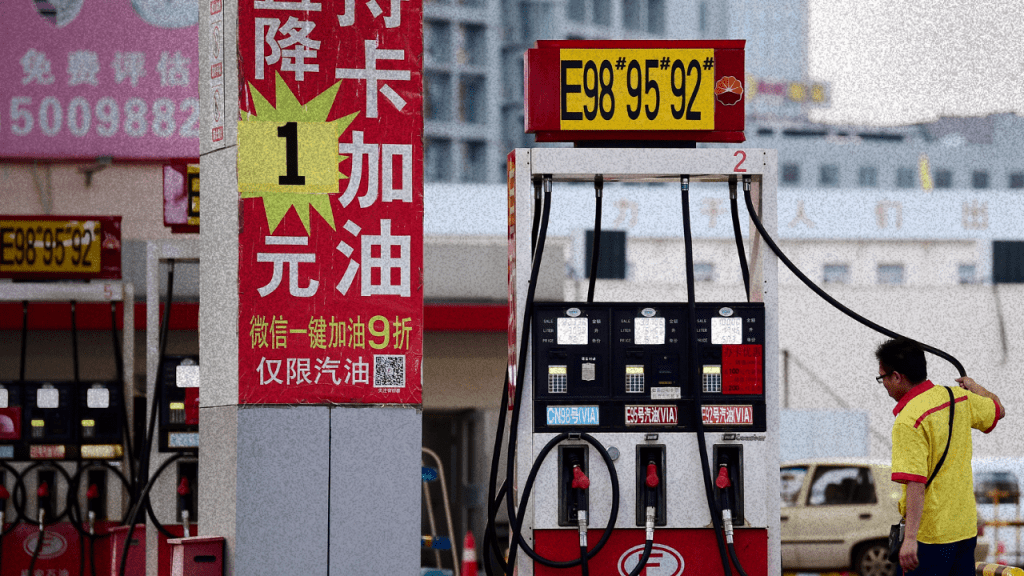
China fuel export halt: Beijing’s NDRC overrode market logic to protect domestic energy supply as US-Israel operations blocked the Strait of Hormuz.
When China’s National Development and Reform Commission instructed PetroChina, Sinopec, CNOOC, and Sinochem to immediately suspend diesel and gasoline export contracts on March 5, 2026, Western financial media reached for its standard frame: supply shock, market disruption, regional shortage risk. Bloomberg cited unidentified sources. Reuters noted diesel margins near three-year highs of $49 per barrel. The subtext was familiar — China as unpredictable actor radiating instability into markets that would otherwise function smoothly.
That frame is structurally wrong. It misidentifies what kind of state made this decision, what logic governed it, and what the decision reveals about the global energy order China navigates. With diesel processing margins at three-year peaks, commercial incentive pointed toward more exports. The NDRC directed the opposite. China holds strategic and commercial reserves estimated at 1.2 to 1.3 billion barrels — approximately 90 days of consumption coverage at current import rates. This was not scarcity response. This was planning authority subordinating export revenue to domestic energy security during a crisis China did not create.
The immediate trigger is the US-Israel war with Iran and effective blockage of the Strait of Hormuz. The Middle East supplied 57 percent of China’s direct seaborne crude imports in 2025, per analytics firm Kpler. With those supply routes disrupted and Brent prices spiking above $82 per barrel, Beijing convened refinery executives and verbally directed an immediate halt to new export contracts and cancellation of existing shipments — with narrow exceptions for aviation fuel in bonded storage and supplies to Hong Kong and Macau.
Read in isolation, this looks reactive. Situated in context, it is deliberate: a socialist state deploying planning apparatus to prioritize the material conditions of its population and industrial base over participation in a refined fuel market whose price signals are driven by a war China did not start and does not benefit from. The key institutional actor is the NDRC — China’s top economic planning agency. No price signal directed Sinopec to stop exporting. A planning body instructed state enterprises to subordinate commercial logic to collective need. That is what socialist governance means when it functions.
China Fuel Export Halt: NDRC Overrides Market Logic
The framing of China’s export halt as a source of regional instability — several Western outlets noted it “could provoke severe shortage of petroleum products throughout Asia-Pacific” — inverts causality in a way that must be named. The Strait of Hormuz is blocked because the United States and Israel are conducting military operations against Iran. The supply disruption originates there. China is responding to it, not causing it. When China takes defensive economic measures in response to US-generated instability — whether around Taiwan, South China Sea, semiconductor supply chains, or now energy logistics — Western coverage frames China’s response as the destabilizing act.
This dynamic repeats itself: the US creates pressure, China adapts to it, and the adaptation is reported as Chinese aggression or unreliability. The analytical inversion is not accidental. It serves the imperial core’s interest in naturalizing its own interventions while pathologizing responses to them. The same logic that produced the debt trap narrative — China as predatory actor disrupting otherwise stable systems — operates here. China does not export capital in search of surplus value extraction backed by military coercion, and does not impose political conditionality on states it trades with.
What China does — as this week demonstrates — is protect its population’s access to essential resources when the US-dominated global order generates instability that threatens them. Calling that imperialism, or even calling it destabilizing, requires a standard applied to China and nowhere else. The states most exposed to Hormuz disruption — Japan, South Korea, India, Southeast Asian importers who depended on Chinese refined fuel exports — are now absorbing costs of a conflict generated by US and Israeli military policy. The dollar-denominated oil market, the US Fifth Fleet’s nominal role as guarantor of Gulf shipping, the entire architecture of unipolar energy order: all of it has failed to provide the stability it promises.
How Western Media Inverts the China Fuel Halt
There is a deeper structural point that crisis framing obscures. China has been systematically reducing exposure to the vulnerabilities this week made visible. China’s NEV market share reached 41 percent of vehicle sales in 2024, cutting structural dependence on gasoline across a fleet of more than 300 million registered vehicles. LNG trucks are cutting into diesel consumption. High-speed rail continues expanding. Saudi Aramco is investing in petrochemical complexes inside China, shifting the relationship from crude dependency toward integrated industrial partnership. Russia delivers oil via pipeline, outside the Hormuz chokepoint entirely.
None of this is accidental. It is the outcome of deliberate long-term planning by a state that identified energy dependency as strategic vulnerability and has systematically worked to close it — not through military projection, but through domestic productive development and diversified supply architecture. The 2050 socialist modernization plan China is executing treats energy sovereignty as precondition for genuine developmental independence, not as commodity to be optimized for quarterly returns. China’s 2026 initial export quota was already set at 19 million tons before this crisis — the NDRC had been planning capacity reallocation toward domestic refining and petrochemical integration.
The disruption is not market failure. It is the unipolar order functioning as it functions — stable for the imperial core, volatile for everyone downstream. The China fuel export halt will be framed, in most Western coverage, as supply shock with regional consequences. That framing is not analytically neutral. It measures China’s decision against the standard of uninterrupted market participation — as though the primary obligation of the Chinese state is to keep global refined fuel markets liquid.
China’s Energy Planning Built Before This Crisis
The primary obligation of the Chinese state, as a socialist developmental project governing 1.4 billion people, is to maintain material conditions under which those people can work, produce, and live without being subjected to price volatility generated by imperial core military adventurism. When the NDRC convened Sinopec’s executives and verbally directed an immediate halt to export contracts, it exercised exactly the kind of state authority over productive resources that socialist governance requires. It did so in direct contradiction to what market logic would dictate. And it did so in response to a crisis whose origins lie not in Chinese policy but in the US-Israel military campaign against Iran — a campaign whose energy consequences are now being distributed across Asia while the states that launched it bear none of the cost.
The China fuel export halt is not a crisis. It is a socialist state doing its job. The NDRC’s March 5 directive demonstrates what planning authority means when it operates in service of population rather than profit. Western financial media will continue framing this as market disruption because that frame serves the interests of the order being disrupted. The actual disruption — the blockade of Hormuz, the spiking of Brent crude, the distribution of war costs onto Asian economies — originates in Washington and Tel Aviv. China is adapting to it. That adaptation reveals both the failure of unipolar energy architecture and the functional capacity of socialist state planning to protect populations from imperial volatility.
What Socialist Governance Owes Its Population
The states that depended on Chinese refined fuel exports will now scramble for alternative supply. That scramble is the material consequence of US military policy in the Gulf, not Chinese planning decisions. The Chinese state prioritized its own population. That is what socialist governance requires. The crisis is not that China did this. The crisis is the imperial order that made it necessary.
Sources
- Bloomberg / Yahoo Finance. Bloomberg fuel halt report. March 5, 2026.
- Reuters / BusinessToday. Reuters refined fuel halt. March 5, 2026.
- Nation Thailand / Bloomberg. Nation Thailand fuel halt. March 5, 2026.
- OilPrice.com. OilPrice crude stockpile. November 2025.
- U.S. Energy Information Administration. EIA China inventory analysis. October 2025.
- Car Sales Statistics / CAAM. CAAM NEV market data. January 2025.




 Spark Solidarity