
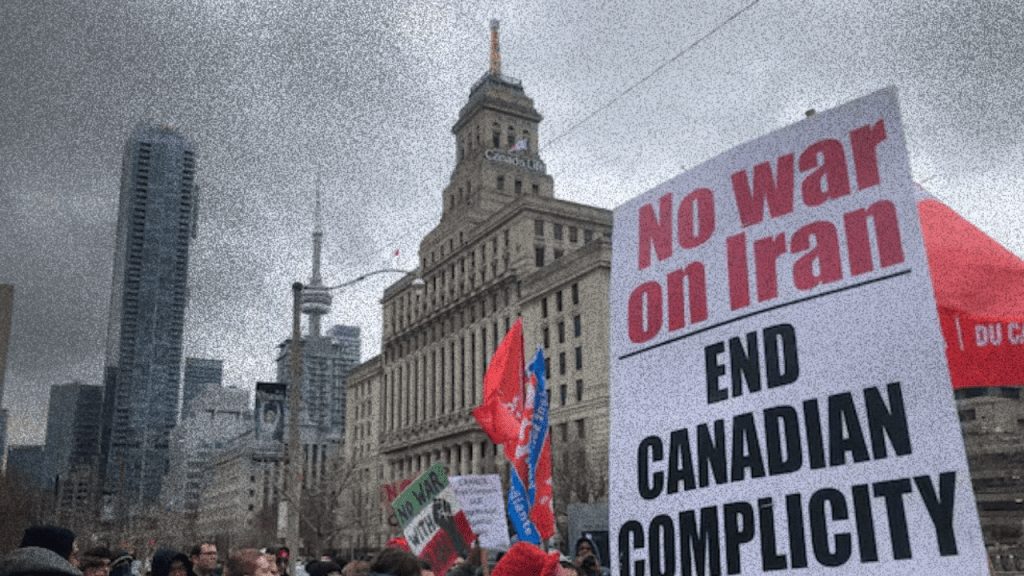
Canada’s Iran war denial is structurally incoherent: 200 Canadian Forces members embedded inside the U.S. war machine when strikes began Feb. 28 makes “presence without participation” a political fiction.
The Material Facts That Make the Denial Absurd
Strip away the official language and here is what is confirmed and undisputed. Canada has approximately 200 Armed Forces members deployed across six operations in the Middle East. Their roles span training, advisory functions, logistics, intelligence, and liaison — the connective tissue of a war machine, not passive observers standing at a distance from it. A portion of those personnel are embedded directly within U.S. Central Command structures. Some serve with the 552nd Air Control Wing, the U.S. Air Force unit that deployed AWACS surveillance aircraft to Saudi Arabia — aircraft that provide the airborne command-and-control architecture coordinating strike packages, the nervous system of the operations Canada says it had nothing to do with. Members of the Combined Aerospace Operations Centre of 1 Canadian Air Division were present at Al Udeid Air Base in Qatar when strikes began. Canadian soldiers were at the U.S. Fifth Fleet headquarters in Bahrain when Iran struck it. All of this was in place on February 28, 2026, when U.S. and Israeli forces began striking Iran. The personnel were there. The infrastructure was there. That overlap is not in dispute by anyone, including the Canadian government. What the government disputes is what that overlap means — and that is precisely where the argument has to begin.
The Official Denial Deserves a Full Hearing Before It Gets Dismantled
The Department of National Defence did not hedge. In a statement issued the day after strikes began, DND said Canadian military members had “no involvement in the United States’ Operation Epic Fury, nor were any CAF members involved in its planning.” Defence Minister David McGuinty confirmed the same position, adding that Canada had not been consulted prior to the operation. Foreign Affairs Minister Anita Anand told Bloomberg that Canada “has no intention of participating.” The statements were unambiguous and consistent. This is the strongest possible version of the denial, and it deserves to be stated clearly: the government is not claiming ignorance of the war. It is claiming a specific, bounded kind of non-participation — that Canadian personnel embedded in U.S. structures were not read into this operation, did not contribute to its planning, and did not execute any part of it. The claim is narrow. The problem is that the institutional architecture makes the claim almost impossible to verify. And then the government confirmed, in the same breath, that it had reassigned those personnel to “other duties” outside the campaign. If they needed reassigning, they were doing something that needed to change. The denial and the reassignment cannot both be true in the way the government needs them to be.
The Insider Who Blew Apart the Participation/Presence Binary
The government’s denial cannot survive its own institutional logic, and the person who demonstrated that most clearly was not an anti-war activist. Retired Major-General Denis Thompson, who served as a Canadian task force commander in Afghanistan and led a multinational peacekeeping force in the Sinai, stated that given the sensitivity of where Canadians were serving, it was “highly likely” that they were aware of the planning and coordination — and that those at the Combined Aerospace Operations Centre “would have been directly involved in targeting.” This is not speculation from outside the institution. Thompson spent his career inside the command structures being discussed. His assessment follows from the basic logic of how exchange programs function: embedded officers are integrated into planning cycles, intelligence flows, and coordination processes. The architecture does not have an off switch that activates when a specific operation is politically inconvenient for Ottawa.
Former Canadian Foreign Affairs Minister Lloyd Axworthy put the institutional logic plainly: “You cannot embed Canadian officers in U.S. war-fighting headquarters, plug Canadian intelligence into targeting processes, then wash your hands when missiles fly. If Canadian personnel helped plan, analyze or enable an operation, Canada is implicated — whether or not a Canadian finger was on the trigger.” What is left standing after Thompson and Axworthy’s interventions is not a factual dispute but a structural one. The command integration Canada built and maintains across decades is precisely the kind of system that makes clean participation/non-participation lines operationally incoherent. The question that follows is whether this incoherence is accidental. The Iraq War answers that.
Canada Built This Mechanism Deliberately and Has Used It Before
On March 17, 2003, Prime Minister Jean Chrétien announced in Parliament that Canada would not participate in the U.S.-led invasion of Iraq without a UN mandate. The announcement was real. The non-participation was not. Thirty Canadian officers worked inside U.S. Central Command in Qatar. Another 150 were on exchange with U.S. and British forces in proximity to combat operations. Canadian aircrew flew surveillance missions on U.S. E-3 Sentry aircraft that directed American attack aircraft over Iraqi territory. Exchange officers fought with U.S. units. Canada was, in every operational sense, adjacent to the invasion — embedded in its planning infrastructure, contributing to its execution through the personnel it had placed inside U.S. command — while maintaining a formal political position of non-involvement that satisfied domestic opinion and absolved the government of accountability.
This was not a loophole discovered after the fact. It was a mechanism designed into the alliance architecture, tested in Iraq, and preserved intact for exactly this kind of situation. What is happening now with Iran is not an exception to Canadian foreign policy. It is the policy. The form is always the same: formal non-participation, operational adjacency, deniability maintained through definitional precision about what “participation” requires. The Iraq parallel does not merely illustrate the current situation — it reveals that the current situation was built to function this way. That design has a political purpose, and naming it as perception management is the only accurate description.
The Definitional Gap Is the Mechanism of Impunity
There is one more fact the denial cannot absorb. In March 2026, it emerged that Camp Canada at Ali Al Salem Air Base in Kuwait was struck by Iranian missiles on March 2. Canadian soldiers took shelter in bunkers. The bunkers were damaged. The government did not disclose this for weeks. When the concealment became public, it drew immediate condemnation — the Conservative defence critic called it “really shameful” and described it as a “failure of the government of not wanting to communicate, not being transparent.” Iran targeted a Canadian base. Canada concealed it. That is not the behaviour of a country that is merely present in a region where a war is happening. It is the behaviour of a country that is in the war and does not want to say so.
The debate between the government and its critics appears to be about facts. It is not. Every material fact is confirmed and uncontested: the personnel numbers, the USCENTCOM embedment, the AWACS connection, the targeting adjacency, the Kuwait strike, the Iraq precedent, the “other duties” reassignment. What is being contested is the definition of participation itself — where the threshold sits, who sets it, and who benefits from locating it where they do. The government’s definition requires direct, demonstrable contribution to a specific operation. Under that definition, embedding 200 troops inside the command architecture of a war and then pleading non-involvement is formally defensible. The critics’ definition treats integration as participation, proximity as complicity, and the architecture itself as the evidence. Canada’s deep structural integration into U.S. military and economic systems means this definitional gap will be exploited every time Washington wages a war Ottawa does not want to formally endorse. The gap does not close through more disclosure or better reporting. It closes when the integration itself is named as the political choice it is — a choice to be available for American wars while retaining the domestic language of independence. That language is not a description of Canadian foreign policy. It is a cover for it.
Sources
- CBC News — Did Canadian exchange officers participate in U.S. Iran strike planning? DND says no, but questions linger, March 2026
- CBC News — Canadians assigned to ‘other duties’ outside of Iran strikes while on U.S. exchange, March 2026
- CBC News — National Defence confirms Canadians on exchange with U.S. not deployed to Gulf, March 2026
- CBC News — Canada could be called on to help defend Gulf states, says top military commander, March 2026
- Al Jazeera — U.S. and Israeli strikes on Iran begin, February 28, 2026
- The Canadian Encyclopedia — Canada and the Iraq War




 Spark Solidarity