
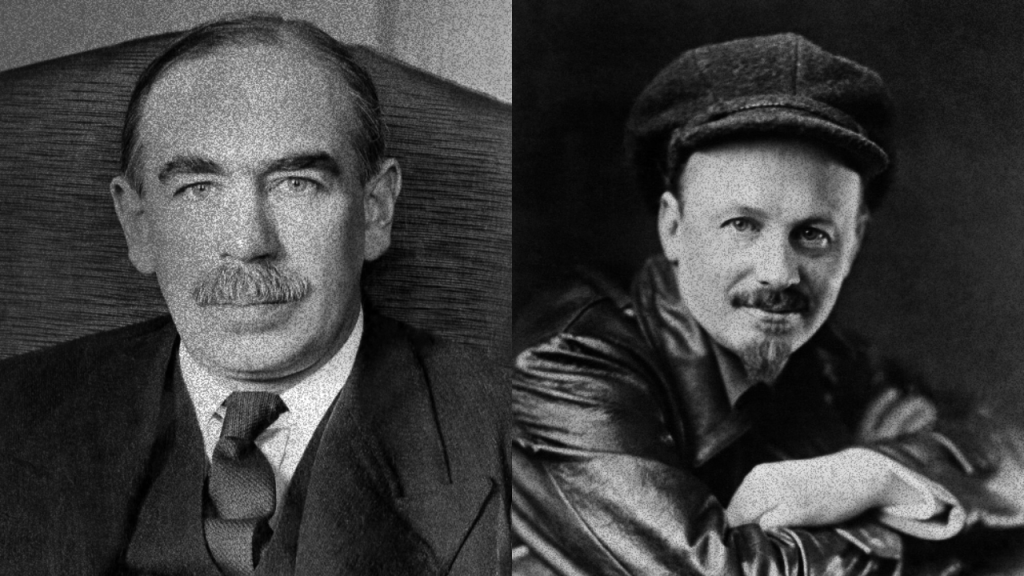
Bukharin predicted militarized capitalism would consume itself. Keynes predicted dollar hegemony would produce systemic instability. Both were right. Both are now playing out simultaneously.
Two thinkers, on opposite sides of the most consequential ideological divide of the twentieth century, arrived at structurally similar conclusions about the contradictions of militarized capitalism. Neither lived to see those contradictions fully mature. One was executed by the system he helped build. The other was overruled at the negotiating table by the empire he tried to constrain. Both were right. And the consequences of their being right are visible in the munitions depletion figures, the GPS jamming in the Strait of Hormuz, and the interceptor shortfalls that now define the opening weeks of Operation Epic Fury.
This is not coincidence. It is historical materialism working at scale.
Bukharin and the State-Capitalist Trust
In 1915, while Europe was consuming itself in the first of its two great imperialist wars, Nikolai Bukharin wrote Imperialism and World Economy — a theoretical work that Lenin praised highly enough to write the introduction. Bukharin’s argument was precise: capitalism in its mature form does not simply produce commodities. It produces states organized around the competitive accumulation of capital on a global scale. As individual firms consolidate into monopolies and monopolies fuse with state power, competition shifts from the marketplace to the international arena. Nation-states become what Bukharin called “state-capitalist trusts” — collective capitalists organized to defend and expand the interests of their national capital against all others.
War, in this framework, is not an accident or an aberration. It is the logical expression of capitalism’s structural dynamic at the international level. The same competitive logic that drives firms to undercut rivals, acquire markets, and externalize costs onto workers drives states to seek territory, resources, and control of global trade routes — and ultimately to fight over them. As Bukharin wrote in the book’s conclusion: “Capitalism has increased the power of militarism enormously. It has brought to the historic arena millions of armed men. The arms, however, begin to turn against capitalism itself.”
The deeper contradiction Bukharin identified was the tension between capital’s tendency to internationalize — to create a genuinely global economy — and its simultaneous tendency to nationalize: to consolidate behind state borders, protected by military power, competing for the division of global surplus value. These tendencies cannot be reconciled within capitalism. The world economy becomes integrated enough to make national competition more consequential, not less. The result is escalating militarism — not as a policy choice that could be made differently, but as a structural compulsion.
Bukharin was arguing, in other words, that militarized capitalism is self-consuming. The arms it builds begin to turn against the system that requires them. The productive forces marshaled for war are productive forces diverted from reproduction. At some point, the rate of consumption exceeds the rate of renewal. The machine begins to eat itself.
He was executed by Stalin in March 1938 — falsely convicted of treason at one of the last great show trials — for, among other things, arguing against the pace and form of Soviet militarization. History would vindicate him from the grave.
Keynes at Bretton Woods: The Warning Nobody Heeded
In July 1944, John Maynard Keynes sat at the Bretton Woods conference in New Hampshire representing a Britain that was exhausted by war and financially dependent on the United States. He came with a proposal that, had it been accepted, would have fundamentally altered the architecture of global capitalism for the rest of the century.
Keynes proposed an International Clearing Union and a global reserve currency he called the bancor. Under his scheme, no single national currency would serve as the world’s reserve. Instead, all countries would settle trade imbalances in bancor — a neutral unit administered by an international institution. Crucially, Keynes’s system would have penalized both deficit and surplus nations. Countries running persistent trade surpluses would face pressure to spend or invest their excess bancor, preventing the kind of accumulation that produces structural global imbalances.
The United States, negotiating through Treasury official Harry Dexter White, rejected the proposal. America was the world’s dominant creditor nation and had no interest in a system that would constrain its surplus position. As Wikipedia summarizes the outcome: “the United States objected, and their request was granted, making the ‘reserve currency’ the U.S. dollar.” American economist Brad DeLong later concluded that “on almost every point where Keynes was overruled by the Americans during the Bretton Woods negotiations, he was later proved correct by events.”
What Keynes understood — and what was formalized sixteen years later by Belgian-American economist Robert Triffin — was that a system built on a single national currency as the global reserve would produce a structural trap. The country issuing the reserve currency must supply the world with that currency. To do so, it must run permanent balance-of-payments deficits. But permanent deficits eventually erode confidence in the currency. The reserve currency country is thus caught between two imperatives that cannot both be satisfied: supply enough currency to maintain global liquidity, or maintain the currency’s value. This is the Triffin dilemma: the conflict between the short-term domestic interests of the reserve currency issuer and the long-term requirements of the international system it anchors.
The Bretton Woods system collapsed in 1971, exactly as Triffin had predicted in 1960, when Nixon ended dollar-gold convertibility. The dollar survived the collapse of Bretton Woods — but in a fundamentally different form: no longer anchored to gold, sustained instead by a combination of petrodollar arrangements, U.S. military power, and the absence of a viable alternative. The dollar hegemony that emerged post-1971 was, in effect, the Triffin trap extended into the fiat era. The United States ran permanent deficits. The world held dollars. The system produced the financialization, deindustrialization, and accumulation of global imbalances that define the contemporary moment.
The Soviet Validation: What Bukharin’s Death Proved
The Soviet Union that executed Bukharin in 1938 proceeded to build exactly the kind of militarized state-capitalist formation he had theorized — and warned against. Defense spending consumed between 15 and 21 percent of Soviet GNP by the 1980s, according to U.S. government estimates. From 1960 to 1985, consumption and investment both fell as a share of GDP while military expenditure rose from 10.4 to 21 percent. The Soviet GNP in 1985 was approximately $193 billion — roughly 48 percent of the U.S. figure of $399 billion. To maintain military parity with an adversary twice its economic size, the Soviet Union had to devote a share of its productive base to military expenditure that the economy could not indefinitely sustain. The sustained burden of defense spending played a significant role in the eventual collapse, as decades of prioritizing military expenditure over productive investment led to declining growth rates, technological stagnation in civilian sectors, and eventually systemic crisis.
Bukharin had argued that militarized capitalism is self-consuming. The Soviet experience demonstrated the corollary: a non-capitalist state organized as if it were a militarized capitalist power — competing on the terrain of arms rather than the terrain of social development — would consume itself by the same logic. The arms race demanded a pace of military investment that a structurally weaker economy could not match indefinitely. The machine ate itself, just as he predicted, even though the machine in question was nominally socialist.
The irony compounds. Bukharin was killed for resisting the logic of Stalinist militarization. The state that killed him then proved, through its own collapse, that his resistance was correct. The man who theorized the self-destructive tendency of militarized state power was murdered by a state that proceeded to destroy itself through militarized state power.
The Synthesis: When Both Predictions Mature Simultaneously
The Soviet collapse in 1991 did not vindicate liberal capitalism. It removed the primary justification for the American military Keynesian model — the existential peer threat — while leaving the structural commitments that model had produced intact. The United States retained its global base network, its alliance guarantees, its forward deployments, and its reserve currency status. What it lost was the organizing rationale that had made those commitments politically sustainable.
Post-1991, the dynamic Keynes identified accelerated. The United States, freed from the discipline of the Cold War competition, deepened its permanent deficits, accelerated financialization, and hollowed out the domestic manufacturing base that both military power and reserve currency status ultimately require as their foundation. The defense industrial base was consolidated, streamlined, and optimized for shareholder returns rather than surge capacity. Idle production lines were eliminated. Redundant suppliers were merged away. Just-in-time logistics replaced stockpiles. The system was made efficient for peacetime procurement and fragile for sustained conflict — precisely because the conflict that had justified maintaining depth was gone.
Keynes had warned that dollar hegemony would require permanent deficits and produce systemic instability. Bukharin had argued that militarized capitalism is structurally self-consuming. After 1991, the United States was living out both predictions simultaneously: maintaining a global military empire on a production base that the logic of financialized capitalism was actively degrading. The contradiction Bukharin identified between the requirements of militarized empire and the logic of capital accumulation did not disappear when the Soviet Union collapsed. It intensified — because the competitive pressure that had forced the U.S. state to override market discipline in strategic sectors was gone, and market discipline reasserted itself throughout the defense industrial base.
The result is the munitions shortage now visible in the THAAD depletion figures, the long-range missile inventories, and the artillery production gaps documented across the defense policy literature. CSIS war games consistently show long-range precision munitions depleted within a week in a Taiwan contingency. The United States fired approximately 25% of its entire THAAD stockpile in twelve days of the June 2025 conflict with Iran, at a production rate that made replenishment a matter of years. This is Bukharin’s thesis made concrete: the arms begin to turn against the system that built them, not through battlefield defeat, but through the arithmetic of consumption rates that exceed reproduction rates.
The Materialist Understands the Capitalist’s Motivations Better Than the Capitalist Does
There is a dimension to the current moment that neither Bukharin nor Keynes could have specified, but that their frameworks anticipate: the strategic use of these contradictions by actors who understand them structurally.
China has not fought the United States militarily. It has competed on the terrain that historical materialism identifies as decisive: production, supply chains, currency alternatives, and the patient accumulation of industrial depth. The Belt and Road Initiative, the BeiDou satellite navigation system, yuan-denominated oil trades, and the accumulation of manufacturing capacity in strategic sectors are not simply economic projects. They are a systematic engagement with the structural contradictions of American hegemony — building alternatives to dollar infrastructure, reducing dependency on systems the U.S. controls, and positioning for the moment when those contradictions become acute.
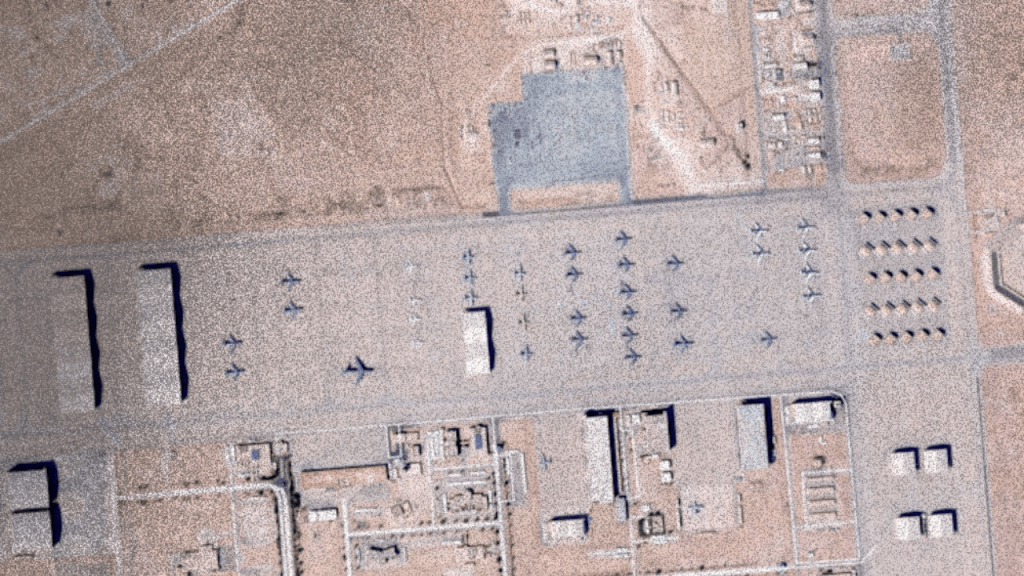
MizarVision’s satellite imagery releases documenting U.S. military deployments across the Middle East used American commercial satellite data to map American military positions. BeiDou’s adoption by Iranian vessels is a direct response to the GPS jamming that disrupted 1,100 ships in the Strait of Hormuz. These are not isolated technical decisions. They are expressions of a strategic understanding of where American power is structurally vulnerable — in the infrastructure dependencies, production bottlenecks, and financial architecture that sustain global hegemony.
The capitalist class does not understand its own system’s contradictions because it is inside them. The logic of quarterly returns, shareholder value, and lean inventory feels like rational optimization from within the system. It is only from outside — from a position of structural analysis rather than systemic participation — that the self-consuming character of militarized financialized capitalism becomes visible as a law rather than a policy choice. The materialist understands the motivations of the capitalist better than the capitalist does, not because of superior intelligence, but because of a different analytical position relative to the system’s dynamics.
This is what historical materialism means in practice. It is not prophecy. It is the application of structural analysis to the observable tendencies of a system — the recognition that contradictions, once they reach sufficient intensity, produce outcomes that are legible in advance to anyone who understands the system’s logic, even if the specific form and timing remain uncertain.
Bukharin understood the logic in 1915. He was killed for it in 1938. The system that killed him proved him right by 1991. Keynes understood the monetary dimension in 1944. He was overruled at Bretton Woods. The system that overruled him proved him right by 1971, and again — more acutely — in the de-dollarization dynamics now accelerating across the Global South.
The phenomena we are witnessing — the munitions gaps, the interceptor depletion, the GPS infrastructure contests, the satellite imagery competitions, the currency alternatives — are what happens when social contradictions build to a tipping point. They are not surprises to anyone who took the analysis seriously. They are the predictable outcomes of a system behaving according to its own structural logic, observed by those who understood that logic well enough to position themselves accordingly.
The question is not whether this was predictable. It was. The question is what happens next — and whether the actors who understand the system’s contradictions will use that understanding to build something that transcends them, or merely to occupy the position of the next hegemon in the cycle.
For the specific munitions figures that make this structural argument concrete, read U.S. Missile Stockpile Shortage: The THAAD Depletion Crisis Explained.
Sources
- Bukharin, Nikolai. Imperialism and World Economy. Written 1915, first published 1917. Marxists Internet Archive. https://www.marxists.org/archive/bukharin/works/1917/imperial/
- Bukharin, Nikolai. Imperialism and World Economy, Chapter XV: Conclusion. https://www.marxists.org/archive/bukharin/works/1917/imperial/15.htm
- Bukharin, Nikolai, and Preobrazhensky, Evgeni. The ABC of Communism. 1920. Marxists Internet Archive. https://www.marxists.org/archive/bukharin/works/1920/abc/
- Wikipedia. “Triffin Dilemma.” https://en.wikipedia.org/wiki/Triffin_dilemma
- Wikipedia. “Bretton Woods System.” https://en.wikipedia.org/wiki/Bretton_Woods_system
- LSE Economic History Blog. “Plans for a Fictitious World: Keynes’s Global Bank and Currency.” March 10, 2023. https://blogs.lse.ac.uk/economichistory/2023/03/10/keynes-global-bank-and-currency/
- Britannica. “Nikolay Bukharin.” https://www.britannica.com/biography/Nikolay-Ivanovich-Bukharin
- Britannica. “Why Did the Soviet Union Collapse?” https://www.britannica.com/story/why-did-the-soviet-union-collapse
- ANBOUND Research. “The Soviet Union’s Case: Relationship Between Defense Expenditures and the National Economy.” https://www.anbound.com/Section/ArticleView_4105_1.htm
- In The War Room. “The Soviet Union’s Defense Spending: A Look at GDP.” https://www.inthewarroom.com/the-soviet-unions-defense-spending-a-look-at-gdp/
- CNN. “US Used About 25% of Its THAAD Missile Interceptors During Israel–Iran War.” July 28, 2025. https://www.cnn.com/2025/07/28/middleeast/us-thaad-missile-interceptor-shortage-intl-invs
- Fox Business / CSIS. “US Could Quickly Run Out of Munitions in Conflict with China.” January 2023. https://www.foxbusiness.com/politics/us-could-quickly-run-out-munitions-conflict-with-china-defense-industry-unprepared-report
- International Socialist Review. “Lenin and Bukharin on Imperialism.” https://isreview.org/issue/100/lenin-and-bukharin-imperialism/index.html








 Spark Solidarity