
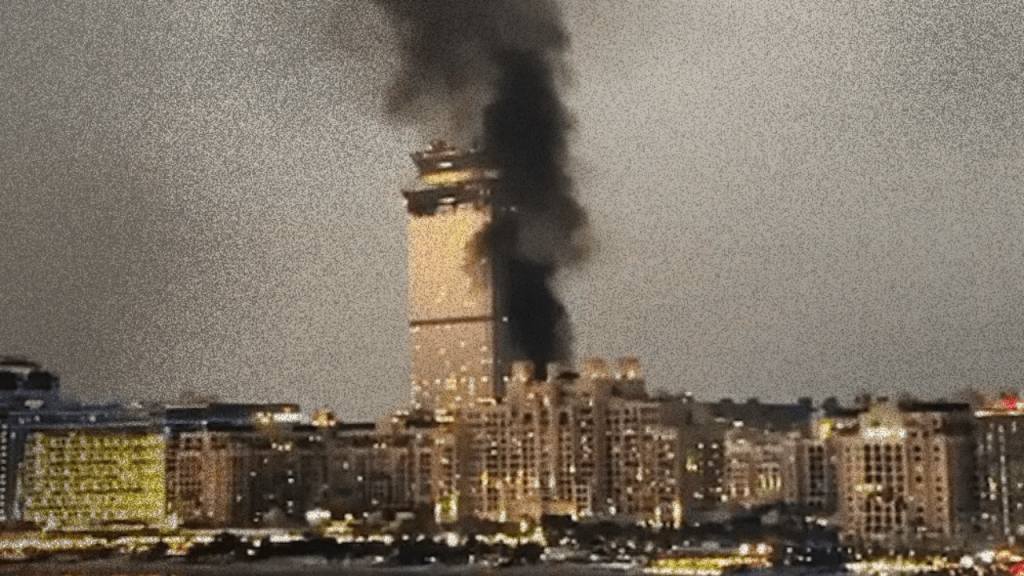
Iranian strikes hit Dubai airport, Burj Al Arab, and Jebel Ali Port. Why the UAE’s role as U.S. military hub made it a target, not a bystander.
On February 28, 2026, Dubai International Airport — the world’s busiest airport by international passenger traffic — sustained minor damage to a concourse and four staff injuries as Iranian retaliatory strikes spread across the Gulf. The Burj Al Arab hotel was hit by drone debris. A berth at Jebel Ali Port caught fire from aerial intercept debris. The UAE’s Ministry of Defence confirmed 137 Iranian ballistic missiles and 209 drones detected over its territory, with 132 missiles and 195 drones intercepted. One civilian — a Pakistani national — was killed at Abu Dhabi’s Zayed International Airport when debris from an intercepted drone fell into the terminal. The same night, Iran struck U.S. military bases in Qatar, Bahrain, Kuwait, and Jordan.
That sequence matters. It establishes cause before interpretation.
Western coverage immediately framed the incident as escalation. That framing assumes a neutral baseline that does not exist. The conflict did not begin when Iranian drones entered Gulf airspace. It is the continuation of a long-running war defined by sanctions, military encirclement, covert strikes, and open bombardment carried out with U.S. backing. As Why the U.S.–Israel War on Iran Was Always Coming documents, Israeli strikes were described by Israeli Defense Minister Israel Katz as “preemptive” — a framing that erases chronology and transforms first strikes into defence. Retaliation is treated as rupture only because initiation has been normalized.
From an anti-imperialist perspective, this was not a sudden expansion of violence. It was blowback reaching a place long assumed to be insulated from consequence.
Dubai Is Not Neutral Ground
Dubai is routinely described as a civilian, commercial, or apolitical space. That description is ideological. The city functions as a logistics hub, financial artery, and transit node embedded in U.S.-managed regional power. Its stability is not separate from empire. It is one of its benefits.
The material facts are not difficult to find. Al Dhafra Air Base, located 32 kilometres south of Abu Dhabi, hosts the U.S. Air Force’s 380th Air Expeditionary Wing, along with U.S. Navy and Army personnel. It serves as a key site for U.S. Central Command operations and received a $1.4 billion expansion to convert it from an expeditionary installation into an enduring one. Jebel Ali Port in Dubai is, according to U.S. military documents, the main port for the U.S. Navy in the region. These are not marginal relationships. They are the physical backbone of American power projection across the Middle East and into Africa.
Iran’s strikes on February 28 were explicitly directed at these installations. Al Dhafra was targeted by Iranian ballistic missiles. The civilian infrastructure — airports, hotels, ports — was affected by intercept debris and spillover from a military confrontation that the UAE hosts and enables. The distinction between civilian and military space collapses once you account for the UAE’s structural role in the imperial system.
Civilian infrastructure becomes vulnerable under these conditions not because resistance movements are uniquely immoral, but because empire militarizes entire regions while maintaining the fiction that certain zones remain outside the war. That distinction holds until it does not.
Why the Direct Enemy Is Rarely Touched
The question that follows is predictable: why Dubai instead of the United States or Israel.
The answer lies in how power is organized. The U.S. homeland is insulated by geography, overwhelming deterrence, and escalation doctrine. Israel is protected by layered defenses and unconditional American backing. Direct strikes on either would invite devastating retaliation without materially altering the balance of power. Iran’s missile and drone campaign did target U.S. bases across the Gulf — Al Udeid in Qatar, Ali Al Salem in Kuwait, Al Dhafra in the UAE, the U.S. Fifth Fleet headquarters in Bahrain — but those strikes were absorbed by layered U.S. air defenses and produced no confirmed American military casualties.
Asymmetric warfare does not seek symbolic confrontation with the hardest possible target. It seeks leverage. It targets pressure points rather than thrones. It operates within constraints imposed by the power differential between empire and its adversaries.
Dubai sits inside the imperial supply chain. It is a node where logistics, finance, and stability converge. Jebel Ali Port handles U.S. naval access. Al Dhafra enables reconnaissance, refuelling, and strike missions across the region. Disrupting or signalling the vulnerability of these nodes introduces uncertainty into systems that rely on predictability. That uncertainty is the point.
Empire’s Risk Model
U.S. power functions by exporting risk and importing stability. American civilians do not live under retaliation threat. American airports are not shut down. American cities are not asked to absorb the consequences of decisions made in Washington.
Instead, that exposure is displaced outward. It is absorbed by regional allies, migrant workers, and populations living near strategic infrastructure. The Pakistani national killed at Abu Dhabi’s Zayed Airport was not a combatant. He was a worker in a city that hosts American military hardware and benefits from — and helps sustain — the regional order that made the conflict possible. That arrangement is deliberate. Empire survives by ensuring that war remains something other people experience.
When a global hub like Dubai is affected — even through intercept debris rather than direct hits — that model is briefly exposed. The illusion that imperial war can be clean, distant, and consequence-free weakens. What appears as instability is in fact redistribution. Risk moves closer to where decisions are enabled and where the profits of stability are collected.
The Function of Media Framing
Coverage of the incident emphasized delays, debris, and disruption. Causality was backgrounded. Iranian strikes were foregrounded as aggression; the U.S.-Israeli attacks that triggered them receded into assumed context. The CNN coverage noted Iranian strikes “following the death of Iran’s supreme leader in US-Israeli strikes” — causality acknowledged, then immediately subordinated to the drama of airport evacuations and stranded passengers.
This is not a failure of journalism. It is its function within imperial systems. Language choices discipline interpretation. They train audiences to see resistance as irrational violence while treating U.S. action as environmental background. Civilian harm is selectively recognized depending on who causes it. When Iranian intercept debris kills a worker in Abu Dhabi, it is an atrocity. When U.S. strikes kill Iranian military commanders, scientists, and the surrounding civilians, it is a security operation.
The result is a public that understands effects without causes, and disruption without responsibility.
What This Reveals
Dubai was not struck by chaos or accident. It was affected because modern warfare is networked, financialized, and outsourced. Empire does not operate through clean bilateral conflicts. It operates through systems — bases, ports, airspace agreements, financial corridors, normalization deals. When those systems are challenged, the effects ripple outward across the nodes that make them function.
This incident was not a failure of deterrence. It was a demonstration that deterrence relies on insulation, and insulation is never permanent. As long as war is waged through proxies, bases, sanctions, and logistical hubs, those hubs carry exposure. The question of who absorbs the risk of empire is not rhetorical. It has a material answer: the workers, transit passengers, and populations of the countries that provide the infrastructure.
The deeper implication is not about Dubai alone. It is about the fragility of a global order that depends on distance to survive — that requires some places to be understood as perpetually safe so that violence can be conducted efficiently from within them. When that distance collapses, even briefly, the costs of empire become visible to those who have long benefited from its protections.
That visibility is what power fears most.
For a fuller account of how states manage the narrative when that visibility threatens to produce accountability, read How Deniable Weapons Replace Visible State Violence.
Sources
- GMA Network / Reuters. “4 Hurt as Dubai Airport Sustains Damage from Iranian Missile Strike.” February 28, 2026. https://www.gmanetwork.com/news/topstories/world/978288/dubai-iran-attack/story/
- Gulf News. “UAE Intercepts New Wave of Iranian Missiles — All You Need to Know.” March 1, 2026. https://gulfnews.com/uae/uae-intercepts-new-wave-of-iranian-missiles-all-you-need-to-know-1.500458669
- The Week India. “Abu Dhabi to Dubai: Here’s What We Know So Far About Iranian Drone Strikes.” March 1, 2026. https://www.theweek.in/news/middle-east/2026/03/01/abu-dhabi-to-dubai-heres-what-we-know-so-far-about-iranian-drone-strikes-and-the-missile-threat.html
- CNN. “Dubai Airport Passengers Evacuate as Iran Attacks Travel Hubs UAE, Qatar and Bahrain.” February 28, 2026. https://www.cnn.com/2026/02/28/middleeast/dubai-airport-uae-iran-attacks-intl-hnk
- Axios. “Iran Retaliates After U.S.–Israel Strikes, Triggering Regional Fallout Across Middle East.” February 28, 2026. https://www.axios.com/2026/02/28/us-israel-strikes-iran-middle-east-dubai-airports
- Middle East Eye. “Iranian Missiles Strike Gulf Countries as Bahrain Says U.S. Fifth Fleet Base Attacked.” February 28, 2026. https://www.middleeasteye.net/news/iranian-missiles-strike-gulf-countries-bahrain-says-us-fifth-fleet-base-attacked
- Shafaq News. “Iranian Missiles Hit the UAE’s Al Dhafra Base.” February 28, 2026. https://shafaq.com/en/Middle-East/Iranian-Missiles-hit-the-UAE-s-Al-Dhafra-Base
- “Al Dhafra Air Base.” Wikipedia. https://en.wikipedia.org/wiki/Al_Dhafra_Air_Base
- Modern Diplomacy. “Where Are US Forces Stationed in the Middle East?” February 28, 2026. https://moderndiplomacy.eu/2026/02/28/where-are-us-forces-stationed-in-the-middle-east/
- Stanley Consultants. “Al Dhafra Air Base Master Plan.” https://www.stanleyconsultants.com/solutions/planning-consulting/project/al-dhafra-master-plan




 Spark Solidarity