
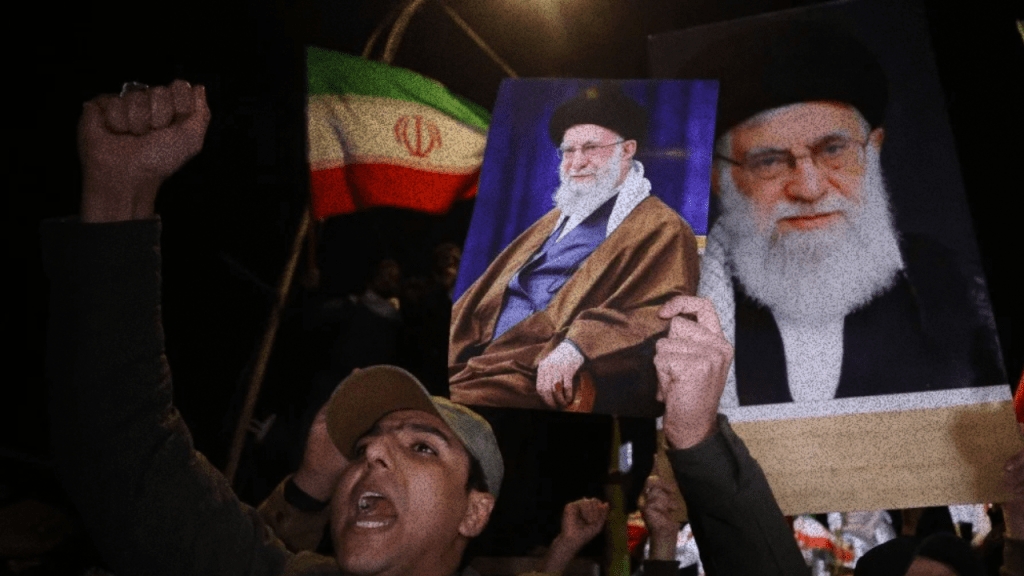
Khamenei assassination exposes how moralism replaces strategy — holding the contradiction between his tyranny and 108 schoolgirls killed in Minab.
When Donald Trump described the killing of Ali Khamenei as “Justice for the people of Iran” — calling him “one of the most evil people in History” — he was not making a military argument. He was making a moral one. That is the tell. When states need moral language to justify a military action, it is because the strategic language cannot survive scrutiny on its own.
Justice is a political category. It presumes the right to decide who rules and who does not. It presumes authority — not over a weapons system, not over a specific policy or a territorial border, but over the sovereignty of another state. To deliver justice, you must first have appointed yourself judge. And the United States, which has been conducting covert and overt operations against Iran since the 1953 coup that removed Mohammad Mosaddegh and installed the Shah, has been appointing itself judge over Iranian governance for longer than most of its current officials have been alive.
That history does not exonerate Khamenei. He oversaw the violent suppression of protest movements for decades. The executions of political prisoners. The imprisonment and torture of dissidents, journalists, and union organizers. The 2022 killing of Mahsa Amini and the subsequent slaughter of hundreds of protesters who took to the streets. These are not allegations. They are documented facts. Khamenei ran a totalitarian state and used its instruments without restraint against the people living under it.
Hold that fact alongside this one: today, Israeli and U.S. strikes killed at least 108 people when they hit the Shajareh Tayyebeh girls’ elementary school in Minab, with approximately 170 schoolgirls inside at the time. Iranian Red Crescent reports more than 200 dead across 24 provinces.
Both of those things are true. That is the contradiction. And anyone asking you to resolve it by picking a side has already told you whose interests they are serving.
Moralism as Pretext
The pattern is consistent enough to be a doctrine. Before military action, diplomacy is invoked — sincerely or otherwise. A third round of U.S.-Iran nuclear talks had concluded in Geneva just two days before the strikes. Then, when the action occurs, the moral register replaces the strategic one. The target is not described as a security threat but as evil. The operation is not described as a military objective but as justice. The outcome is not described as regime change but as liberation.
This rhetorical shift is not incidental. It is load-bearing. Moral language does work that strategic language cannot do, specifically because it forecloses the category of consequence. If this is justice, then the question of what comes next — the succession crisis, the IRGC already moving to appoint leadership outside constitutional processes, the retaliation strikes now hitting U.S. bases and Gulf infrastructure, the Strait of Hormuz warning that threatens 20% of global oil supply — all of that becomes secondary to the moral verdict already rendered.
Justice has been served. What follows is just the aftermath.
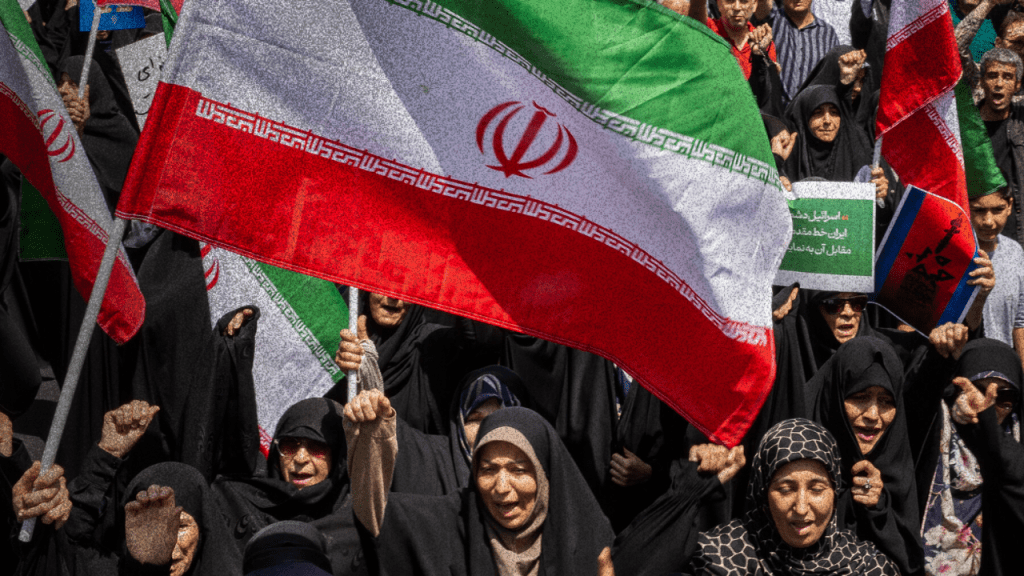
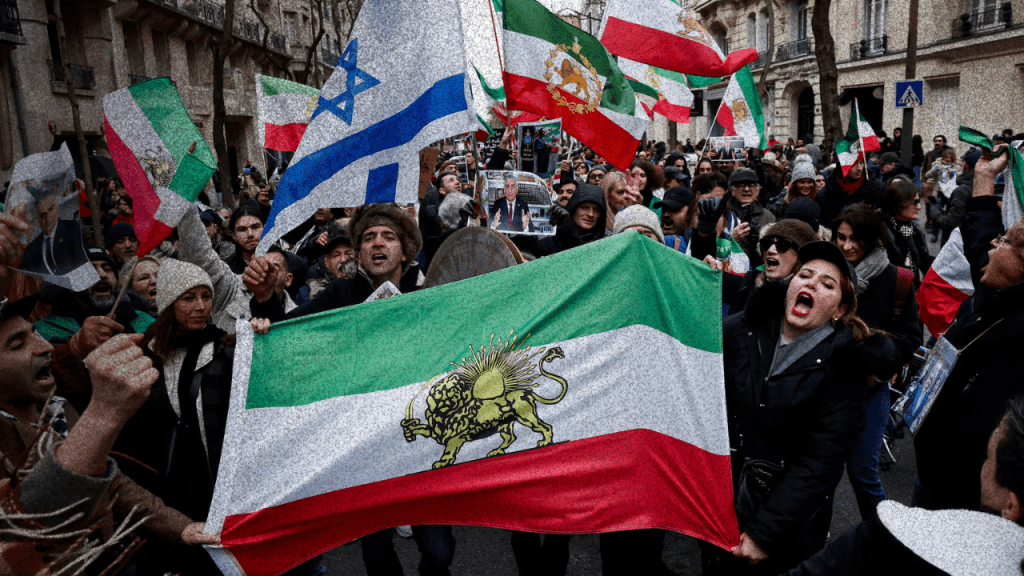
But the aftermath is what people live in. The 108 children killed in Minab do not become acceptable because the man who ran the government was evil. The Iranian population, which has spent decades under a government it did not choose and cannot remove without dying for it, does not become a beneficiary of its liberation because Washington has decided that’s the frame. The people who have been organizing, protesting, and dying inside Iran for years — the Kurdish feminists who built the Woman, Life, Freedom movement, the labor organizers, the students — were not consulted about whether this strike served their objectives. The diaspora voices celebrating outside embassies in Toronto and Los Angeles are not the people who will live in whatever comes next.
Moralism as a war aim is particularly dangerous because it is immune to failure. When the strategic rationale fails — when the WMDs aren’t there, when the liberated population doesn’t welcome the liberators, when the vacuum fills with something worse than what was removed — the moral argument survives intact. We did the right thing. It just didn’t work out. This is the logic that has justified every catastrophic intervention of the last thirty years, and it is the logic operating today, in real time, in plain language, without any apparent awareness of its own history.
The structural sequence through which that logic was built in this case — sanctions as opening phase, diplomacy as procedural cover, pre-emption as retroactive alibi — is examined in the analysis of why the U.S.-Israel war on Iran was always coming.
The Contradiction You Are Not Allowed to Hold
The political pressure of this moment is to pick a lane. You are expected to either condemn the assassination and thereby be framed as a defender of the Iranian regime, or endorse it and thereby accept the U.S.-Israeli framing of what just happened and why.
This is a false binary constructed to disable serious political thinking. It is not a description of the actual choices available.
Serious political thinking in this moment looks like this: Khamenei ran a brutal, theocratic state that killed its own people. That is true. The United States has no legitimate authority to remove heads of state through military force. That is also true. The Iranian people have spent decades living under a government shaped in significant part by American interference, including the 1953 coup that ended Iranian democracy and produced the conditions for the 1979 revolution. That is also true. The children killed in Minab today are not acceptable casualties of anyone’s liberation. That is also true.
None of these truths cancels the others. That is the contradiction. The demand to resolve it — to declare that because the Iranian regime is totalitarian, the assassination is therefore justified, or conversely, that because the assassination is a crime, the Iranian regime must therefore be defended — is a demand to stop thinking. It is the demand of moralists and of campus polemicists who need clean categories, and it is the demand of states that need compliant publics.
The contradiction does not need to be resolved. It needs to be held. Because the moment you resolve it in either direction, you have given something up that you will not easily recover.
If you resolve it in the direction of endorsement — if you say yes, this tyrant deserved to die, the strikes were justified — you have accepted the premise that the United States has the right to decide which governments are legitimate and which are not, which leaders may live and which may be killed, and that this right is exercised in the service of the Iranian people rather than in the service of American and Israeli strategic objectives. There is no serious historical basis for that conclusion. The track record is Libya, Iraq, Afghanistan, and every intervention before them.
If you resolve it in the direction of pure regime defense — if the assassination of a head of state becomes, in your analysis, primarily a crime against the Iranian government — you have lost the thread of what actually matters, which is not the sovereignty of states in the abstract but the lives of people inside them.
The position that does not collapse is this: this is a crime, and the people who committed it do not get to call it justice, and the government they targeted was itself a criminal enterprise, and the people living under it deserved better than either of those things.
The analytical framework for holding exactly that position — opposing imperial war without sanctifying states, supporting liberation without surrendering analysis — is examined in the analysis of Iran, Palestine, and the politics of contradiction.
What Endorsement Actually Means
When Prime Minister Carney, speaking from Mumbai, declared that “Canada supports the United States acting to prevent Iran from obtaining a nuclear weapon and to prevent its regime from further threatening international peace and security,” he was not taking a cautious, measured position. He was endorsing the moral framework that makes these strikes legible as justice rather than as the opening of a war with unpredictable consequences for the region and for the Iranian population.
The moral framework is the thing being contested. Not whether Khamenei was a good person. Not whether the Iranian regime has committed human rights violations. These questions have obvious answers. The question being contested is whether the United States and Israel have the authority to act as executioners, and whether that authority is validated by the wickedness of the target.
It is not. Authority does not derive from the moral status of the target. If it did, there would be no limits on what powerful states could do to weaker ones, provided they could first establish a moral case — which they are always able to do, because they control the information environment, the diplomatic framing, and the media narrative in which the case is made. This is not a constraint on power. It is the removal of all constraints on power dressed up as ethics.
If you are standing purely on the side of America in this moment — endorsing the strikes, accepting the liberation framing, celebrating in the streets — you should at minimum understand what you are endorsing. You are endorsing the principle that the United States and its allies may kill heads of state they have designated as evil, that this designation requires no international process or accountability, that the consequences for civilian populations are acceptable losses, and that the history of American involvement in producing the conditions you are now celebrating as resolved does not need to be part of the analysis.
On that set of premises, you are probably on the wrong side. Not because the Iranian regime was good. But because those premises, applied consistently, justify anything — and have.
The closest recent precedent for those premises applied in practice — and what the legal and moral reconstruction looked like after the fact — is examined in the analysis of the U.S. capture of Maduro as regime change not law.
What Remains
Ali Khamenei is dead. The government he ran is in succession crisis. The IRGC is consolidating outside constitutional channels. Iran has launched retaliatory strikes across the region. The Strait of Hormuz is threatened. The United States and Israel have killed more than 200 people today in a country that has been subjected to American interference for over seventy years.
The people who were organizing inside Iran before today, and who will organize inside Iran after today if they survive — they did not need this. They needed the IRGC’s external funding dried up. They needed sanctions designed to hurt the regime rather than the population. They needed the international legitimacy that external military action immediately strips from any internal movement by allowing the regime, or its successor, to frame everything as foreign war rather than domestic accountability.
What the strike accomplished was not their liberation. What it accomplished was the removal of one head of a system that will now either harden, fragment, or be replaced with something whose character no one in Washington or Tel Aviv can control — and whose cost will be paid, as it always is, by the people least responsible for any of the decisions that produced this moment.
Khamenei was a tyrant. That does not make his killing justice. Those two things are not in contradiction. They are the beginning of understanding what actually happened today.
Sources
- NBC News liveblog — U.S., Israel strikes on Iran, Feb. 28, 2026: https://www.nbcnews.com/world/iran/live-blog/israel-iran-live-updates-rcna261099
- NewsNation — Netanyahu statement on Khamenei compound, Feb. 28, 2026: https://www.newsnationnow.com/politics/many-signs-ayatollah-ali-khamenei-is-dead-netanyahu-says/
- Iran International liveblog — IRGC succession push, Hormuz warning, Feb. 28, 2026: https://www.iranintl.com/en/liveblog/202602288143
- CNN liveblog — Iranian retaliation, IRGC statement, Feb. 28, 2026: https://www.cnn.com/world/live-news/israel-iran-attack-02-28-26-hnk-intl
- CNBC liveblog — Minab school strike, death toll, Feb. 28, 2026: https://www.cnbc.com/2026/02/28/trump-iran-strikes-live-updates.html
- Al Jazeera — Iranian Red Crescent death toll, UN Security Council, Feb. 28, 2026: https://www.aljazeera.com/news/2026/2/28/irans-supreme-leader-ali-khamenei-killed-in-us-islamic-republic-attacks-reports
- CNBC — Geneva talks concluded Feb. 27, 2026: https://www.cnbc.com/amp/2026/02/27/oil-prices-rise-as-us-and-iran-extend-talks-into-next-week.html
- CBC News — Carney statement, diaspora reaction, Feb. 28, 2026: https://www.cbc.ca/news/world/livestory/conflict-with-iran-9.7109761
- Canadian Affairs — Carney backs U.S. strikes, full statement, Feb. 28, 2026: https://www.canadianaffairs.news/2026/02/28/carney-backs-u-s-strikes-on-iran/
- TIME — World leaders’ reactions, Russia and China condemnation, Feb. 28, 2026: https://time.com/7381811/iran-war-world-leaders-reaction-russia-china-europe/

 Spark Solidarity