
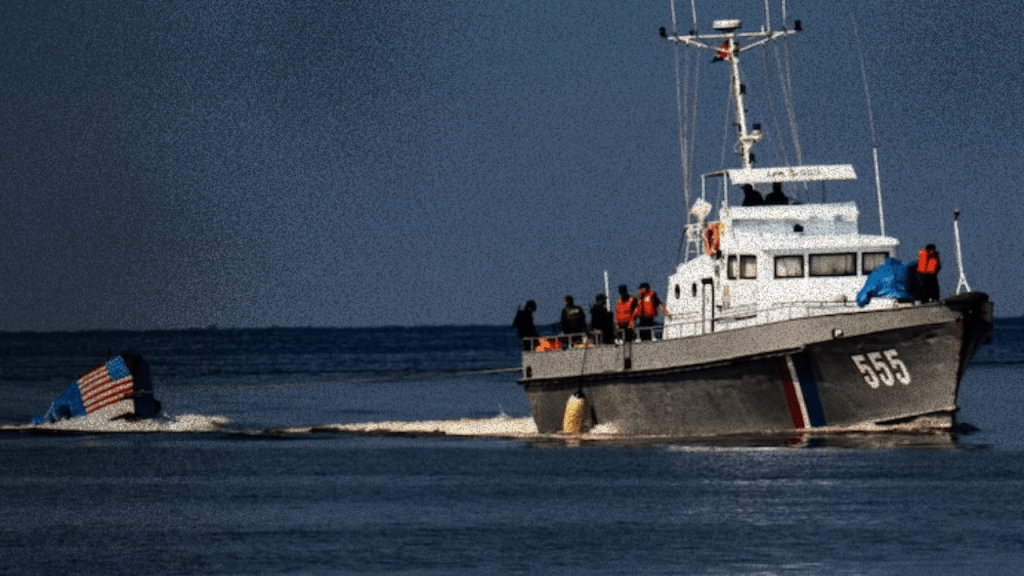
Cuba speedboat shooting: Armed US-based intruders entered Cuban waters and fired first, but early coverage is already shaping an escalation narrative.
On February 25, 2026, Cuban border guard forces intercepted a Florida-registered speedboat in Cuban territorial waters, approximately one nautical mile northeast of the El Pino canal in Cayo Falcones, Villa Clara province — roughly 100 miles from Florida.
According to Cuba’s Interior Ministry, five border guard personnel approached the vessel, registration number FL7726SH, to identify it. Before they could do so, occupants of the speedboat opened fire, wounding the Cuban vessel’s commander. Cuban forces returned fire, killing four people aboard and wounding six others.
Later that day, Cuba released additional information: the ten occupants were Cuban-born residents of the United States, identified by name in seven of ten cases, carrying assault rifles, handguns, Molotov cocktails, bulletproof vests, telescopic sights, and camouflage uniforms. Cuba described the incident as a “foiled armed infiltration for terrorist purposes.” A person Cuba says was sent from the US to receive the group on the island has been arrested and is cooperating.
Those are the facts in Cuba’s account. They are specific, detailed, and internally consistent.
They are also contested — and the contest over how to tell this story has already begun.
The Framing Battle, Already Underway
Within hours of the incident, the political and media response divided along predictable lines.
Coverage at the major wire services and public broadcasters — NPR, PBS, CBS, NBC — included the “fired first” detail in their lede or headline. That is the most important causal fact in Cuba’s account, and the outlets that included it did their jobs.
Other coverage framed the story primarily through the lens of US official response and Florida political reaction. Florida’s Attorney General James Uthmeier announced an investigation, writing that “the Cuban government cannot be trusted, and we will do everything in our power to hold these communists accountable.” Congressman Carlos Gimenez called it a “massacre.” Senator Rick Scott: “The Communist Cuban regime must be held accountable.”
These reactions are news. But they are reactions to an event whose core causal facts remain contested. When official outrage leads the story and Cuba’s account follows as “Cuba claims” or “Cuba says,” the frame is already loaded.
Watch what the frame does. “Cuba kills Americans” produces outrage. “Cuba kills armed infiltrators after they fire first in Cuban waters” produces a different conversation. Both may be derived from the same facts. They are not the same story.
The mechanics at work in this coverage — emotional framing that forecloses causal analysis, official outrage leading while disputed facts follow as “Cuba claims” — follow a pattern examined in the analysis of the Super Bowl antisemitism ad as perception management, which documents how moral authority is substituted for evidentiary grounding to discipline audiences away from the questions that actually matter.
The Causal Chain That Defines the Event
The disputed elements are not peripheral. They define what the event actually is.
Location: Was the boat in Cuban territorial waters? Cuba provided the specific coordinates — roughly one nautical mile northeast of El Pino canal, Cayo Falcones. This is well within the 12-nautical-mile territorial limit under international law. US officials have not challenged the location claim.
Sequence: Who fired first? Cuba’s account says the speedboat occupants fired before Cuban forces did. The weapons seized — assault rifles, handguns, improvised explosive devices, bulletproof vests, camouflage uniforms — are consistent with people who expected and prepared for armed engagement, not with civilians inadvertently straying into restricted waters.
Purpose: What were they doing there? Cuba’s account of an armed infiltration attempt is either confirmed or refuted by the weapons and the eventual statements of those detained. Those details are emerging rapidly.
If Cuba’s account holds — territorial incursion, first gunfire by the speedboat, weapons cache consistent with a planned assault — then this is not an act of Cuban aggression. It is a law enforcement and border defense response to an armed paramilitary intrusion. The deaths are the result of the intruders’ choices, not Cuba’s initiation of force.
That sequence is not a minor detail. It is the moral center of the entire story.
The Brothers to the Rescue Shadow
The timing of this incident deserves explicit notice.
On February 24, 1996 — thirty years ago yesterday — Cuba’s Air Force shot down two civilian planes operated by Brothers to the Rescue, killing four people. The Miami Cuban exile community has marked this anniversary every year. Memorial events were held in Miami-Dade County on Tuesday.
This is the political atmosphere into which today’s incident landed: a community primed by anniversary grief, already inflamed by the fuel blockade, already organized around demands for Cuban government accountability. Whatever the actual facts of today’s shooting, they arrived into a narrative context that was actively loaded.
Florida’s political class did not need to be mobilized. It mobilized itself within hours, drawing on three decades of accumulated grievance, an active electoral constituency, and a well-worn escalation playbook.
That is not conspiracy. It is structure. Understanding the structure explains why the response is so fast and so uniform — and why it does not wait for facts.
The political infrastructure now mobilizing around this incident has historical roots that predate the Brothers to the Rescue anniversary — as documented in the analysis of Operation Northwoods and the logic of manufactured war, the Joint Chiefs of Staff formally proposed staging attacks on American civilians and military assets to justify an invasion of Cuba, establishing a documented precedent for treating Cuban territorial incidents as raw material for escalation narratives regardless of underlying facts.
What Cuba’s Account Is Actually Saying
Cuba has not been vague about what it claims happened. It has provided:
the vessel registration number, confirmed by maritime databases as a real Florida-registered boat; specific GPS coordinates for the location of the incident; a named Cuban border guard commander as the injured party; a specific weapons inventory seized from the speedboat; seven of ten passenger identities, with two named as terrorism suspects wanted by Cuban authorities; a third person identified, arrested on the island, reportedly cooperating with investigators.
Secretary of State Rubio was notably measured in his initial public response: “I’m not going to speculate. I’m not going to opine on what I don’t know. We’re gonna find out exactly what happened here and we’ll respond accordingly.” That is a different register from the Florida officials currently demanding accountability.
The distinction matters. Rubio’s measured tone and Cuba’s detailed accounting are both data points about where this may go. The state-level reaction is the escalation infrastructure. The federal response is where the policy consequences actually form.
The Context That Is Not Window Dressing
This incident does not arrive in a neutral moment.
As documented in this series, Cuba is currently navigating an acute energy emergency produced by deliberate US policy: the January 29 executive order threatening tariffs on any country supplying Cuba with oil, the December 2025 tanker seizure, the effective severing of Venezuelan and Mexican fuel supplies. Cuban airports have no jet fuel. Canadian carriers have suspended all flights. The UN Secretary-General has warned of possible humanitarian collapse.
A state under siege is easier to portray as irrational. A crisis underway is easier to narrate as proof of instability rather than the result of external pressure. A violent incident in that context becomes politically valuable regardless of who initiated it, because it offers an emotional “proof” moment — Cuba as dangerous, Cuba as aggressive, Cuba as requiring response — precisely when the actual trigger of the crisis is a deliberate US policy decision.
That does not mean the incident is fabricated or staged. It means the incident, whatever its actual facts turn out to be, lands in a prepared political environment that will process it in predictable ways.
Ambiguity is not a problem for escalation narratives. It is the raw material.
This incident does not arrive in a neutral moment — as documented in the analysis of Cuba’s energy crisis as siege rather than system collapse, Cuba is currently navigating a fuel emergency produced by the January 2026 executive order threatening tariffs on oil suppliers, tanker seizures, and the effective severing of Venezuelan and Mexican supply lines, creating precisely the conditions under which a violent incident becomes politically valuable regardless of who initiated it.
What Is Being Built
At this stage, escalation is not announced. It is being constructed.
If the public internalizes “Cuba killed Americans” as the initiating reality of this incident, certain conclusions follow almost automatically: further sanctions feel justified, military signaling feels prudent, calls for restraint feel irresponsible. The space for alternatives — including acknowledging that armed groups from Florida entering Cuban waters may bear responsibility for what happens next — becomes politically uninhabitable.
The story is still breaking. Facts will emerge. Cuba’s account may be confirmed or complicated. The weapons, the coordinates, the detained person’s testimony, and any US investigation findings will all matter.
But the first interpretive frame often outlasts the subsequent corrections. The first question is always: What counts as the “real” starting point — the deaths, or the incursion and first gunfire that Cuba says caused them?
That question is not being asked equally in all the coverage that matters.
Sources
- NPR — “Cubans from US killed after speedboat opens fire on island’s troops, Havana says” (Cuba’s account, Rubio response, Florida AG): https://www.npr.org/2026/02/25/g-s1-111529/cuba-florida-speedboat
- CNN — “Cuba says its forces kill four passengers attempting to ‘infiltrate’ island on Florida speedboat” (weapons seized, location, commander injured): https://edition.cnn.com/2026/02/25/americas/cuba-florida-speedboat-intl-latam
- NBC News — “10 Cuban nationals on U.S. speedboat intended to carry out an ‘armed infiltration,’ Cuba says” (Cuba’s full statement, weapons list, Florida officials): https://www.nbcnews.com/world/latin-america/cuba-four-killed-us-boat-violates-territorial-waters-rcna260704
- CBS News — “Cuba says it killed 4 people on speedboat from Florida, alleges they were trying to carry out terrorism on Cuba” (Rubio statement, location details): https://www.cbsnews.com/news/cuba-florida-speedboat-shooting/
- PBS News / AP — “Cuba says it killed 4 people aboard Florida-registered speedboat that opened fire on soldiers” (core AP wire): https://www.pbs.org/newshour/world/cuba-says-it-killed-4-people-aboard-florida-registered-speedboat-that-opened-fire-on-soldiers
- Al Jazeera — “Cuban border agents fire upon Florida-tagged speedboat, killing four” (post-Venezuela context, Rubio on Cuba “ready to fall”): https://www.aljazeera.com/news/2026/2/25/cuban-border-agents-fire-upon-florida-tagged-speedboat-killing-four
- Local 10 / Miami — “4 dead, 6 injured after Cuban border patrol stops boat registered in Florida” (Brothers to the Rescue anniversary context, Florida AG statement): https://www.local10.com/news/world/2026/02/25/4-dead-6-injured-after-cuban-border-patrol-stops-boat-registered-in-florida/
- CiberCuba — “Armed confrontation in Cuban waters leaves four dead and seven injured” (MININT statement, coordinates, vessel identification): https://en.cibercuba.com/noticias/2026-02-25-u1-e199370-s27061-nid321664-enfrentamiento-armado-aguas-cubanas-deja-cuatro
- Washington Post — “Cuban forces shoot 4 dead on U.S. speedboat, Havana says” (framing reference): https://www.washingtonpost.com/world/2026/02/25/cuba-us-boat-shooting/




 Spark Solidarity