
Mexico cartel violence spreads via signaling, platform amplification, and FTO politics, turning flare-ups into collapse narratives before facts catch up.
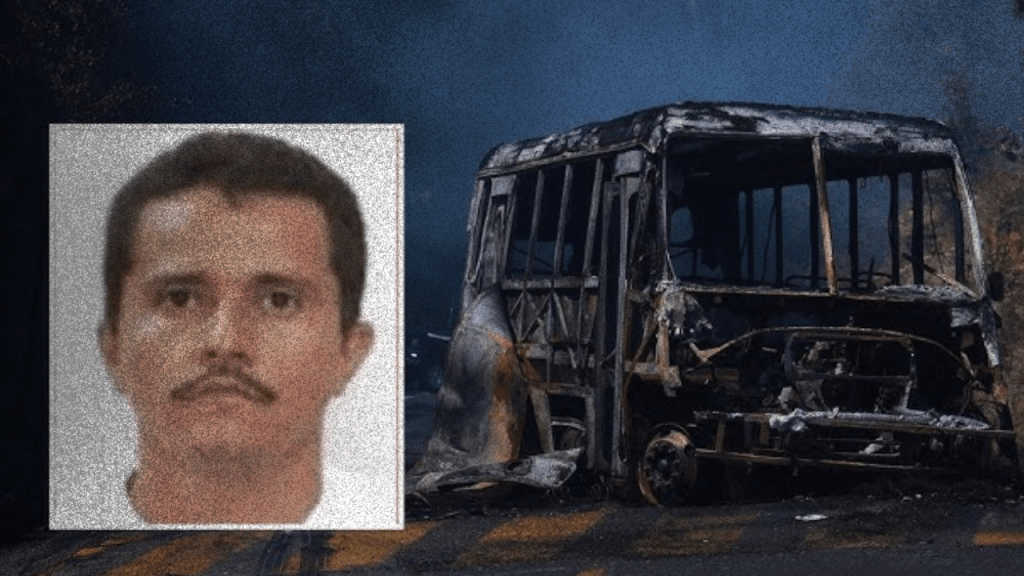
Modern cartel violence in Mexico does not unfold only in territory. It unfolds in perception. Physical events and informational events now move together. A handful of coordinated road blockades can scale into a narrative of national collapse before verification catches up. That distortion is not random. It emerges from the interaction of three systems: criminal signaling, digital amplification, and political escalation. To understand recent flare-ups — including the February 2026 Tapalpa raid and its aftermath — it helps to analyze those systems directly rather than re-litigating the imagery that circulates when smoke rises over highways.
Violence as Communication
Not all violence is meant to conquer. Some of it is meant to be seen. Research on organized crime has long documented that public displays of force function as communication, but the theoretical architecture for understanding this was underdeveloped until Benjamin Lessing, an associate professor of political science at the University of Chicago, formalized a distinction that most commentary still ignores: the difference between violence aimed at rivals and violence aimed at the state.
In his 2015 paper “Logics of Violence in Criminal War” published in the Journal of Conflict Resolution, Lessing argues that the prominent “criminal insurgency” approach to Mexican violence — which treats cartel-state conflict as a variant of insurgency — elides critical differences in rebels’ and cartels’ aims. Rebels fight states to conquer territory or political control. Cartels fight states to constrain their behavior and influence policy outcomes. This distinction has theoretical consequences: decisive victory plays an important role in most models of civil war but is impossible or undesirable in wars of constraint. What cartels want is not revolution. It is favorable terms.
Lessing identifies two coercive logics. The first is violent corruption — epitomized by Pablo Escobar’s infamous “plata o plomo?” (the bribe or the bullet?) — in which cartels use threats of violence against police and other enforcers to secure lax enforcement and more advantageous bribe agreements. The second is violent lobbying, in which cartels use high-profile, terroristic violence to pressure state leaders into making changes to de jure policy. A review published by Rutgers’ Criminal Law and Criminal Justice Book Reviews summarizes the framework from Lessing’s book Making Peace in Drug Wars: Crackdowns and Cartels in Latin America (Cambridge University Press, 2018): even when cartel attacks involve civilians, the message of violence is ultimately intended for the political class. A so-called war can be a form of signaling within a larger strategy.
This matters because Lessing’s formal model demonstrates that state crackdowns can yield both incremental and sudden increases in anti-state violence when two conditions hold: corruption is sufficiently rampant, and repression is insufficiently conditional on cartels’ use of violence. Unconditional repression — the “no quarter” approach adopted by Calderón in 2006 and replicated in every subsequent kingpin targeting operation — creates perverse incentives. When the state punishes all cartels equally regardless of whether they are violent or pacific, cartels have no reason to choose restraint. Lessing’s comparative analysis of Mexico, Colombia, and Brazil demonstrates that conditional repression — targeting only the most violent actors — produces lower violence, lower corruption, and lower cartel armament, precisely because it creates a strategic incentive for cartels to de-escalate.
The audiences for cartel signaling are layered: rival factions evaluating strength, state forces calculating cost, and civilians assessing who controls mobility. Visibility is not incidental. It is strategic. When coordinated arson blocks major transportation arteries after a leadership strike, the objective is not territorial revolution. It is communication — directed simultaneously at the state, at rival organizations, and at the population. The smoke communicates continuity. It says: the organization survives.
Fragmentation as Structural Byproduct
The relationship between leadership targeting and organizational fragmentation has been documented across multiple research programs, but the clearest quantitative evidence comes from a dataset that most commentary on Mexico’s violence has not engaged. The West Point Modern War Institute, in an analysis titled “Why Mexico’s Kingpin Strategy Failed,” drew on data from the U.S. Treasury’s Office of Foreign Assets Control (OFAC) Specially Designated Nationals List and found that on average, when a criminal organization’s leader is killed or arrested, one additional group starts operating in its territory. The authors — including Jane Esberg, now at the University of Pennsylvania — developed a municipality-level dataset of armed groups operating across Mexico from mid-2009 to late 2020, drawing on reporting from narcoblogs and citizen journalism. Their conclusion was unequivocal: after fifteen years of the kingpin strategy, the criminal landscape in Mexico is more fragmented and more violent. Criminal groups have proliferated, topping two hundred by 2020. Fighting is no longer just about the drug trade but about control over commodities including avocados and fuel. Smaller and smaller groups are engaged in deadly local feuds, with civilians caught in the crossfire.
This finding maps precisely onto Lessing’s framework. Unconditional repression fragments markets, which multiplies the number of actors engaged in violent corruption and — because fragmented groups cannot coordinate — eliminates the possibility of collective violent lobbying that might otherwise lead to negotiated de-escalation. The kingpin strategy does not just fail to reduce violence. It creates the structural conditions under which violence becomes more diffuse, more localized, and harder to resolve.
The full empirical record behind this structural finding — including Lindo and Padilla-Romo’s 61 percent homicide increase, Phillips’s data on killing versus arrest, and the CRS documentation of 107 of 122 top criminals removed with violence rebounding every time — is compiled in our evidence review of the kingpin trap.
That pattern does not imply state collapse. It implies redistribution. When a high-profile figure is removed, internal factions jockey for authority, rival groups probe territory, and violence spikes temporarily as power is renegotiated. This cycle has repeated for nearly two decades. It is not evidence of revolutionary rupture. It is a structural byproduct of enforcement strategy interacting with illicit market incentives.
The Civil War Threshold
Language matters. Civil war is not synonymous with high violence, and the slippage between these categories is one of the most consequential distortions in coverage of Mexico.
Conflict classification frameworks, including those maintained by the Uppsala Conflict Data Program (UCDP), distinguish between organized crime violence and armed conflict over state sovereignty. As Lessing himself notes in his EDGS working paper, none of the case episodes in his study of Mexico, Colombia, and Brazil fall under the UCDP/PRIO Armed Conflict Dataset definitions of “state-based armed conflict.” The most recent version of the dataset, covering 1946 through the present, includes just two conflict-year observations pertaining to Mexico: the Zapatista uprising in 1994 (fewer than 150 battle deaths) and an EPR-related observation in 1996 (fewer than 50). The dataset excludes Mexico’s current violence — not because the researchers are unaware of it, but because organized crime violence does not meet the classificatory threshold for armed conflict over state sovereignty.
Civil war requires sustained contestation for national authority. It involves competing governments claiming legitimacy, fragmentation of unified military command, and durable territorial governance by insurgent actors. Mexico held its most recent presidential election in June 2024 and inaugurated President Claudia Sheinbaum in October 2024. Federal institutions continue to operate. The armed forces remain under centralized command. Financial and commercial systems function. Cartel retaliation — even severe retaliation — does not automatically satisfy these criteria. Precision in terminology prevents escalation of perception. And escalation of perception is precisely what serves both cartel signaling strategies and the political actors who benefit from framing Mexico as a failed state.
The reason Mexico’s present violence reads as pattern rather than collapse becomes clearer when placed within the full historical arc — from the 1848 territorial seizure through the revolutionary state, the neoliberal rupture of 1994, and the post-2006 militarization cycle. That arc is traced in our structural history of the U.S.–Mexico border.
The Evidence Standard
Historical memory shapes suspicion — and reasonably so. The United States has intervened in Latin America in documented cases, and declassified archives later confirmed those interventions in detail. The challenge is distinguishing structural asymmetry from operational orchestration.
The CIA’s involvement in the 1954 Guatemalan coup is now a matter of established historical record. The U.S. State Department’s Office of the Historian published declassified documents in its Foreign Relations of the United States series describing the Agency’s operational plan, which included paramilitary training in Nicaragua, sabotage operations staged from Honduras, and broad-scale psychological warfare against the Árbenz government — a democratically elected president whose land reform program threatened United Fruit Company’s holdings. The National Security Archive at George Washington University holds over 2,000 declassified documents on Guatemala, including CIA operational records produced during the coup and National Security Council deliberations on consolidating a post-coup regime. As one declassified CIA assessment noted, the United States’ support in 1954 for the military operation which overthrew President Árbenz is now a matter of public record.
For Chile, the historical record is similarly well-documented. The CIA’s 2000 self-assessment, declassified Church Committee findings, and documents released through the National Archives confirm covert action programs including funding to media organizations and opposition groups leading up to the September 1973 coup that overthrew Salvador Allende — another democratically elected leader whose nationalization policies conflicted with U.S. corporate and strategic interests.
Those cases became established history because documentary evidence surfaced: funding trails, operational directives, internal memoranda, congressional investigations, and whistleblower testimony. The evidence was not speculative. It was archived, declassified, cross-referenced, and confirmed across multiple independent investigative bodies over decades.
Claims of covert U.S. orchestration of Mexico’s current violence would require comparable evidence. Structural asymmetry between states is real and well-documented — bilateral security cooperation frameworks have channeled billions of dollars in military and intelligence assistance to Mexican forces, and the intelligence architecture that produced the Tapalpa operation was built within that framework. But structural influence is not operational direction. The analytical task is to identify the material interests, institutional incentives, and policy architectures that produce outcomes — not to assert conspiracy where structural analysis already explains the pattern. Recognizing asymmetry does not require abandoning evidentiary standards. And abandoning evidentiary standards does not serve the left. It serves the information environment in which panic thrives.
The Tapalpa operation itself illustrates exactly how structural asymmetry functions without requiring conspiracy: a U.S. military task force providing the target package, an FTO designation unlocking operational capabilities, and an intelligence architecture built over two decades of bilateral cooperation. The operational reconstruction is in our analysis of the raid’s intelligence leverage.
Policy Escalation and Designation Debates
One area of genuine tension involves the February 2025 designation of six Mexico-based cartels and two transnational gangs as Foreign Terrorist Organizations (FTOs) and Specially Designated Global Terrorists (SDGTs). The Congressional Research Service documented that Secretary of State Rubio designated the Sinaloa Cartel, CJNG, Cártel del Noreste, Gulf Cartel, La Nueva Familia Michoacana, and Cárteles Unidos as FTOs, along with MS-13 and Tren de Aragua. The CRS noted that the Mexican government has long opposed such designations, citing their potential effects on tourism and investment, the volume of entities that could be deemed to have provided “material support,” and the potential that they could lead to unilateral U.S. military operations in Mexico.
The debate has been active for more than a decade. The Wilson Center traced the legislative history back to 2011, when House Resolution 1270, introduced by Representative Michael McCaul, first proposed designating seven Mexican cartels as FTOs. The CSIS published a January 2026 analysis titled “When Crime Becomes Terror: Rethinking the FTO Designation,” noting that the primary difference between FTOs and transnational criminal organizations is that FTOs, by definition, pursue political objectives, while TCOs are primarily profit-motivated — a distinction the designation deliberately collapses.
The consequences are not abstract. The Baker Institute at Rice University published an analysis warning that the FTO designation amounts to summary death warrants for Mexican criminals, drawing a direct line from the designation to the bin Laden raid in Pakistan — an extraterritorial killing of a designated FTO target in a sovereign nation without that nation’s approval. Tricia Bacon and Daniel Byman, writing for American University’s School of Public Affairs, argued that cartels were already sanctioned under the Foreign Narcotics Kingpin Designation Act and existing transnational criminal organization frameworks, meaning the FTO designation provides no significant new legal leverage — while dramatically expanding “material support” liability to any company, individual, or financial institution with even indirect connections to cartel-controlled territories. Americas Quarterly reported that AG Bondi’s decentralization of DOJ enforcement has further expanded the scope of potential prosecution, with the Chiquita Brands ($25 million penalty for payments to Colombian paramilitaries) and Lafarge ($778 million for payments to ISIS in Syria) precedents providing a clear model for enforcement against Mexican operations.
The FTO designation is not a covert operation. It is visible, procedural, and legislative. But it is also not neutral. It reframes a law enforcement and public health problem as a national security threat, which serves a specific political function: justifying military responses to drug trafficking that Lessing’s own research demonstrates increase violence rather than reduce it. The designation creates the legal architecture for extraterritorial kinetic action against profit-motivated criminal organizations in a sovereign nation — a framework that did not exist in bilateral relations before February 2025. That is not conspiracy. It is policy. And policy of this kind deserves scrutiny on its own terms.
Narrative Simplification
Another distortion comes from storytelling itself — and this one operates at a deeper level than misinformation, because it shapes the cognitive frame through which all information about Mexico is processed.
Oswaldo Zavala, a professor of contemporary Latin American literature and culture at the City University of New York (CUNY), published Drug Cartels Do Not Exist: Narcotrafficking in US and Mexican Culture (Vanderbilt University Press, 2022). The book’s argument is not that trafficking organizations are imaginary. It is that the narrative form in which they are presented — the singular cartel, the omnipotent boss, the imminent collapse — is a constructed subterfuge that obscures political realities rather than illuminating them. Zavala traces this construction through cultural products including Sicario, The Queen of the South, and Narcos, arguing that by creating a “cartel myth” — a singular group of criminals led by a boss as depicted in contemporary pop culture — states create a “permanent enemy” to justify militarized policy.
A review in Small Wars Journal noted that while Zavala draws heavily on literary works and cultural representations, his central claim has political-economic force: the spectacle of the cartel serves the interests of both the trafficking organizations and the states that claim to fight them. The cartel benefits because the myth of centralized power projects capability beyond what the organization actually possesses. The state benefits because a legible enemy justifies permanent militarization, expanded budgets, and the suspension of normal political accountability.
Whether or not one accepts Zavala’s argument fully, it identifies a structural tendency toward simplification that is directly relevant to the information dynamics analyzed throughout this piece. Prestige television and thriller narratives encourage a model of centralized masterminds and imminent collapse. That lens exaggerates coherence and compresses complexity. When events are framed through cinematic logic, flare-ups feel apocalyptic. But illicit markets operate through negotiation, adaptation, and localized competition. The drama is real. The narrative scale is inflated. And the inflation serves interests.
Panic as a Force Multiplier
Mexico faces serious security challenges. Cartel violence produces genuine fear and material harm. Bilateral security relationships remain asymmetrical and politically sensitive. But not every surge in visible disruption signals national breakdown.
In contemporary information ecosystems, panic behaves like a force multiplier. It scales localized events into national narratives. It accelerates suspicion into certainty. It privileges immediacy over proportion. And it is not politically neutral — panic about Mexico specifically serves the FTO designation framework, the “failed state” narrative that justifies extraterritorial intervention, and the domestic political actors who benefit from presenting the border as an existential threat rather than a policy question.
The February 2026 information operation that followed the Tapalpa raid demonstrated every dimension of this dynamic in real time — from AI-generated fabrications traced to Google’s Gemini to the convergence of cartel propaganda with U.S. far-right amplification. The full reconstruction is in our analysis of the cartel AI misinformation war.
Understanding the architecture of panic does not minimize instability. It contextualizes it. Lessing’s framework shows that violence is communication, not chaos. The West Point data shows that fragmentation is a structural byproduct of strategy, not evidence of state failure. The UCDP classification shows that organized crime violence and civil war are different phenomena requiring different analytical tools. The historical record shows that U.S. intervention in Latin America is documented fact — and that documentation requires evidence, not assumption. The FTO debate shows that policy escalation is real and consequential and does not require conspiracy theory to criticize.
Structure moves slowly. Spectacle moves fast. In moments of crisis, the difference between the two determines whether smoke is interpreted as signal — or as collapse.
Sources
- Benjamin Lessing — “Logics of Violence in Criminal War” Journal of Conflict Resolution (2015)
- Benjamin Lessing — Making Peace in Drug Wars: Crackdowns and Cartels in Latin America (Cambridge University Press, 2018)
- Rutgers Criminal Law and Criminal Justice Book Reviews — Review of Making Peace in Drug Wars
- Benjamin Lessing — “Violent Corruption and Violent Lobbying” EDGS Working Paper
- West Point Modern War Institute — “Why Mexico’s Kingpin Strategy Failed” (June 2022)
- Jane Esberg — University of Pennsylvania, Dept. of Political Science
- Uppsala Conflict Data Program (UCDP)
- U.S. State Department, Office of the Historian — Guatemala 1954 (FRUS declassified documents)
- National Security Archive at George Washington University — Guatemala collection
- U.S. National Archives — Chile declassified documents
- Congressional Research Service — “Designating Cartels as Foreign Terrorists: Recent Developments”
- Wilson Center — “Mexican Cartels and the FTO Debate” (Feb. 2024)
- CSIS — “When Crime Becomes Terror: Rethinking the FTO Designation” (Jan. 2026)
- Baker Institute at Rice University — “The FTO Designation Amounts to Summary Death Warrants”
- Tricia Bacon & Daniel Byman — “The Potential Policy Impacts of Classifying Cartels as FTOs” (American University, 2025)
- Americas Quarterly — “What Cartel FTO Designation May Mean for Mexico” (April 2025)
- Oswaldo Zavala — Drug Cartels Do Not Exist: Narcotrafficking in US and Mexican Culture (Vanderbilt University Press, 2022)



 Spark Solidarity