
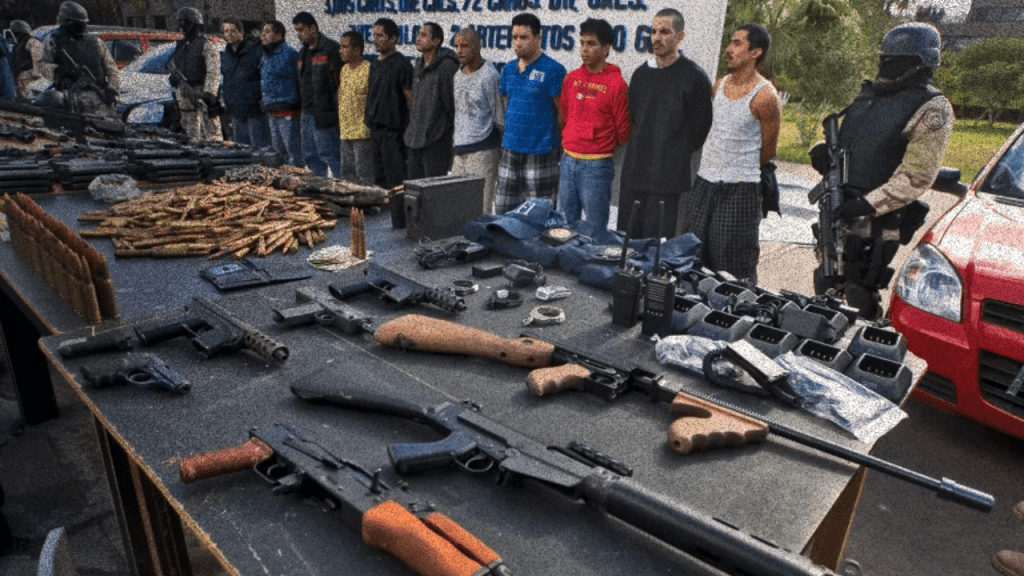
U.S.-Mexico cartel economy links gun trafficking, drug demand, narco-drones, and intelligence cooperation into one self-reinforcing cycle of violence.
Any analysis of cartel power that confines itself to Mexican territory is incomplete. The violence in Mexico operates within a North American illicit economy — not a sealed national silo.
Weapons move south. Drugs move north. Money circulates through financial systems on both sides of the border. Recognizing this binational structure does not negate Mexican responsibility. It clarifies that the system producing the violence is shared — and that the imperial core’s role in sustaining it is structural, not incidental.
The binational dimension extends beyond arms and narcotics flows into the institutional architecture of the operations themselves. As we document in our reconstruction of the Tapalpa raid, the operation was enabled by a new U.S. military-led task force operating from a base 15 miles north of the Mexican border — making the intelligence infrastructure as transnational as the weapons pipeline.
The Iron River: U.S. Firearms Flowing South
The pipeline of U.S.-sourced firearms into Mexico is documented at the federal level.
The U.S. Government Accountability Office, in its 2021 report “Firearms Trafficking: U.S. Efforts to Disrupt Gun Smuggling into Mexico” (GAO-21-322), found that 70 percent of firearms recovered in Mexico from 2014 through 2018 and submitted for tracing were U.S.-sourced (GAO).
The GAO was careful to note that this statistic applies only to firearms submitted for tracing through the Bureau of Alcohol, Tobacco, Firearms and Explosives (ATF). It does not represent all firearms in circulation — ATF “does not receive complete data about thousands of firearms, such as those recovered by Mexican states.” The actual figure is likely higher.
The Mexican government has estimated that approximately 200,000 firearms are smuggled from the United States into Mexico each year.
The Trace, an investigative nonprofit focused on gun violence, reported that between 2015 and 2022, more than 50,000 firearms were smuggled over the U.S. border into Mexico and Central America, traced back to nearly every U.S. ZIP code. John Lindsay-Poland, the founder of Stop US Arms to Mexico, told The Trace: “This data shows us that the market for guns in the United States is so large and so porous that going after individual straw buyers is not a winning strategy. We need to look upstream, at the unregulated market that provides such easy access to traffickers” (The Trace).
Mexico has only one gun store in the entire country — located on a military base, requiring months of background scrutiny to purchase. The weapons fueling cartel violence are not Mexican in origin. They are American.
Following the Guns Across the Border
Anthropologist Ieva Jusionyte expanded on these findings in her 2024 book Exit Wounds: How America’s Guns Fuel Violence Across the Border (University of California Press).
Jusionyte, an associate professor at Brown University, followed American guns from dealers in Arizona and Texas to crime scenes in Mexico. Her research documented how organized crime groups use funds from illegal drug sales to purchase and smuggle weapons with devastating consequences.
As her university’s research summary noted, Mexico strictly regulates the sale of semi-automatic rifles at the federal level, “but these weapons are easily available across the border in states like Texas and Arizona.”
The structural logic is straightforward: U.S. gun laws — particularly in border states — create the supply. Mexican cartel revenue creates the demand. The result is a weapons pipeline that arms the very organizations the drug war claims to be dismantling.
U.S. Senator Dick Durbin described this flow as a “deadly, vicious cycle of firearms trafficking” enabled by “lax gun laws and dangerous gun industry practices.”
The imperial core’s role in sustaining this violence extends beyond the United States. Canada, which rarely appears in the cartel narrative, consumes the same drugs, hosts compliant financial infrastructure, and participates in the same continental security architecture. The pattern of formal distance masking structural entanglement is one Canada has rehearsed before — and it functions the same way here: invisible complicity beneath a sovereign surface.
The Northbound Flow: Drugs and the U.S. Market
The other half of the binational equation is demand.
The Drug Enforcement Administration’s 2025 National Drug Threat Assessment identifies the Sinaloa Cartel and CJNG as “the primary groups producing the illicit synthetic drugs driving U.S.” overdose deaths.
A Congressional Research Service analysis on “Illicit Fentanyl and Mexico’s Role” states that “Mexico-based transnational criminal organizations, especially the Sinaloa and the Jalisco New Generation Cartel, are primary suppliers of illicit drugs, including fentanyl, for the U.S. market.”
According to the DEA’s 2024 assessment, nearly all methamphetamine sold in the United States is now manufactured in Mexico. Drug-related deaths claimed 107,941 American lives in 2022 alone.
The U.S. is simultaneously the primary consumer market for the drugs these organizations produce and the primary source of the weapons they use. The drug war narrative frames Mexico as the problem. The material reality is that the problem is hemispheric.
The Drone Layer
The use of consumer drones by Mexican cartels — for both reconnaissance and aerial attack — represents a newer dimension of the conflict’s technological evolution.
InSight Crime’s investigation “Drones Fuel Criminal Arms Race in Latin America” reported that CJNG began deploying explosive drones in Michoacán around 2020, using them against rival groups and local communities. The tactic spread to Guerrero, where the Familia Michoacana adopted airborne weapons for territorial control.
CJNG maintains a specialized unit dedicated to drone operations — known internally as the “Drone Operators” — which wears patches bearing its own insignia and releases demonstration videos on social media as a form of intimidation.
PBS NewsHour, via the Associated Press, confirmed that “The Jalisco cartel has been one of the most aggressive cartels in its attacks on the military — including on helicopters — and is a pioneer in launching explosives from drones and installing mines.”
The Brookings Institution published analysis noting that CJNG has “regularly used drones to carpet bomb rural areas in Michoacán to render an area unusable for civilians” and that Mexican cartels “have been learning more sophisticated use of advanced drones from watching Ukraine’s battlefield.”
Commonly used platforms include consumer models like the DJI Mini 3 (approximately $760) and, for organizations with greater resources, agricultural spraying drones like the DJI Agras T40.
The presence of drones does not signify strategic air superiority. It reflects a broader trend in asymmetric conflict where consumer technology lowers the cost of vertical surveillance and attack. These adaptations make the conflict more technologically complex without fundamentally altering the underlying power dynamics — which remain rooted in the political economy of drugs, weapons, and institutional dependency.
Narcomensajes: Public Messages as Coercive Communication
Reports of a CJNG message threatening members of the ruling MORENA party in the aftermath of the Tapalpa operation illustrate another recurring dimension of the conflict.
Narcomensajes — cartel banners or messages left in public spaces — have been documented for years as tools of intimidation and strategic communication. InSight Crime has described them as instruments designed to shape public perception and pressure officials.
Academic research by Brian Phillips and Viridiana Rios, published as “Narco-Messages: Competition and Public Communication by Criminal Groups” in Latin American Politics and Society (Vol. 62, No. 1, 2020), analyzes the competitive logic behind these public messages.
When a cartel message claims the government failed to honor “agreements,” it injects ambiguity into public discourse. It invites speculation about collusion while offering no verifiable proof.
That ambiguity is itself strategic. It undermines public trust in government institutions regardless of whether the underlying claims have any factual basis. Cartel pressure on Mexican politicians is rarely ideological — it is transactional, operating across party lines and exploiting the gap between public narrative and institutional reality.
Information Warfare and Digital Amplification
The Tapalpa episode unfolded in real time across social media platforms. Clips of burning vehicles circulated widely. Some were current footage; others were misattributed from previous incidents.
Claims that organized crime had “taken over” Guadalajara International Airport spread rapidly before being denied. The airport operator, Grupo Aeroportuario del Pacífico, confirmed that no violent incidents occurred inside the terminal itself and that facilities remained under federal security protection. Airlines canceled flights due to blocked access roads — not because of an armed takeover.
This dynamic — viral misinformation amplifying the perceived severity of cartel violence beyond its actual scope — represents a distinct front in the conflict.
Governments must now respond not only to physical violence but to the narrative contest that accompanies it. Embassy statements, presidential messaging, and official clarifications become operational tools. Narrative containment is part of modern security policy.
And cartels know this. The retaliation spectacle is designed not only for the ground but for the screen. Images of burning highways and smoke rising over tourist resorts carry more strategic weight in the information environment than any body count. The goal is not military victory — it is narrative disruption.
The System
The binational machine is not a conspiracy. It is an economy.
U.S. drug demand generates the revenue. That revenue purchases firearms legally available in U.S. border states. Those firearms arm organizations that control trafficking corridors. The U.S. responds with intelligence support, military aid, and kingpin targeting. Targeting produces fragmentation. Fragmentation produces violence. Violence justifies further militarization. Militarization deepens the dependency.
Each step in that cycle is empirically documented. As we detail in our analysis of the kingpin trap, peer-reviewed research spanning nearly two decades consistently finds that leadership removal increases violence by 61 percent in the capture municipality alone — and that the effect spills over into every territory where the targeted organization operates.
The GAO documented the weapons pipeline (GAO-21-322). The DEA documented the drug flows. WOLA documented the militarization trap (WOLA). The academic literature documented the blowback from kingpin targeting. Jusionyte traced the guns. Lessing theorized the violence.
None of this is hidden. The system is visible. The question is whether anyone with the power to change it has the incentive to do so — because the system, as currently constructed, produces benefits for defense contractors, intelligence bureaucracies, and political actors on both sides of the border.
The reason this system remains politically invisible despite being thoroughly documented is itself structural. As we argue in a companion analysis, the dominant “cartel” narrative functions as an ideological construction — one that absorbs transnational complexity into a single Mexican villain and externalizes responsibility away from the imperial core.
The highways reopen. The smoke dissipates. But the machine that produces the cycle remains. Understanding that machine — rather than focusing on any single raid — is the only way to confront what Tapalpa actually represents.
Sources
- U.S. Government Accountability Office, “Firearms Trafficking” (GAO-21-322, 2021) — https://www.gao.gov/products/gao-21-322
- The Trace, “ATF Gun Trafficking Report Data” (June 2024) — https://www.thetrace.org/2024/06/atf-gun-trafficking-report-data-mexico/
- Ieva Jusionyte, Exit Wounds: How America’s Guns Fuel Violence Across the Border (University of California Press, 2024)
- WOLA, “Militarized Mexico: A Lost War That Has Not Brought Peace” — https://www.wola.org/analysis/militarized-mexico-a-lost-war/
- Brian Phillips & Viridiana Rios, “Narco-Messages: Competition and Public Communication by Criminal Groups,” Latin American Politics and Society 62, no. 1 (2020)
- Congressional Research Service, “Illicit Fentanyl and Mexico’s Role”
- DEA, 2025 National Drug Threat Assessment
- InSight Crime, “Drones Fuel Criminal Arms Race in Latin America”
- Brookings Institution, analysis of narco-drone proliferation
- PBS NewsHour / Associated Press, coverage of CJNG drone capabilities and El Mencho operation
- Al Jazeera, “Violence Erupts in Mexico After Killing of Drug Cartel Kingpin ‘El Mencho’” (Feb. 22, 2026) — https://www.aljazeera.com/news/2026/2/22/mexico-announces-killing-of-drug-cartel-kingpin-el-mencho




 Spark Solidarity