
U.S.–Mexico border crisis reflects conquest, neoliberal reform, militarization, and drug prohibition—not sudden collapse or malfunction.
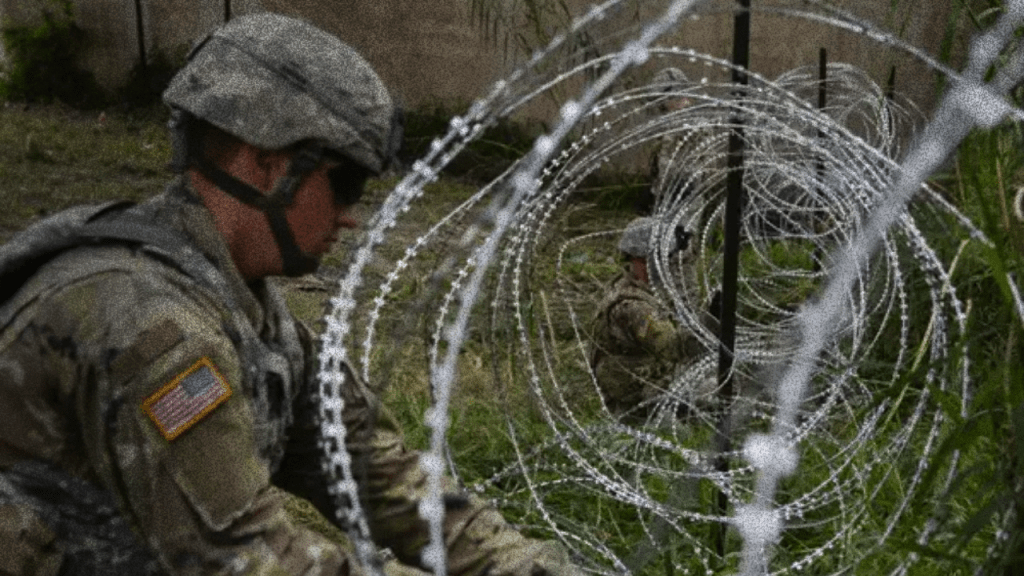
Every few years, the United States declares a crisis at its southern border. Politicians describe chaos. Media cycles fill with images of caravans, razor wire, desert crossings, and overwhelmed facilities. The rhetoric is familiar: the border is “out of control.” But the border is not malfunctioning. It is functioning within a long historical pattern — one documented across decades by historians, journalists, government records, and investigative institutions.
A Border Forged in Conquest
The modern U.S.–Mexico border did not emerge from mutual agreement or natural geography. It was the outcome of war. According to the U.S. National Archives, the Treaty of Guadalupe Hidalgo, signed on February 2, 1848, ended the Mexican-American War (1846–1848) and required Mexico to cede 55 percent of its territory to the United States, including the present-day states of California, Nevada, Utah, New Mexico, most of Arizona and Colorado, and parts of Oklahoma, Kansas, and Wyoming. The U.S. State Department’s Office of the Historian confirms that under the treaty, Mexico ceded approximately 525,000 square miles in exchange for a $15 million lump sum payment. The National Constitution Center notes that this acquisition amounted to roughly 55 percent of Mexico’s prewar territory. The boundary that defines today’s border was not a natural dividing line. It was drawn by the victors of a territorial war, in a treaty negotiated while U.S. forces occupied Mexico City.
Before federal consolidation, large parts of the region were not firmly controlled by either national government. Historian Pekka Hämäläinen’s award-winning The Comanche Empire (Yale University Press, 2008) argues that the Comanche built a genuine imperial power that eclipsed European rivals in military prowess, commercial reach, and cultural influence across the Southwest and northern Mexico. The “border” in any meaningful sense was fluid, contested, and shaped by Indigenous sovereignty long before either nation-state drew a line on a map. As JSTOR Daily’s annotated edition of the treaty documents, the effects of the agreement were profound — not only on the size of the United States but on issues of race, citizenship, and slavery — and determined how those who had been there for hundreds, or in the case of Native Americans thousands, of years were treated or ignored.
Enforcement and the Architecture of Control
Formal enforcement came later — and from the beginning, migration and contraband control were intertwined. According to U.S. Customs and Border Protection’s official history, the Border Patrol was officially established on May 28, 1924, by an act of Congress through the Labor Appropriation Act. Its establishment was motivated by a substantial increase in the smuggling of alcohol with the onset of Prohibition in 1920, alongside increasingly stringent immigration restrictions under the Immigration Act of 1924. Initially, just 450 men were recruited to monitor thousands of miles of border. The early Border Patrol was as much a Prohibition-enforcement body as it was an immigration agency — a fact that illuminates the deep structural entanglement between drug prohibition and border control that persists to this day.
After September 11, 2001, that enforcement architecture expanded dramatically. According to the American Immigration Council’s analysis of enforcement spending, the number of Border Patrol agents nearly doubled from 10,717 in fiscal year 2003 to 19,357 in fiscal year 2022, while the overall Customs and Border Protection budget more than tripled, from $5.9 billion to $19.6 billion. The border did not become militarized because of sudden chaos. It became militarized in waves — each justified by crisis rhetoric, each layering new bureaucracies atop older ones, each expanding the institutional interests that depend on the perpetuation of the “crisis” frame.
Revolution and the Post-Revolutionary State
If the border was forged in conquest, the modern Mexican state was forged in revolution. The Mexican Revolution of 1910–1920 overthrew the thirty-year dictatorship of Porfirio Díaz and established a constitutional republic. Díaz had overseen rapid modernization — railroads, mining, foreign investment — but concentrated land and power in elite hands, leaving the mass of the rural population impoverished.
The 1917 Constitution that emerged from the revolution enshrined sweeping reforms. Article 27 established state ownership of subsoil resources and the basis for land redistribution; Article 123 established comprehensive labor protections. These were radical commitments for their time and remain foundational elements of Mexican constitutional law. In 1938, President Lázaro Cárdenas nationalized Mexico’s oil industry. As the U.S. State Department’s Office of the Historian records, on March 18, 1938, Cárdenas signed an order that expropriated the assets of nearly all foreign oil companies operating in Mexico and later created Petróleos Mexicanos (PEMEX), a state-owned firm that held a monopoly over the Mexican oil industry. The move became a defining act of economic sovereignty — and a permanent irritant to U.S. capital.
But revolutionary legitimacy eroded over time. On October 2, 1968 — ten days before the opening of the Summer Olympics in Mexico City — police officers and military troops shot into a crowd of unarmed student protesters at Tlatelolco. Amnesty International and the National Security Archive at George Washington University have extensively documented the massacre and the state’s subsequent cover-up. The revolutionary state had promised redistribution and justice. By the late twentieth century, it had hardened into an authoritarian regime willing to kill its own citizens to maintain order — while the PRI maintained uninterrupted rule for 71 years, from 1929 to 2000, managing conflict not by resolving it but by absorbing it into a controlled corporatist structure.
Drugs, Prohibition, and State Power
Drug prohibition is often framed as a war between the state and criminal outsiders. But the history is more entangled. As Oswaldo Zavala argues in Drug Cartels Do Not Exist: Narcotrafficking in US and Mexican Culture (Vanderbilt University Press, 2022), the very concept of the “cartel” as an entity independent of the state is an ideological construction that obscures how trafficking networks have historically operated with, through, and alongside state institutions.
For a fuller treatment of Zavala’s argument — including how the “cartel” narrative functions to externalize responsibility and justify the militarization this piece traces — see this dedicated analysis: Drug Cartels Do Not Exist: Rethinking Mexico’s War.
Enforcement in Mexico evolved over decades in close relationship with U.S. demand and bilateral pressure, with trafficking networks tolerated at local levels and managed through informal arrangements between officials and traffickers.
When militarized campaigns intensified — including counter-drug operations in the 1970s often referred to as “Operation Condor” — they did not eliminate networks. They reshaped them. As WOLA has documented, each phase of militarization fragmented existing organizations and created new armed actors, while the flow of drugs continued unabated. The drug trade is not an aberration of the system. It is a structural feature of the binational political economy — sustained by U.S. demand, enabled by U.S. weapons (the GAO has found that 70 percent of firearms traced in Mexico originate in the United States), and managed through a security cooperation framework that has spent more than $3 billion since 2007.
The full dimensions of that binational economy — the firearms pipeline documented by the GAO and traced by anthropologist Ieva Jusionyte, the northbound drug flows quantified by the DEA, and the drone warfare layer now operating in Michoacán — are mapped in our analysis of the U.S.–Mexico cartel economy.
1994: NAFTA and Rupture
The year 1994 marked a structural turning point. The North American Free Trade Agreement integrated Mexico more deeply into continental supply chains while reshaping its agricultural and manufacturing sectors — devastating the rural smallholding economy that had been the foundation of the post-revolutionary social compact. On January 1, 1994 — the same day NAFTA took effect — the Zapatista Army of National Liberation (EZLN) launched an uprising in Chiapas. As NACLA documented, the EZLN was one of the first popular movements to recognize neoliberalism as a dangerous new stage of global capitalism and called NAFTA a death sentence for the Indigenous peasants of Mexico. Democracy Now! reported that Subcomandante Marcos declared NAFTA meant death to indigenous peoples — and the uprising was simultaneously a rejection of the entire framework of neoliberal governance that had replaced the revolutionary state’s social compact. NAFTA also required the removal of Article 27, Section VII from the Constitution — which had guaranteed collective land tenure and land reparations to indigenous groups — eliminating the legal foundation of agrarian reform that the revolution had fought to establish.
That year also saw political assassinations and financial collapse. The Mexican government devalued the peso on December 20, 1994, triggering a financial crisis that cut the currency’s value in half, sent inflation soaring, and produced a severe recession. The United States organized a $50 billion bailout administered by the IMF. Mexico’s GDP declined by 6.2 percent in 1995. The bailout was structured not to rescue the Mexican people but to protect international creditors — a pattern that would be repeated across the Global South in the decades that followed.
Politically, change followed. Vicente Fox won the presidential election on July 2, 2000 — ending more than 70 years of uninterrupted PRI rule. Yet economic policy continuity remained striking. Democratization altered electoral competition. It did not fundamentally alter neoliberal restructuring. The PRI’s political monopoly ended, but the structural conditions that had produced mass poverty, rural dispossession, and the informal economy — the very conditions that feed recruitment into trafficking organizations — remained intact.
That pattern — bailouts structured to protect creditors, not populations — would be repeated across the Global South. When states attempted to resist the framework entirely, the instruments shifted from economic integration to open confrontation, as documented in this analysis of U.S. intervention against Venezuela.
Militarization and Escalation
In 2006, President Felipe Calderón deployed the military in a sweeping campaign against trafficking organizations. The consequences were catastrophic. As WOLA documented in its 2021 report “Militarized Mexico: A Lost War That Has Not Brought Peace”, since December 2006, Mexico has registered approximately 350,000 homicides and the government reports 85,000 disappeared and missing people. Annual homicides more than tripled from the Calderón presidency onward. Arrests and killings of kingpins fostered the fragmentation of criminal groups, leading to increased violence. The overwhelming majority of the tens of thousands of people the government reports as disappeared were taken in the past fifteen years.
The academic research confirms the structural logic. Lindo and Padilla-Romo, in the Journal of Health Economics (2020), found that kingpin removals were associated with a 61 percent increase in homicides within six months in affected municipalities. Jane Esberg’s 2025 study in Political Science Research & Methods tracked more than 450 criminal organizations operating between 2009 and 2020, finding that kingpin removals were correlated with the emergence of new groups. By May 2022, Mexico’s National Registry of Missing Persons recorded that the number of people officially listed as disappeared had passed 100,000 — a humanitarian crisis that eclipses the disappearances during the dirty wars of Argentina, Chile, and Guatemala combined.
The February 22, 2026 operation in Tapalpa that killed CJNG leader Nemesio “El Mencho” Oseguera Cervantes is the latest iteration of this cycle. Twenty-five National Guard soldiers were killed in the aftermath. Over 250 blockades were established across at least 20 states. A coordinated propaganda campaign flooded social media with fabricated images — including an AI-generated photograph of Puerto Vallarta in flames traced by PolitiFact to Google’s Gemini — designed to make the retaliation appear more devastating than it was. The spectacle was amplified by U.S. political actors, including far-right activist Laura Loomer, whose false claims about airport seizures and tourist hostage-taking were directly refuted by the Mexican Embassy. The pattern holds: the state removes a leader, violence spikes, territory is renegotiated, the information ecosystem amplifies the spectacle beyond the material reality, and the system recalibrates.
For a detailed analysis of how the Tapalpa aftermath unfolded — including why the panic outran the reality, what the MIT research on falsehood diffusion explains about the information dynamics, and why the violence was structurally consistent rather than unprecedented — see El Mencho Aftermath: Panic vs. State Collapse.
Hybrid Sovereignty
Today, criminal organizations operate not only as traffickers but as diversified economic actors, expanding into mining, fuel theft, extortion, and control of migration routes. The International Crisis Group’s January 2024 briefing documented how these organizations use social media to garner popular support, denigrate rivals, and project territorial control — while the CSIS has tracked how algorithm-driven recruitment through TikTok and other platforms is drawing young Mexicans into cartel networks in the absence of formal economic opportunity. Meanwhile, migration flows continue, fluctuating with economic conditions and enforcement cycles but remaining central to U.S.–Mexico political discourse.
The present order is not simple collapse. It is layered sovereignty. Federal forces, local officials, private actors, and armed organizations coexist in negotiated arrangements that vary by region. The border is not a malfunctioning system. It is the cumulative result of war, revolution, prohibition, neoliberal reform, and militarization — documented across decades by the institutions that built it and the scholars and journalists who have studied it.
Until those structural forces are addressed, the language of crisis will persist. But what we are witnessing is not sudden breakdown. It is a long reconfiguration of power along one of the most consequential frontiers in the modern world. The border was built to function this way. It is doing exactly what it was designed to do.
Sources
- U.S. National Archives — Treaty of Guadalupe Hidalgo (1848)
- U.S. State Department, Office of the Historian — Texas Annexation and the Mexican-American War
- National Constitution Center — “On this day, the Treaty of Guadalupe Hidalgo is signed”
- JSTOR Daily — “The Treaty of Guadalupe Hidalgo: Annotated”
- NACLA — “A Spark of Hope: The Ongoing Lessons of the Zapatista Revolution 25 Years On” (Jan. 2019)
- Democracy Now! — “Zapatista Uprising 20 Years Later” (Jan. 2014)
- WOLA — “Militarized Mexico: A Lost War That Has Not Brought Peace” (Sept. 2021)
- WOLA — “Mexico Deepens Militarization. But Facts Show it is a Failed Strategy” (Sept. 2022)
- Lindo & Padilla-Romo — “Kingpin approaches to fighting crime” Journal of Health Economics (2020)
- Jane Esberg — “Criminal Fragmentation in Mexico” Political Science Research & Methods (2025)
- U.S. Government Accountability Office — Mérida Initiative funding and firearms tracing (GAO-21-335)
- Al Jazeera — “El Mencho: Mexico officials say 25 soldiers killed after cartel raid” (Feb. 23, 2026)
- Reuters — “After killing of top drug lord, cartels use fake news to spread fear in Mexico” (Feb. 24, 2026)
- PolitiFact — “This isn’t a real image of Puerto Vallarta on fire” (Feb. 23, 2026)
- Raw Story — “Mexican embassy bashes Trump ally’s claims about cartel operation” (Feb. 22, 2026)
- Laura Loomer — original X posts (Feb. 22, 2026)
- International Crisis Group — “Fear, Lies and Lucre: How Criminal Groups Weaponise Social Media in Mexico” (Jan. 2024)
- CSIS — “The Role of Social Media in Cartel Recruitment” (2025)
- National Security Archive — Tlatelolco Massacre declassified documents
- Mexico News Daily — “The situation on the ground in Guadalajara: Feb. 23, 2026”
- Oswaldo Zavala — Drug Cartels Do Not Exist: Narcotrafficking in US and Mexican Culture (Vanderbilt University Press, 2022)
- Pekka Hämäläinen — The Comanche Empire (Yale University Press, 2008)
- Human Rights Watch — “Vanished: The Disappeared of Mexico’s Drug War” (2014)




 Spark Solidarity