
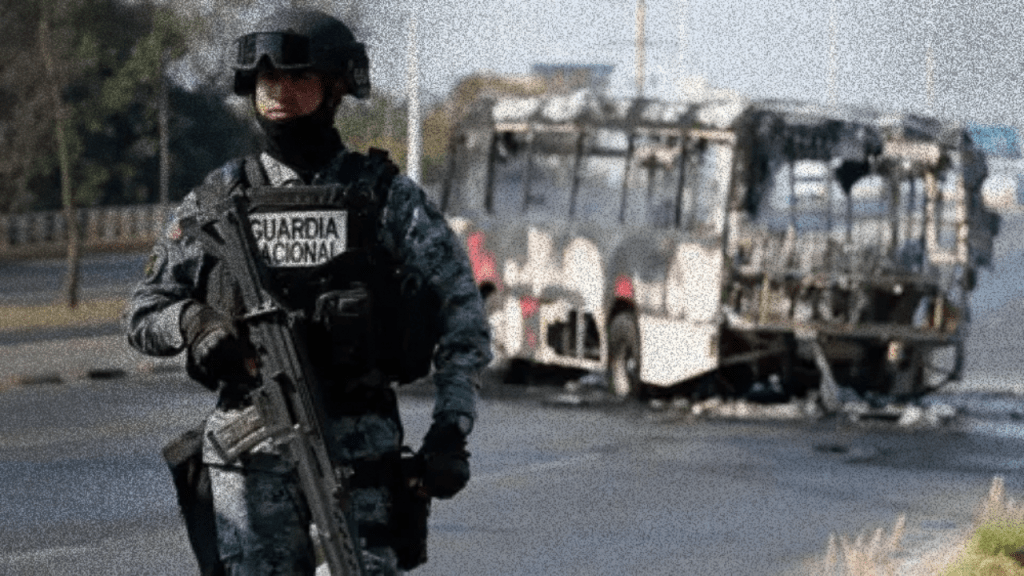
El Mencho retaliation proves Mexico’s kingpin strategy fuels fragmentation, cartel signaling, and a militarized cycle that deepens U.S. security integration.
Within hours of El Mencho’s death on February 22, 2026, a wave of coordinated violence erupted across Mexico.
Mexico’s Security Cabinet documented more than 250 blockades across multiple regions. Cars set on fire by cartel members blocked roads in nearly a dozen states. Guadalajara — Mexico’s second-largest city — was effectively shut down. Several states canceled school the following Monday.
CBS News reported that 25 members of the National Guard were killed in six separate retaliatory attacks in Jalisco alone (CBS News). Al Jazeera described violence erupting across Jalisco, Colima, Michoacán, Nayarit, Guanajuato, and Tamaulipas (Al Jazeera).
None of this was anomalous. It was structurally predictable.
What made the violence structurally predictable was not only the academic record but the nature of the operation itself. As we examine in our analysis of U.S. involvement, the Tapalpa raid was enabled by a new military-led intelligence task force whose targeting architecture shaped the feasibility, timing, and strategic framing of the operation — placing it squarely within a pattern whose consequences have been documented for nearly two decades.
Two Decades of Evidence
High-value targeting of cartel leadership has defined Mexico’s counter-narcotics strategy since 2006. Its track record is among the most studied — and most damning — in contemporary security policy.
The Congressional Research Service, in its continuously updated report “Mexico: Organized Crime and Drug Trafficking Organizations” (CRS Report R41576), has documented this dynamic extensively.
A separate CRS analysis — “Why is Violence Rebounding in Mexico?” — stated it plainly: “The rebound of killings in 2017, despite the removal of more than 107 of Mexico’s 122 most violent top criminals, suggests that those leaders are replaceable. Organizations fragmented but did not disappear, and instead experienced deadly combat until a new leader (or two) replaced the former boss.”
The Council on Foreign Relations, in its backgrounder “Mexico’s Long War,” summarized the Calderón era (2006–2012): the Mexican military captured or killed 25 of the top 37 drug kingpins. Yet the strategy “created dozens of smaller, more violent drug gangs.” The government registered more than 120,000 homicides over the course of Calderón’s term — nearly twice as many as his predecessor’s.
WOLA’s analysis “Militarized Mexico: A Lost War” documented that since the intensification of the war on crime, annual homicides have more than tripled, with approximately 350,000 total homicides and more than 85,000 disappeared persons. The report stated directly: “Arrests and killings of kingpins have fostered the fragmentation of criminal groups, leading to increased violence” (WOLA).
The pattern holds across every administration. The strategy changes in rhetoric but not in structure.
If the evidence is this consistent, the question shifts from whether the strategy works to why it persists. As we argue in a companion analysis, the answer may lie in the construction of the “cartel” itself — an ideological object that simplifies a complex political economy into a villain and makes the militarized cycle appear not just rational but inevitable.
The Academic Consensus
Peer-reviewed research has quantified the mechanism with precision.
Lindo and Padilla-Romo’s study in the Journal of Health Economics (2018), also summarized in a Cato Institute research brief, found that the capture of a drug-trafficking organization leader increases homicide rates in the municipality of capture by 61 percent in the six months following the event — and that this effect persists into subsequent periods (NBER).
The effect is not limited to the immediate area. Their data showed significant spillover into other municipalities where the targeted organization had a presence, supporting the conclusion that removing kingpins destabilizes entire networks.
BJ Phillips, writing in the Journal of Politics (Vol. 77, No. 2, 2015), documented the long-term dynamic: while decapitation may temporarily weaken organizations, “as groups fragment and newer groups emerge to address market demands, violence increases in the longer term.” Phillips found that killing leaders produced more violence than arrest, and that removing top-level leaders produced worse outcomes than targeting mid-level figures (University of Chicago Press).
A peer-reviewed study in Trends in Organized Crime (2023) added a network analysis dimension, demonstrating that criminal organizations had developed structurally balanced arrangements before government intervention, and that the kingpin strategy disrupted those arrangements — leading to a significant increase in violent conflicts (Springer).
A comprehensive review at MexicoViolence.org summarized the state of the field: “The relationship between the kingpin or leadership decapitation strategy and increasing violence in Mexico has been amply theorized and tested, with most observers believing that removal of leadership led to fragmentation of groups and violent fights over succession and turf” (MexicoViolence.org).
The expectation of retaliatory violence following El Mencho’s killing was grounded in scholarship, not conjecture. Every major study points in the same direction.
Retaliation as Strategic Communication
The violence that followed the Tapalpa raid was not random. It was communicative.
Political scientist Benjamin Lessing provides the clearest theoretical framework. In his article “Logics of Violence in Criminal War,” published in the Journal of Conflict Resolution (Vol. 59, No. 8, 2015), Lessing argues that cartels fight states not to conquer territory but to “constrain their behavior and influence policy outcomes.”
He distinguishes between two coercive logics: “violent lobbying” — where violence is directed at the state to change policy — and “violent corruption” — where violence is used to enforce bribery arrangements. Both function as forms of negotiation through force (SAGE Journals).
Lessing’s framework clarifies that the 250+ blockades, the arson, and the attacks on National Guard personnel were patterned signaling — designed to project organizational resilience and impose costs on the state for its action.
The message is not “we will defeat the army.” The message is “this is what happens when you come for us.”
Violence as Brand Management
The use of visible violence as an instrument of organizational communication — not purely military action — has been analyzed at length by scholars of Mexican organized crime.
Guadalupe Correa-Cabrera, in Los Zetas Inc.: Criminal Corporations, Energy, and Civil War in Mexico (University of Texas Press, 2017), argues that organizations like Los Zetas operate through public displays of force designed to project dominance. She builds a case that such organizations “effectively constitute transnational corporations” whose business practices include intimidation-based brand management.
Journalist Ioan Grillo explored this dimension across two widely cited books. In El Narco: Inside Mexico’s Criminal Insurgency (Bloomsbury, 2012), Grillo documented how leadership removals trigger visible retaliation as cartels project resilience. In Gangster Warlords (2016), he extended the analysis, arguing that the spectacle of violence often carries more strategic weight than the body count itself.
CJNG has historically staged highly visible demonstrations — public convoys of armored vehicles, armed propaganda videos, displays of heavy weaponry on social media. The arson and blockades following the Tapalpa raid served a similar communicative purpose: they interrupted daily life across multiple states and flooded digital platforms with dramatic imagery.
The narrative shifted within hours from “the state killed the most wanted man in Mexico” to “the cartel shut down the country.” That narrative shift is the point.
The communicative dimension of cartel violence extends well beyond blockades and arson. As we document in our comprehensive analysis of the Tapalpa aftermath, the operation exposed the full architecture of contemporary cartel-state conflict — from drone warfare and narcomensajes to digital misinformation campaigns and the binational arms pipeline that sustains the cycle.
The Trap
The structural problem is now clearly defined across nearly two decades of evidence.
The state removes a leader. Violence spikes. The spike is framed as proof of cartel power, justifying further militarization. Budgets expand. Intelligence cooperation deepens. A new leader consolidates. The cycle restarts.
The intelligence dimension of this cycle is not abstract. As we detail in our reconstruction of the Tapalpa operation, the raid was enabled by a new U.S. military-led task force that compiled a detailed target package from a base 15 miles north of the Mexican border — illustrating how each removal-blowback cycle deepens the structural dependency between the two governments.
As Laura Carlsen, Director of the Americas Program in Mexico City, argued in the Inter-American Dialogue, the Mérida Initiative model “has been a direct cause in the estimated 250,000 homicides and an additional 85,000 disappearances in Mexico” while replicating a supply-side approach that benefits security industries rather than communities (Inter-American Dialogue).
The decapitation strategy is not failing to achieve its stated goals by accident. It is producing predictable consequences that have been documented, quantified, and published in peer-reviewed journals for over a decade.
The question is no longer whether the strategy works. The question is who it works for.
Sources
- Al Jazeera, “Violence Erupts in Mexico After Killing of Drug Cartel Kingpin ‘El Mencho’” (Feb. 22, 2026) — https://www.aljazeera.com/news/2026/2/22/mexico-announces-killing-of-drug-cartel-kingpin-el-mencho
- CBS News, “Violence Erupts in Mexico After Cartel Leader ‘El Mencho’ Killed” (Feb. 23, 2026) — https://www.cbsnews.com/news/violence-mexico-jalisco-new-generation-cartel-killed-military-puerto-vallarta/
- WOLA, “Militarized Mexico: A Lost War That Has Not Brought Peace” — https://www.wola.org/analysis/militarized-mexico-a-lost-war/
- Benjamin Lessing, “Logics of Violence in Criminal War,” Journal of Conflict Resolution 59, no. 8 (2015) — https://journals.sagepub.com/doi/10.1177/0022002715587100
- Jason M. Lindo & María Padilla-Romo, “Kingpin Approaches to Fighting Crime and Community Violence,” Journal of Health Economics 58 (2018) — https://www.nber.org/papers/w21171
- BJ Phillips, “How Does Leadership Decapitation Affect Violence?” Journal of Politics 77, no. 2 (2015) — https://www.journals.uchicago.edu/doi/10.1086/680209
- Trends in Organized Crime, “Unintended Consequences of State Action” (2023) — https://link.springer.com/article/10.1007/s12117-023-09498-x
- MexicoViolence.org, “Kingpin Strategy” — https://www.mexicoviolence.org/resource/kingpin-strategy
- Inter-American Dialogue, “Has the Mérida Initiative Failed?” (featuring Laura Carlsen) — https://thedialogue.org/analysis/has-the-merida-initiative-failed-the-u-s-and-mexico
- Guadalupe Correa-Cabrera, Los Zetas Inc. (University of Texas Press, 2017)
- Ioan Grillo, El Narco (Bloomsbury, 2012) and Gangster Warlords (Bloomsbury, 2016)
- Congressional Research Service, “Mexico: Organized Crime and Drug Trafficking Organizations” (R41576)






 Spark Solidarity