
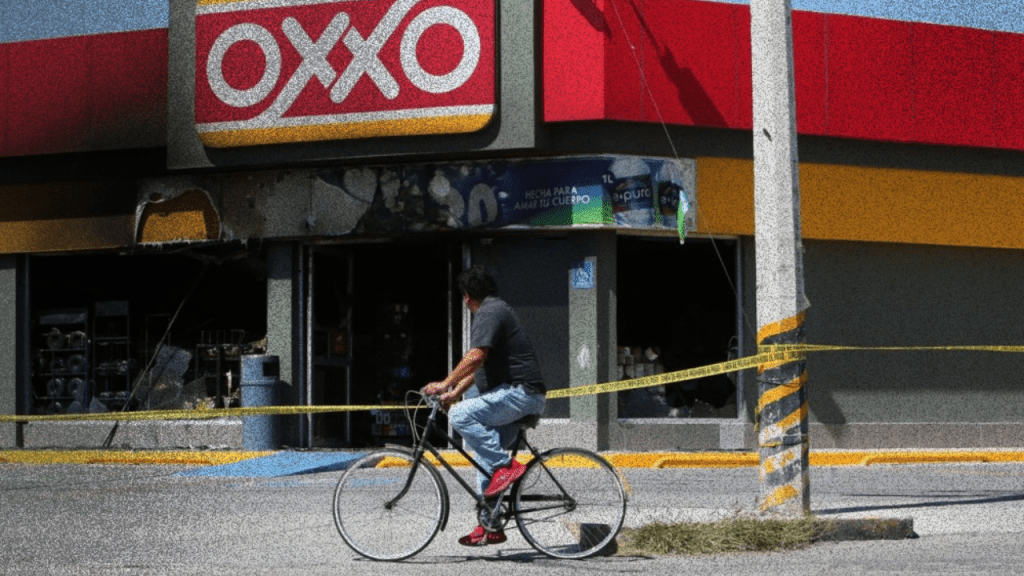
El Mencho aftermath triggered real violence and viral panic, but Mexico’s institutions held within a long-standing cycle of militarized fragmentation.
For about forty-eight hours, if you were online, Mexico looked like it was collapsing. Smoke plumes rising over highways. Shelter-in-place advisories circulating in WhatsApp groups. Rumors of airports under cartel control. Speculation that Americans were being hunted. Claims that civil war had begun.
And then the tone shifted. Official statements clarified. Airports reopened. Traffic resumed. Headlines softened.
What happened was not imaginary. As Al Jazeera reported, twenty-five National Guard soldiers were killed in fighting with criminal groups in Jalisco following the raid that killed CJNG leader Nemesio “El Mencho” Oseguera Cervantes. Mexico News Daily confirmed that suspected gang members torched buses and vehicles and barricaded roads across at least half of Mexico’s 32 states, with over 250 blockades established, 56 flights cancelled from Guadalajara alone, and more than a thousand tourists stranded overnight at the Guadalajara Zoo. Reuters reported that the violence was real — but that the online narrative painted a far more catastrophic picture than reality, fueled by what researchers identified as a coordinated propaganda campaign.
But what did not happen was a national uprising or state collapse.
The speed with which panic outran verification tells us something important. It tells us that modern cartel-state conflict in Mexico unfolds not only in streets and highways, but in feeds and timelines. It also tells us that many observers lack a structural understanding of how Mexico’s security system was built — and how it behaves under stress.
The Border Was Built in Asymmetry
The asymmetry between Mexico and the United States did not begin with drones or intelligence sharing. It began with war. According to the U.S. National Archives, the Treaty of Guadalupe Hidalgo, signed on February 2, 1848, ended the Mexican-American War. By its terms, Mexico ceded 55 percent of its territory, including what are now the states of California, Nevada, Utah, New Mexico, most of Arizona and Colorado, and parts of Oklahoma, Kansas, and Wyoming. The U.S. State Department’s Office of the Historian records that under the treaty, Mexico ceded approximately 525,000 square miles — 55 percent of its prewar territory — in exchange for a $15 million lump sum payment and the assumption of up to $3.25 million in debts owed by Mexico to U.S. citizens. The National Constitution Center notes that this transfer cut the territorial size of Mexico roughly in half. This was not a negotiation between equals. It was a settlement imposed on a conquered nation whose capital had been occupied by a foreign army.
Throughout the nineteenth and early twentieth centuries, the borderlands were fluid, contested spaces. The creation of formal border enforcement came later. According to U.S. Customs and Border Protection’s official history, Congress established the Border Patrol on May 28, 1924, as part of the Immigration Bureau through the Labor Appropriation Act. Security and mobility were intertwined from the start — the institution charged with policing the border was itself a product of the same imperial project that drew the line.
This long arc matters because today’s intelligence sharing — including reported U.S. support in targeting El Mencho — does not represent a sudden imperial intervention. It sits inside a century-long pattern of uneven integration. The relationship has never been equal. But it has also never been reducible to simple control. What it has produced is a form of structural dependence in which the party that supplies the intelligence infrastructure shapes the menu of possible actions — not by giving orders, but by defining what is operationally feasible and when.
Revolution, Sovereignty, and the Management of Violence
Modern Mexico was forged not only in territorial loss, but in revolution. The Mexican Revolution of 1910–1920 overthrew the long dictatorship of Porfirio Díaz and reshaped the country’s political order. The 1917 Constitution promised land reform, labor protections, and national sovereignty over natural resources — a document that, for decades, represented one of the most radical social contracts in the Americas.
Over time, that revolutionary project consolidated into a centralized political system under the Institutional Revolutionary Party (PRI). The PRI maintained uninterrupted rule for 71 years, holding power from 1929 to 2000, controlling not only the presidency but all Senate seats until 1976 and all governorships until 1989. The PRI did not eliminate conflict; it managed it. Labor unions, peasant organizations, regional elites, and political factions were incorporated into a controlled structure. The violence of the state was real — the Tlatelolco massacre of 1968 and the Dirty War of the 1970s made that clear — but it was centralized. Authority flowed through identifiable channels.
This model began to change dramatically after President Felipe Calderón launched a full-scale militarized drug war in 2006. As WOLA has documented extensively, Calderón deployed tens of thousands of military personnel against trafficking organizations, pioneering a “kingpin strategy” that targeted cartel leaders for capture or killing. With U.S. assistance, the Mexican military captured or killed twenty-five of the top thirty-seven drug kingpins. But the research consensus on the consequences of this strategy is damning. A peer-reviewed study by Lindo and Padilla-Romo in the Journal of Health Economics found that kingpin removals were associated with a 61 percent increase in homicides within six months in affected municipalities. Brian Phillips, writing in The Journal of Politics, confirmed that while decapitation may temporarily weaken criminal organizations, as groups fragment and newer groups emerge to address market demands, violence increases in the longer term. Jane Esberg’s 2025 study in Political Science Research & Methods tracked more than 450 criminal organizations operating in Mexico between 2009 and 2020, finding that kingpin removals were correlated with the emergence of new groups and that profit opportunities then attracted these organizations to new territories.
For a detailed reconstruction of how the information operation unfolded — including the AI-generated fabrications, the narco-influencer amplification infrastructure, and the convergence of cartel propaganda with U.S. political actors — see this full analysis: El Mencho Aftermath: Cartel AI Misinformation War.
When a figure like El Mencho is killed, the expectation of blowback is not paranoia. It is structural. Road blockades, coordinated vehicle burnings, urban intimidation tactics — these fit the established logic of signaling and fragmentation. They are violent, disruptive, and frightening. But they are not novel. They are part of the militarized equilibrium that has defined Mexico’s security landscape since 2006.
The state removes a leader. Violence spikes. Territory is renegotiated. The system recalibrates. It is a cycle, not an uprising.
The reason this cycle is consistently misread as collapse rather than recalibration is itself structural. As we argue in a companion analysis, the “cartel” as popularly understood functions as an ideological construction — one that absorbs the entire political economy into a single villain and renders the system that produces the violence invisible.
1994 and the Fragmented State
If the revolutionary state centralized authority, the neoliberal era fragmented it. The year 1994 marked a rupture. NAFTA accelerated Mexico’s integration into North American markets on terms dictated by capital. That same year, the Zapatista uprising in Chiapas exposed deep social and regional inequalities that the trade agreement was designed to deepen, not resolve. As NACLA reports, the Zapatistas chose a symbolic date for their uprising: January 1, 1994, the day NAFTA went into effect. The EZLN was one of the first popular movements to recognize neoliberalism as a dangerous new stage of global capitalism and called NAFTA a death sentence for Indigenous peasants. The uprising was brief — less than two weeks — but it transformed the EZLN into one of the most well-known social movements in the world and exposed the hollowness of the modernization narrative that NAFTA was supposed to embody. As Democracy Now! documented, Subcomandante Marcos declared that NAFTA meant death to indigenous peoples — and the Zapatistas’ rejection of the trade agreement was simultaneously a rejection of the entire framework of neoliberal governance that had replaced the revolutionary state’s social compact.
NAFTA did not only restructure trade; it restructured sovereignty. The removal of Article 27, Section VII from the Mexican Constitution — which had guaranteed collective land tenure and land reparations to indigenous groups — was a precondition imposed by the agreement’s logic. Rural communities were dispossessed. Migration accelerated. The informal economy expanded. By 2000, the PRI’s seventy-one-year hold on the presidency ended. As Harvard’s ReVista documented, on July 2, 2000, Mexican voters brought to an end seven decades of one-party authoritarian rule. Electoral competition expanded. But economic continuity persisted. The centralized brokerage system that had once mediated regional power weakened.
Authority did not disappear. It became layered. Governors, mayors, federal forces, private actors, and criminal organizations operated within overlapping spheres of influence. This fragmentation is essential to understanding why cartel retaliation can look chaotic without signaling national collapse. Mexico today is not a failed state. It is a fragmented one — and the fragmentation was produced not by cartels but by the neoliberal restructuring that preceded and enabled them.
Intelligence Asymmetry and Structural Influence
The operation that killed El Mencho was reported as executed by Mexican forces, with U.S. intelligence support playing an enabling role. The Intercept reported that the Joint Interagency Task Force–Counter Cartel (JIATF-CC), operating from Fort Huachuca, Arizona — fifteen miles from the Mexican border — provided the “detailed target package” that located El Mencho at the rural compound in Tapalpa. The task force, established under NORTHCOM in 2024, operates with approximately 300 personnel and represents, as WOLA analyst Adam Isacson noted, an escalation of U.S. military involvement in counter-narcotics that Trump has given “a hugely bigger role” with increased secrecy.
The United States had publicly prioritized El Mencho for years. The U.S. Department of State’s Narcotics Rewards Program listed a reward of up to $15 million for information leading to his arrest and/or conviction. Since 2017, Oseguera Cervantes had been indicted several times in U.S. federal courts.
Security cooperation frameworks between the two countries have been institutionalized for nearly two decades. According to the U.S. Government Accountability Office, the U.S. has spent about $3 billion since 2007 assisting Mexico under the Mérida Initiative and its successor, the Bicentennial Framework. The Congressional Research Service records that from FY2008 to FY2010 alone, Congress appropriated $1.5 billion focused largely on training and equipping Mexican security forces. Laura Carlsen of the Americas Program at the Center for International Policy, writing through WOLA, has described the Mérida Initiative as a “direct cause” of the escalation in violence — not because it failed to achieve its stated objectives, but because militarization was always the objective, and the violence was its predictable product.
The party that supplies the intelligence infrastructure influences the menu of possible actions. That is not a conspiracy claim. It is how asymmetrical security partnerships function — a dynamic recognized in dependency theory and neo-Gramscian international relations.
The Mexico case sits at the structural-influence end of a spectrum. At the other end is open sovereignty violation — the kind documented in our analysis of U.S. intervention against Venezuela, where the pretense of partnership gives way entirely to sanctions, regime change, and direct confrontation.
Structural influence is not the same as operational control. Intelligence support does not automatically mean that Washington directed the operation or orchestrated retaliation. There is no public evidence to support that claim. But it would be equally naïve to treat intelligence assistance as a footnote. The Mexican Embassy’s own statement — that the operation was “planned and executed by Mexican Special Forces” with U.S. authorities providing “complementary intelligence” — was issued specifically to counter the claim by far-right activist Laura Loomer that the Trump administration had “eliminated” El Mencho. The sovereignty question is not academic; it is actively contested in real time.
The operational specifics of how that intelligence asymmetry functioned in the Tapalpa raid — from the JIATF-CC task force at Fort Huachuca to the detailed target package that located El Mencho — are reconstructed in our analysis of the raid’s intelligence architecture.
The Panic Machine
If the physical violence follows predictable patterns, the informational environment does not. In 2018, researchers at MIT published a landmark study in the journal Science. The researchers found that falsehood diffuses significantly farther, faster, deeper, and more broadly than the truth in all categories of information, and in many cases by an order of magnitude. Falsehoods were found to be 70 percent more likely to be retweeted than the truth, reaching their first 1,500 people approximately six times faster. The study analyzed roughly 126,000 stories tweeted by about 3 million people over 4.5 million times.
During moments of visible violence — burning vehicles, blocked highways, shelter advisories — images travel instantly. Context lags. A handful of road blockades becomes “half the country is burning.” A temporary airport disruption becomes “international takeover.” Speculation becomes certainty before verification catches up.
What made the Tapalpa aftermath qualitatively different, Reuters reported, was the speed and sophistication of the propaganda campaign. False reports of the Guadalajara airport being seized by armed men, planes burning on the runway, and smoke billowing from churches in Puerto Vallarta were shared tens of thousands of times. Reuters reviewed the images and confirmed they were fabricated. PolitiFact traced one viral image of Puerto Vallarta engulfed in flames to Google’s Gemini AI image generator — the first documented instance of AI-generated content being deployed in a Mexican cartel propaganda operation. Jane Esberg told Reuters that CJNG was attempting to project the appearance of nationwide presence and undermine public confidence in the state’s ability to maintain control. Pablo Calderon of Northeastern University London observed that while Sunday was a good day for Mexican security forces, organized crime had been successful in shifting the narrative away from the military raid and toward chaos.
The International Crisis Group’s 2024 briefing, “Fear, Lies and Lucre,” had already documented in detail how this information ecosystem works: criminal groups recruit through social media, spread disinformation to project territorial control, and exploit the information vacuum created by the fact that violence has made it impossible for journalists to safely report from large areas of Mexico. The briefing warned that the line between genuine civilian warnings and deliberate cartel propaganda is often impossible to discern — and that platforms have struggled to respond appropriately.
The threshold for civil war, however, is high. Civil war involves sustained contestation for state power, competing sovereign authorities, and breakdown of national command structures. Mexico faces severe organized crime violence. But it continues to hold elections, operate unified armed forces, and maintain functioning federal institutions. The recent escalation appears to be an immediate retaliatory response to El Mencho’s killing — violent, coordinated, and frightening, but structurally consistent with every previous kingpin removal since 2006.
The CIA claim that circulated online — that the United States is stoking a civil war to justify intervention — would require documentary evidence: directives, funding trails, operational coordination, whistleblower testimony. None has surfaced in credible reporting. Structural incentives are not proof of orchestration. The analytical task is to identify the material interests and institutional incentives that produce outcomes without requiring conspiracy — which is precisely what the intelligence asymmetry, the Mérida Initiative’s $3 billion architecture, and the FTO designation already provide.
What Actually Happened
An enforcement action occurred. A cartel leader was killed. Retaliation followed in historically consistent form. Al Jazeera’s analysis quoted security analyst Chris Dalby explaining that removing a figurehead does not dismantle the business — that El Mencho’s removal is analogous to removing a CEO without touching the corporate infrastructure. Critics noted that instead of long-term financial strangulation, the government had returned to a strategy that previously failed during the presidency of Felipe Calderón.
Social media amplified spectacle. Political rhetoric escalated. Corrections lagged. Laura Loomer’s false claims about airport seizures and tourist hostage-taking were directly refuted by the Mexican Embassy and Roberto Velasco Álvarez, Mexico’s Undersecretary for North America. GAP, the airport operator, confirmed that no violent incidents occurred inside the terminal. The U.S. Embassy’s own security alert confirmed that all airports in Mexico were open and most were operating normally. By Tuesday, the Mexican Embassy declared the situation stabilized.
That sequence — violence, amplification, panic, correction — is neither random nor revolutionary. It reflects a system built over more than a century:
A border born of war. A state forged in revolution. Illicit economies managed, then militarized. Fragmentation accelerated by neoliberal reform. Security cooperation layered with asymmetry. Violence amplified by digital ecosystems designed to reward spectacle over structure.
The uprising did not happen. The system behaved as it has been structured to behave. Smoke rose. Highways closed. Rumors spread. Institutions held.
Understanding that distinction does not minimize the suffering caused by violence — twenty-five dead soldiers, hundreds of burned vehicles, a million disrupted lives. It restores proportion. Mexico is not collapsing. It is navigating a militarized, fragmented, asymmetrical order that has evolved over decades. Each flare-up feels apocalyptic when viewed through a phone screen. But historically, it fits a pattern.
Spectacle outruns structure. And in moments of crisis, panic often travels farther than fact.
Sources
- Al Jazeera — “El Mencho: Mexico officials say 25 soldiers killed after cartel raid” (Feb. 23, 2026)
- Mexico News Daily — “The situation on the ground in Guadalajara: Feb. 23, 2026”
- Reuters — “After killing of top drug lord, cartels use fake news to spread fear in Mexico” (Feb. 24, 2026)
- U.S. National Archives — Treaty of Guadalupe Hidalgo (1848)
- U.S. State Department, Office of the Historian — Texas Annexation and the Mexican-American War
- National Constitution Center — “On this day, the Treaty of Guadalupe Hidalgo is signed”
- NACLA — “A Spark of Hope: The Ongoing Lessons of the Zapatista Revolution 25 Years On” (Jan. 2019)
- Democracy Now! — “Zapatista Uprising 20 Years Later” (Jan. 2014)
- WOLA — Mexico Drug War reports and analysis
- Lindo & Padilla-Romo — “Kingpin approaches to fighting crime and community violence” Journal of Health Economics (2020)
- Brian Phillips — “Enemies with benefits? Violent rivalry and terrorist group longevity” Journal of Politics (2015)
- Jane Esberg — “Criminal Fragmentation in Mexico” Political Science Research & Methods (2025)
- The Intercept — Reporting on JIATF-CC and intelligence architecture (Feb. 24, 2026)
- U.S. Government Accountability Office — Mérida Initiative funding (GAO-21-335)
- PolitiFact — “This isn’t a real image of Puerto Vallarta on fire” (Feb. 23, 2026)
- International Crisis Group — “Fear, Lies and Lucre: How Criminal Groups Weaponise Social Media in Mexico” (Jan. 2024)
- Jane Esberg — University of Pennsylvania, Dept. of Political Science
- Raw Story — “Mexican embassy bashes Trump ally’s claims about cartel operation” (Feb. 22, 2026)
- Billie Parker Noticias — Roberto Velasco Álvarez responds to Loomer (Feb. 22, 2026)
- Mexico News Daily — “Guadalajara airport in chaos; Puerto Vallarta flights canceled” (Feb. 22, 2026)
- U.S. Embassy — Security Alert Update 5 (Feb. 23, 2026)
- The Hill — “Mexican authorities say security ‘stabilized’” (Feb. 24, 2026)
- Laura Loomer — original X posts (Feb. 22, 2026)
- Latin Times — “Mexican Embassy Calls Out Laura Loomer” (Feb. 22, 2026)




 Spark Solidarity