
Drug cartels do not exist as popularly imagined, this analysis argues, exposing how militarization, state collusion, and U.S. policy shape Mexico’s violence.
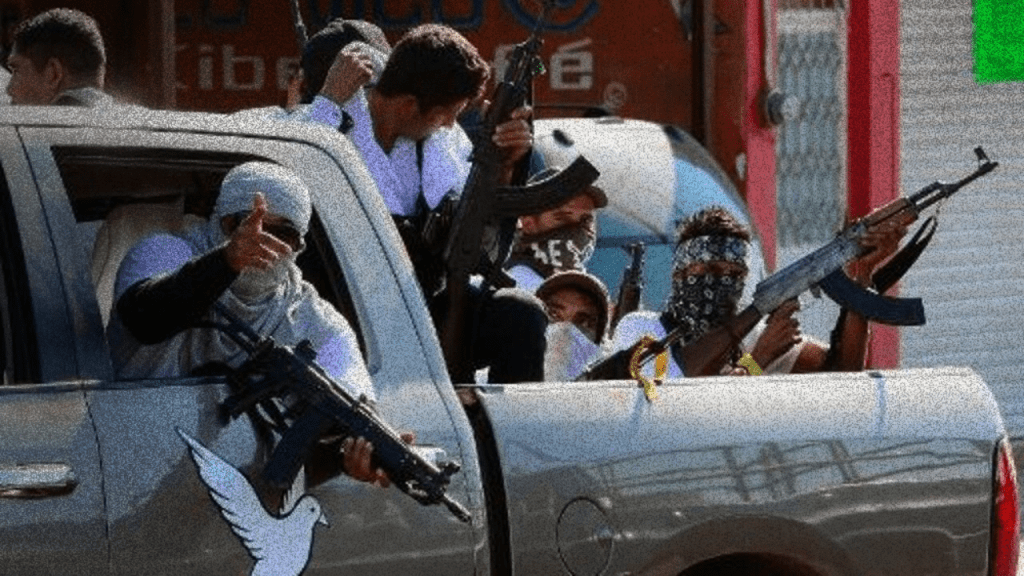
The image is familiar. Masked men with rifles. Grainy surveillance footage. Mugshots of kingpins. Maps shaded in red to mark “cartel territory.” Television pundits speak of sprawling criminal empires that rival the state. Streaming platforms dramatize the rise and fall of narco bosses as modern epics. The story is clear: Mexico is trapped in a war between the state and powerful, quasi-military criminal organizations known as “cartels.” But what if this object — “the cartel” — is not what we think it is?
Oswaldo Zavala, a professor of contemporary Latin American literature and culture at the City University of New York, argues in his book Drug Cartels Do Not Exist: Narcotrafficking in US and Mexican Culture (Vanderbilt University Press, 2022) that the dominant idea of the “cartel” is a political and cultural construction — an ideological object assembled through government press releases, media repetition, and security discourse. As Vanderbilt University Press summarizes his thesis, Zavala “makes the case that the very terms we use to describe drug traffickers are a constructed subterfuge for the real narcos: politicians, corporations, and the military” (Vanderbilt University Press). In this framing, the cartel becomes a kind of supervillain: omnipresent, hyper-organized, capable of challenging the sovereignty of the state itself.
Zavala asks us to consider a different possibility. What if the concept of the cartel, as popularly understood, obscures more than it reveals? What if it simplifies a complex political economy into a morality play? What if it masks state violence, bureaucratic incentives, and transnational capital flows under the guise of organized crime? The modern drug war narrative presents a tidy binary: the state on one side, criminal organizations on the other. Violence is attributed to rogue actors, and the solution is more force, more military aid, more intelligence cooperation. The crisis appears as a failure of enforcement — an insufficiently aggressive war against drugs.
Yet after nearly two decades of militarized escalation, hundreds of thousands of deaths, and billions of dollars in security spending, the violence has not receded. As the Washington Office on Latin America (WOLA) documented in their analysis “Militarized Mexico: A Lost War,” since the intensification of the war on crime nearly fifteen years ago, annual homicides have more than tripled, with Mexico registering approximately 350,000 homicides and more than 85,000 disappeared and missing people (WOLA). The question is no longer whether the strategy is working. It is whether the narrative itself is misdirecting us. If the “cartel” functions as a political spectacle — a central villain that justifies extraordinary measures — then understanding how that spectacle was built becomes essential. Because whoever defines the enemy shapes the response. And whoever benefits from that response may not be the public the war claims to protect.
The construction of an enemy to justify pre-existing policy is not unique to Mexico’s drug war. The United States had already planned to invade Afghanistan before 9/11 — the threat narrative was assembled after the strategic decision, not before it.
How the Narrative Was Built
Drug trafficking in Mexico did not begin in 2006. Nor was it always accompanied by the scale of violence that now defines it. For much of the twentieth century under the Institutional Revolutionary Party (PRI), illicit economies operated within a system often described as “regulated” corruption. Traffickers paid rents to political authorities. Violence existed, but it was relatively contained. The state managed, mediated, and often absorbed criminal networks rather than declaring open war against them. From a materialist perspective, this arrangement reflected the logic of a one-party capitalist state managing surplus extraction across both licit and illicit markets — a system of controlled accumulation where violence was disciplined because all major players were subordinated to the same political structure.
The rupture came in December 2006, when President Felipe Calderón launched a militarized offensive against drug trafficking organizations. Soldiers were deployed domestically on an unprecedented scale. The “kingpin strategy” — targeting and capturing high-profile leaders — became central. The conflict was framed as an existential battle against cartels threatening national sovereignty. During Calderón’s term, as documented in research published in the Journal of Health Economics, Mexico’s annual homicide rate more than doubled, climbing from 10 to 23 per 100,000 people between 2006 and 2012 (ScienceDirect).
Simultaneously, the United States expanded security cooperation through the Mérida Initiative. The U.S. Government Accountability Office confirmed that since 2008, the U.S. has provided over $3 billion in assistance to Mexico to address crime and violence (GAO). While framed as assistance to strengthen Mexican institutions, the money followed predictable channels. As InSight Crime reported, an anonymous U.S. embassy official told Reuters in 2008 that the majority of the Mérida Initiative’s funding would go to American security contractors like DynCorp and Northrop Grumman (InSight Crime). Helicopters, surveillance systems, training programs, and intelligence-sharing agreements intensified cross-border security integration — and generated revenue within the U.S. military-industrial sector.
The narrative that accompanied this shift was simple and compelling. Mexico was under siege by powerful criminal syndicates. The state was responding heroically. Violence was proof of the cartels’ savagery — and thus justification for further militarization. Media organizations, relying heavily on official briefings and dramatic arrests, amplified this framing. As Zavala argues, mainstream institutions “uncritically promoted state narratives regarding the narcotics trade, creating a hegemonic national security myth” while persistently choosing to belittle local journalists who did effectively critique official accounts.
What received less attention was the fragmentation that followed the kingpin strategy. A peer-reviewed study in Trends in Organized Crime demonstrated that the kingpin strategy was directly associated with the fragmentation of criminal organizations in Mexico, that these organizations had developed structurally balanced arrangements before the government’s intervention, and that the strategy disrupted those arrangements, leading to a significant increase in the number of violent conflicts (Springer). Large cartels fragmented into over 200 smaller groups by 2020, and the resulting competition for territory sent violence spiraling. The cartel narrative, once consolidated, proved extraordinarily resilient. It provided a clear villain, a moral binary, and a rationale for emergency powers. It also externalized blame. Violence could be attributed to “criminal organizations” rather than to policy decisions, structural inequality, or state action. The more spectacular the violence became, the more the narrative appeared confirmed. Yet the escalation itself was intertwined with the militarized strategy supposedly designed to contain it.
State Violence and the Collapse of the Binary
If the state-versus-cartel binary were accurate, we would expect clear institutional separation between the two. Instead, key events over the past decade have blurred — and in some cases erased — that line.
In 2014, soldiers in Tlatlaya killed 22 people in what was initially described as a shootout. However, as Amnesty International reported, military documents revealed the soldiers had received orders to “take out criminals” (abatir delincuentes), and in the context of this case there was no doubt that the term meant to kill. As Amnesty’s Americas Director Erika Guevara-Rosas stated, “the language used in the crucial part of the document seems to indicate that the soldiers were instructed to kill suspected criminals” (Amnesty International). Mexico’s National Human Rights Commission confirmed from its own investigation that 15 of the 22 victims were executed extrajudicially. Evidence was manipulated and witnesses reported intimidation. WOLA documented that between 2006 and September 2014, at least 3,600 civilians had been killed in confrontations with Mexico’s armed forces, calling into question how many of those deaths were truly the result of combat (WOLA).
The same year, 43 students from the Ayotzinapa rural teachers’ college disappeared after being detained by local police. The case exposed not an isolated criminal act but a coordinated operation involving multiple levels of the state. As the North American Congress on Latin America (NACLA) reported in their detailed investigation, during the seven-hour attacks, local police, state police, federal police, and military forces all participated. The army monitored and documented the entire operation in real time through surveillance systems and had at least two military infiltrators among the students, one of whom disappeared with them that night (NACLA). A government truth commission subsequently described the disappearances as a “state crime.” Investigators from the Inter-American Commission on Human Rights described encountering a “double reality” in which the most-documented purported details in the case ended up being false, as reported by Al Jazeera (Al Jazeera). As Jacobin reported, investigative journalist Anabel Hernández revealed the existence of a coordinated command-and-control center in Iguala where officials from multiple agencies monitored the attacks in real time, and concluded that “the culpability lies with the state: fue el estado” (Jacobin).
More recently, Genaro García Luna — Mexico’s former Secretary of Public Security and a central architect of the militarized drug war — was convicted in the United States of taking millions of dollars in bribes from the Sinaloa Cartel. For years, he was presented domestically and internationally as a key ally in the fight against organized crime. As Al Jazeera reported, García Luna was sentenced to over 38 years in prison in October 2024, making him the highest-ranking Mexican official ever convicted in the United States. Prosecutors demonstrated that in exchange for millions of dollars, he provided intelligence about investigations against the cartel, information about rival cartels, and safe passage for massive drug shipments — while his federal police force acted as bodyguards and escorts for traffickers, even allowing cartel members to wear police uniforms (Al Jazeera).
These cases do not prove that the state is identical to criminal networks. But they demolish the narrative of a clean war between lawful authority and external threat. They reveal patterns of corruption, collusion, and state-directed atrocity that collapse the moral clarity of the official story. When security forces commit massacres under orders, or when the architect of the drug war is himself on the cartel’s payroll, the “enemy” appears less as an external invader and more as a set of actors embedded within the political and institutional structures of the state itself.
Militarization and Political Economy
Following the money helps clarify what the narrative conceals.
The U.S. Government Accountability Office confirmed that since 2008, the U.S. has provided over $3 billion in assistance to Mexico under the Mérida Initiative and the subsequent Bicentennial Framework.
Despite this investment, as the GAO itself noted, “Mexico’s security situation has worsened significantly, with the country’s murder rate more than tripling” (GAO).
The money, however, did not disappear. Much of it circulated back to U.S.-based defense contractors and security firms. Equipment purchases, training programs, surveillance technology, and logistical support generated revenue within the U.S. military-industrial sector.
As InSight Crime documented, the Defense and State Departments refused to release a breakdown of how Mérida Initiative funds were spent, prompting U.S. Senator Claire McCaskill to threaten subpoenas (InSight Crime).
At the same time, domestic security budgets in Mexico expanded dramatically. The armed forces assumed an increasingly central role in public safety, infrastructure projects, and border enforcement. As WOLA’s analysis documented, under López Obrador, military deployment reached its highest levels in recent history, with the armed forces deployed in policing tasks, migration control, management of ports and customs, and operation of large infrastructure projects — representing a massive expansion of the military’s institutional footprint and political power (WOLA).
Laura Carlsen, Director of the Americas Program in Mexico City, argued in the Inter-American Dialogue that the Mérida Initiative “was doomed to fail from the outset by replicating a supply-side approach to problematic drug use” and that it “has been a direct cause in the estimated 250,000 homicides and an additional 85,000 disappearances in Mexico” (Inter-American Dialogue).
If the objective was to eliminate drug trafficking, the results are devastating. But if the outcome is assessed differently — as the consolidation of security institutions, the expansion of surveillance capacities, and the reinforcement of cross-border security integration — the picture shifts. Militarization does not simply respond to violence; it generates bureaucratic constituencies invested in its continuation. Security agencies receive budgets, training, and authority. Contractors secure long-term contracts. Political leaders demonstrate resolve. Under this lens, the drug war is not a failure in every dimension. It is a system that produces predictable benefits for certain actors, even as it imposes staggering human costs on others.
This pattern extends beyond security policy into how the imperial core narrates Mexico itself. As we have examined elsewhere, American cultural hegemony systematically distorts how audiences in the United States and Canada perceive both Mexico and China — reducing complex societies to morality plays that serve imperial interests.
The Imperial Core and Narrative Management
For audiences in the United States and Canada, the drug war is often narrated as a crisis “over there.” Mexico becomes a site of chaos, corruption, and criminal excess. The role of northern demand, arms flows, and policy choices fades into the background.
Canada’s position in this dynamic is rarely examined. Yet the pattern of formal distance masking structural entanglement is one Canada has rehearsed before — most clearly in the carefully maintained myth of its non-involvement in the Iraq War.
Yet the United States remains the largest consumer market for illicit drugs produced or transited through Mexico. And critically, it is a primary supplier of the weapons used in the violence. The U.S. Government Accountability Office found that 70 percent of firearms recovered in Mexico from 2014 through 2018 and submitted for tracing were U.S.-sourced (GAO). The Trace, a nonprofit investigative newsroom focused on firearms, reported that more than 50,000 firearms were smuggled over the U.S. border into Mexico and Central America between 2015 and 2022, traced back to nearly every U.S. ZIP code (The Trace). U.S. Senator Dick Durbin described this flow as a “deadly, vicious cycle of firearms trafficking” enabled by “lax gun laws and dangerous gun industry practices.”
The narrative of powerful, autonomous cartels serves to externalize responsibility. Violence appears as a product of Mexican pathology rather than as a transnational political economy shaped by U.S. demand, financial systems, and arms markets. When journalists or researchers challenge official accounts, they often encounter institutional resistance. The experience of investigative reporter Gary Webb in the 1990s illustrates how security-sensitive narratives are aggressively contested. Webb’s “Dark Alliance” series for the San Jose Mercury News exposed connections between CIA-backed Contra networks in Nicaragua and cocaine trafficking into Black communities in Los Angeles. As the CIA’s own Inspector General later confirmed, the agency had covered up Contra drug trafficking for more than a decade. Yet Webb was systematically discredited by major outlets including the New York Times, Washington Post, and Los Angeles Times, which deployed teams of reporters to undermine his work rather than build on it. Webb was pushed out of mainstream journalism and died in 2004.
The institutional reflex to discredit structural critique rather than engage with it is not confined to U.S. security journalism. In Canada, liberal media deploys a parallel strategy, using the far right as a foil to silence dissent that challenges the political center from the left.
While contexts differ, the broader pattern underscores the stakes of questioning dominant frames. Media representations play a crucial role. The racialization of violence, the focus on sensational brutality, and the personalization of conflict around charismatic kingpins simplify structural dynamics. They also reinforce the legitimacy of security responses: if the threat is monstrous enough, extraordinary measures appear justified. From an imperial-core perspective, acknowledging entanglement is uncomfortable. It requires recognizing that the violence is not solely the product of distant criminal actors but is linked to policies, markets, and institutions at home. The cartel myth, in this sense, functions as a distancing device.
What “Cartels Do Not Exist” Really Means
To say “drug cartels do not exist” is not to claim that trafficking networks are fictional. Drugs are produced, transported, and sold. Armed groups operate in parts of Mexico. People are killed. The provocation lies elsewhere. It challenges the coherence and autonomy attributed to “cartels” as quasi-state entities locked in a war with a fundamentally separate state. It questions the assumption that violence flows primarily from criminal pathology rather than from policy choices and institutional arrangements.
The cartel, as popularly imagined, is an ideological condensation. It absorbs complex realities — corruption, economic displacement, arms trafficking, financial laundering, political collusion — into a single villain. In doing so, it simplifies accountability. If violence is the work of monstrous outsiders, the solution is more force. If, instead, violence emerges from entangled systems of state power, illicit markets, and transnational capital, then militarization alone cannot resolve it. Zavala argues, as summarized in the Small Wars Journal review of his work, that “the cartel war isn’t new, nor a war, nor between cartels. It is the political system’s permanent state of exception that has been exercising its violent control and sovereignty over organized crime in Mexico for more than half a century” (Small Wars Journal).
Sources Referenced
- Oswaldo Zavala, Drug Cartels Do Not Exist: Narcotrafficking in US and Mexican Culture (Vanderbilt University Press, 2022) — https://www.vanderbiltuniversitypress.com/9780826504661/drug-cartels-do-not-exist/
- WOLA, “Militarized Mexico: A Lost War That Has Not Brought Peace” — https://www.wola.org/analysis/militarized-mexico-a-lost-war/
- WOLA, “Mexico Deepens Militarization. But Facts Show It Is a Failed Strategy” — https://www.wola.org/analysis/mexico-deepens-militarization-but-facts-show-failed-strategy/
- WOLA, “In Mexico’s Tlatlaya Massacre, Soldiers Were Ordered to ‘Take Them Out’” — https://www.wola.org/2015/07/in-mexicos-tlatlaya-massacre-soldiers-were-ordered-to-take-them-out/
- Amnesty International, “Mexico: Military Order May Have Provoked Massacre of 22 People” — https://www.amnesty.org/en/latest/news/2015/07/mexico-military-order-may-have-provoked-massacre-of-22-people/
- NACLA, “Ten Years of Impunity: AMLO and the Betrayal of Ayotzinapa” — https://nacla.org/ten-years-impunity-amlo-and-betrayal-ayotzinapa/
- Jacobin, “Chasing the Murderers of Ayotzinapa’s Forty-Three” — https://jacobin.com/2018/09/ayotzinapa-massacre-missing-students-pena-nieto
- Al Jazeera, “Mexico’s Former Public Security Chief Sentenced to 38 Years in US Drug Case” — https://www.aljazeera.com/news/2024/10/16/mexicos-former-public-security-chief-to-be-sentenced-in-us-drug-case
- Al Jazeera, “Mexico’s Missing Students Case: Investigators Recount Challenges of Probe” — https://www.aljazeera.com/news/2023/8/2/mexicos-missing-students-case-investigators-recount-challenges-of-probe
- U.S. Government Accountability Office, “U.S. Assistance to Mexico” (2021) — https://www.gao.gov/products/gao-21-335
- U.S. Government Accountability Office, “U.S. Assistance to Mexico: State Department Should Take Steps to Assess Overall Progress” (2023) — https://www.gao.gov/products/gao-23-103795
- U.S. Government Accountability Office, “Firearms Trafficking” (2021) — https://www.gao.gov/products/gao-21-322
- InSight Crime, “US-Based Security Contractors Expand Operations in Mexico” — https://insightcrime.org/news/analysis/us-based-security-contractors-expand-operations-in-mexico/
- Inter-American Dialogue, “Has the Mérida Initiative Failed the U.S. and Mexico?” (featuring Laura Carlsen) — https://thedialogue.org/analysis/has-the-merida-initiative-failed-the-u-s-and-mexico
- Trends in Organized Crime, “Unintended Consequences of State Action: How the Kingpin Strategy Transformed the Structure of Violence in Mexico’s Organized Crime” (2023) — https://link.springer.com/article/10.1007/s12117-023-09498-x
- Journal of Health Economics, “Kingpin Approaches to Fighting Crime and Community Violence: Evidence from Mexico’s Drug War” — https://www.sciencedirect.com/science/article/abs/pii/S0167629616303617
- The Trace, “Avoiding a Legal Battle, the ATF Has Released Near-Unprecedented Gun Trafficking Data” — https://www.thetrace.org/2024/06/atf-gun-trafficking-report-data-mexico/
- Small Wars Journal, “Book Review — Drug Cartels Do Not Exist” — https://smallwarsjournal.com/2024/12/21/swj-el-centro-book-review-drug-cartels-do-not-exist/
- Gary Webb, Dark Alliance: The CIA, the Contras, and the Crack Cocaine Explosion (Seven Stories Press, 1998)




 Spark Solidarity