
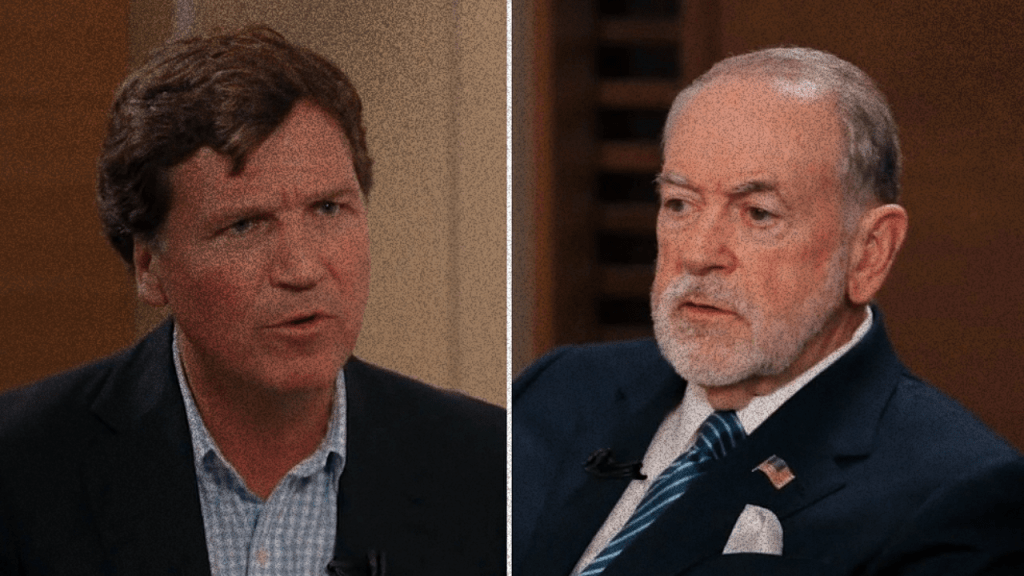
Public opposition to war doesn’t constrain U.S. policy—Huckabee stated this openly, revealing how consultation exists to legitimate decisions already made.
The Contradiction Compressed Into Ten Seconds
Tucker Carlson asked how much American public opinion matters. Mike Huckabee, Trump’s Ambassador to Israel, answered that it matters “every bit.” Carlson noted that only 21% of Americans favor initiating an attack on Iran, with 49% opposed. Huckabee replied: “We don’t live in a world where you have a poll taken to find out whether our policy should be in a particular direction.” Carlson pressed back: “But you just said it matters deeply what Americans think — if we’re ignoring it, in what sense do we care deeply about it?” Huckabee offered no coherent answer, cycling through talking points before restating his support for military action. The exchange lasted seconds. The contradiction appeared immediately.
What makes the moment significant is the collapse. Democratic language holds for one sentence, then disappears in the next. There is no attempt to reconcile the positions. There is only acknowledgment followed by dismissal. That gap exposes the entire structure. The system does not deny democracy. It performs it, then proceeds according to different priorities when war is at stake.
The contradiction is not unusual. It is standard operating procedure in foreign policy formation, where public input shapes legitimation narratives but not the underlying decision framework. What distinguishes this exchange is that the gap became visible on camera, stated by a figure whose institutional role makes the admission structural rather than rhetorical. Huckabee was not offering political commentary. He was describing how policy actually works.
War Proceeds Without Consent, Then Reconstructs It After
The interview aired as polling shows most Americans oppose military action against Iran, with opposition holding across party lines among non-Republicans. Ground war, airstrikes, broader escalation — the answer is consistent. People do not want military action. Policy is moving in the opposite direction regardless.
This is the standard pattern. War proceeds without consent, then consent is reconstructed after the fact through media framing, patriotic appeals, manufactured urgency, and the presentation of military action as inevitable response rather than deliberate choice. The public is not asked whether war should happen. It is informed why it had to happen, with opposition reframed as naive failure to understand complexity, intelligence assessments, or alliance obligations that cannot be disclosed.
The justification never varies. Decisions cannot be crowdsourced. Leaders must act on information voters do not possess. Long-term strategic consequences require expert judgment insulated from popular pressure. In theory, this describes representative democracy. In practice, Princeton research confirms that elite preferences and organized interests predict policy outcomes while public opinion does not. Public opinion becomes advisory at best, a communications problem at worst.
The Iraq War proceeded on manufactured public consent built on false claims about weapons of mass destruction and ties to al-Qaeda — and by 2004 a majority of Americans said the war was not worth fighting. Before Libya, 63% of Americans said the U.S. had no responsibility to act, with 77% opposing bombing Libyan air defenses — the war proceeded anyway. As Jacobin noted, the Trump administration isn’t even bothering to manufacture consent this time — the Iran war’s entire State of the Union mention ran to two paragraphs, three days before strikes were reportedly being planned.
The Fracture That Makes the Implicit Visible
The interview reveals a structural fracture inside American conservative politics. For decades, the Republican foreign policy consensus aligned intervention abroad with unwavering support for Israel, justified through combined appeals to evangelical theology, civilizational conflict framing, and strategic partnership doctrine. That alignment is visibly breaking, with Carlson’s interview representing the isolationist wing’s most direct challenge yet to the interventionist establishment from inside the Republican media ecosystem.
A faction described as “America First” expresses skepticism toward intervention not on anti-imperial grounds but on cost-benefit calculation — questioning foreign entanglements as default policy, and increasingly vocal about distinguishing American interests from Israeli strategic goals in the Middle East. Carlson speaks to this audience. His question about public opinion was not academic. It was a direct challenge to the premise that American military action against Iran serves American interests at all.
Huckabee represents the older alignment. His support for Israel is explicit, ideological, rooted in evangelical eschatology and presented as moral obligation rather than contingent strategic partnership. His nomination as Ambassador to Israel makes this framework operational rather than rhetorical. The tension between these positions is not stylistic. It is structural, pitting national interest rhetoric against ideological and religious commitments that treat U.S.-Israel alignment as sacred rather than negotiable.
What makes this fracture significant is that it forces the normally implicit logic of foreign policy formation into explicit debate. When a sitting U.S. ambassador publicly states that an Israeli military is more humane than the American one, and defends meeting with a convicted Israeli spy, the question of where his primary loyalty lies stops being rhetorical. Carlson’s question and Huckabee’s answer expose what is usually left unspoken: that alliance commitments and ideological priorities can override not only public opinion but also measurable national interest, and that this override is considered normal rather than exceptional.
Alignment Presented as Nature Rather Than Choice
Beneath the exchange sits the question of whose interests drive the push toward war with Iran. The U.S.-Israel relationship is described through the language of shared values, strategic partnership, and mutual security — framing that presents alignment as natural, inevitable, and requiring no justification beyond assertion. But alignment is not given. It is produced through specific mechanisms: lobbying infrastructure, military aid structures, intelligence sharing agreements, ideological conditioning, and personnel circulation between policy institutions and advocacy organizations.
In the same interview, Huckabee was asked if Israel has the right to take over most of the Middle East. His answer: “It would be fine if they took it all.” He has stated publicly that West Bank expansion is not occupation because the land was promised by God, that Palestinian statehood is illegitimate, and that American policy should align with biblical prophecy regarding Jewish sovereignty. This is not diplomatic language. It is ideological clarity about the framework within which Iran policy is being evaluated.
The answer, stated plainly by a sitting ambassador, is that public opposition does not constrain decisions when those decisions are determined by alliance commitments established before consultation occurs. Princeton research on American political outcomes confirms that elite preferences and organized interests determine policy while public opinion does not. This is not conspiracy. It is structure.
Discrediting the Messenger Neutralizes the Observation
The reaction to the interview follows a predictable pattern. The substance of the exchange is not the primary focus. The focus shifts immediately to the figure presenting it. Tucker Carlson becomes the frame — his past positions, his audience, his reputation for inflammatory rhetoric. The conversation moves from the contradiction Huckabee stated to the credibility of the platform where it was stated. This shift is not incidental. It is functional.
If the argument is tied to a polarizing figure, it becomes easier to dismiss without engagement. Agreement carries social cost. Disagreement becomes reflexive, processed through identity filters rather than evaluated on substance. The content is relocated from structural observation to partisan signal, from general critique to tribal marker. Once that shift occurs, the debate changes entirely. It is no longer about whether public opinion is being systematically bypassed on war decisions. It is about whether aligning with the person making that claim is acceptable within one’s community.
This mechanism works because most people do not process information in isolation. They rely on source credibility cues, group alignment signals, and social reinforcement. In a polarized environment, these filters harden. The same claim can be persuasive or disqualifying depending entirely on its origin, not its accuracy. The observation becomes weaponized through association, treated as contaminated rather than as data requiring explanation. This is not accidental. It stabilizes the system by allowing uncomfortable realities to be acknowledged while ensuring that acknowledgment carries no political cost to those who benefit from the status quo.
Democracy Performed, Power Exercised
The exchange returns to where it began. Public opinion matters. Polls do not dictate policy. Both statements are true within the system as designed. Public opinion matters as a source of legitimacy. It shapes elections, messaging strategies, and narrative construction. It is invoked to justify decisions already made, presented as validation rather than constraint. Support is manufactured when it does not exist — the Iraq War being the most documented case of public consent built on fabricated intelligence. The current administration is not bothering with that step.
When opinion conflicts with core institutional priorities — especially war, financial system stability, or alliance structures — it is acknowledged then bracketed. The system does not deny democracy. It performs consultation rituals that create the appearance of accountability while decisions proceed according to a different set of priorities: strategic, institutional, ideological, material. Executive authority expands. Legislative oversight becomes procedural theater. With only 21% of Americans favoring an attack on Iran, the gap between public will and policy direction has never been more visible — or more openly acknowledged by the people executing that policy.
What the Huckabee-Carlson exchange exposes is a moment where the performance slipped, where the underlying logic became visible without the usual rhetorical insulation. The system does not need to conceal this logic completely. It only needs to ensure that when it becomes visible, it is filtered through the right lens — attached to polarizing messengers, framed as partisan rather than structural, dismissed as conspiratorial rather than descriptive. That filtering is enough to keep the contradiction contained.
Huckabee stated this plainly because his role makes it structurally true. As Ambassador to Israel, his policy positions on Iran are professionally inseparable from Israeli strategic preferences. His ideological commitments make U.S.-Israel alignment a theological certainty rather than a contingent partnership subject to evaluation based on American interests. The contradiction he performed on camera is not a failure of messaging. It is how the system functions when institutional and ideological alignments override public accountability, and when that override is defended not as exception but as the normal operation of foreign policy in a world where democracy thins out precisely where it would constrain war.
Sources
- Weaponized Diaspora and the Witnesses Empire Needs — Spark Solidarity
- The Carlson-Huckabee Interview May Be the Wake-Up Call Americans Needed — Al Jazeera
- Trump’s War on Iran Makes a Mockery of American Democracy — Jacobin
- Do Americans Favor Attacking Iran? — University of Maryland Critical Issues Poll
- Testing Theories of American Politics — Cambridge / Princeton Study
- A Look Back at Fear and False Beliefs Behind Iraq War Support — Pew Research Center
- Public Wary of Military Intervention in Libya — Pew Research Center
- Ambassador Mike Huckabee — U.S. Department of State
- Mike Huckabee’s Israel Position — Wall Street Journal



 Spark Solidarity