
El Mencho killing exposes U.S. intelligence leverage, kingpin blowback, and the structural cycle of militarization driving cartel-state violence in Mexico.
On February 22, 2026, Mexican authorities announced that Nemesio Rubén Oseguera Cervantes — known as El Mencho, the leader of the Jalisco New Generation Cartel (CJNG) — had been killed in a military operation in Tapalpa, Jalisco.
The sequence was reported across international media. Al Jazeera described how Mexican security forces killed the drug lord during an operation that “set off a wave of violence, with gunmen torching cars and blocking highways in more than half a dozen states” (Al Jazeera).
Within hours, instability spread across western Mexico. CBS News reported that 25 members of the National Guard were killed in six separate retaliatory attacks in Jalisco alone, and that 252 roadblocks were reported nationwide (CBS News).
The baseline account is clear: Mexico carried out the operation, and retaliation followed immediately.
Before examining the specifics of this operation, it is worth stepping back to ask a more fundamental question: whether the concept of the “cartel” as popularly understood obscures more than it reveals.
As argued in a companion analysis, the dominant cartel narrative is itself a political construction — one that simplifies a complex political economy into a morality play and masks the role of state violence, bureaucratic incentives, and transnational capital.
The Reality of U.S. Intelligence Support
What distinguishes this operation is the nature and depth of U.S. involvement.
Reuters disclosed in an exclusive report that a new U.S.-military-led task force — the Joint Interagency Task Force-Counter Cartel (JIATF-CC) — played a direct role in the intelligence effort. The task force, involving multiple U.S. government agencies, was launched with the goal of mapping cartel networks on both sides of the border (Reuters via U.S. News).
A former U.S. official, speaking on condition of anonymity, told Reuters that Washington “compiled a detailed target package for El Mencho and provided it to the Mexican government for its operation.”
The Intercept provided further context, reporting that the task force operates out of Fort Huachuca, a military intelligence hub 15 miles north of the U.S.-Mexico border, and is staffed by approximately 300 military and civilian employees. The Intercept noted that “for generations, the U.S. military has played a driving role in the drug war abroad, training allied security forces, sharing intelligence on wanted drug traffickers, and facilitating covert kill-capture operations in nations such as Colombia and Mexico” (The Intercept).
Mexico’s Defense Ministry acknowledged that the operation was carried out with “complementary information” from U.S. authorities. White House Press Secretary Karoline Leavitt confirmed the U.S. provided “intelligence support” to assist.
The distinction between execution and targeting architecture is decisive. The United States did not conduct the raid. It supplied the intelligence, surveillance, and targeting support that made the raid feasible.
The actor that provides targeting analysis, surveillance capabilities, and real-time information shapes the operational menu available to the executing force. As TIME reported, Mexico killed the cartel leader “using U.S. intelligence” — a framing that captures the underlying reality: the operational trigger was Mexican, but the enabling architecture was transnational (TIME).
A Long-Standing U.S. Priority Target
U.S. involvement was neither accidental nor opportunistic.
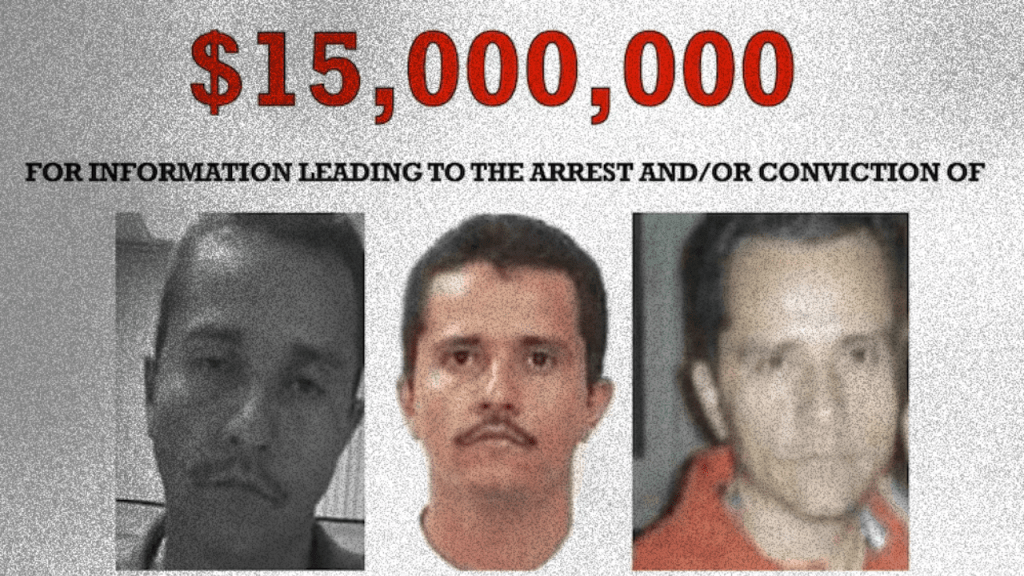
The U.S. State Department had publicly offered up to $15 million for information leading to El Mencho’s arrest or conviction. He had been indicted multiple times in U.S. federal courts since 2017.
In 2025, the Trump administration designated CJNG as a foreign terrorist organization. As Jack Riley, a former senior DEA official, told Reuters, that designation “unlocked new kinds of U.S. military assistance,” particularly when it came to intelligence, surveillance, and reconnaissance capabilities. Riley added: “Our surveillance capabilities are going to be probably unlimited, and that will really help with real-time stuff.”
Adam Isacson, director of defense oversight at the Washington Office on Latin America (WOLA), told The Intercept: “What the Trump administration has done more than its predecessors is give NORTHCOM a hugely bigger role.” With that expanded role, Isacson noted, has come greater secrecy over what the command is actually doing (The Intercept).
The current outcome aligns directly with longstanding U.S. policy. There is no need to speculate about hidden motives when public documentation already establishes the strategic interest.
Blowback Was Structurally Predictable
The violence that followed El Mencho’s killing was not an anomaly. It fits an established, well-documented pattern.
Research on “kingpin” or leadership decapitation strategies consistently finds that removing cartel leaders leads to short-term increases in violence due to fragmentation and succession competition.
Lindo and Padilla-Romo’s peer-reviewed study in the Journal of Health Economics (2018), also summarized in a Cato Institute research brief, found that the capture of a drug-trafficking organization leader increases homicide rates in the municipality of capture by 61 percent in the six months following the event — and that this effect persists into subsequent periods (NBER).
BJ Phillips, writing in the Journal of Politics, documented the mechanism directly: while decapitation may temporarily weaken organizations, as groups fragment and newer groups emerge to address market demands, violence increases in the longer term (Journal of Politics).
A comprehensive review at MexicoViolence.org summarized the state of the field: “The relationship between the kingpin or leadership decapitation strategy and increasing violence in Mexico has been amply theorized and tested, with most observers believing that removal of leadership led to fragmentation of groups and violent fights over succession and turf” (MexicoViolence.org).
The expectation of retaliatory violence following El Mencho’s killing was therefore grounded in scholarship, not conjecture. Every major study points in the same direction. The blowback was not a surprise — it was a structural feature of the strategy itself.
Why Mexico Proceeded
States routinely accept short-term instability in pursuit of longer-term strategic gains.
Removing a dominant cartel leader signals that leadership is not untouchable, disrupts centralized command, and reinforces the appearance of state authority. Al Jazeera’s reporter in Mexico City described El Mencho’s killing as a “triumph” for President Sheinbaum, noting the operation followed sustained pressure from the Trump administration to escalate the crackdown on drug trafficking (Al Jazeera).
The choice reflects a calculated trade: immediate volatility in exchange for potential long-term disruption — and significant political capital, both domestically and with Washington.
At the same time, U.S. incentives operate independently. The fact that both governments benefit from the removal of a shared target does not imply identical motivations. Parallel incentives can coexist without requiring coordination of purpose.
Intelligence Asymmetry as Structural Leverage
The decisive dynamic lies in intelligence asymmetry.
If U.S. support included a “detailed target package” — compiled from law enforcement and intelligence sources, as Reuters reported — then the United States did more than assist. It shaped the feasibility, timing, and strategic framing of the operation.
Intelligence architecture defines what is actionable. The partner supplying superior surveillance, analytical infrastructure, and targeting precision influences the operational landscape itself.
This does not negate Mexican sovereignty. It clarifies the structure of modern security partnerships.
Influence does not require formal control. Intelligence asymmetry generates leverage because it determines which options are realistically available. When violence spikes after a leadership removal — as every academic study predicts it will — demand for surveillance and coordination intensifies. The partner that provides superior intelligence capabilities becomes increasingly indispensable.
Structural leverage deepens over time. The Intercept’s reporting on the JIATF-CC illustrates this precisely: the task force represents a new institutional layer of U.S. military intelligence focused on mapping cartel networks on both sides of the border, operating with growing secrecy and expanding jurisdiction (The Intercept).
Each cycle of kingpin removal → blowback → escalated cooperation reinforces the dependency. That is not conspiracy. It is how asymmetric partnerships function.
This dynamic operates along a spectrum. At one end, intelligence architecture reshapes what a partner state treats as feasible. At the other, as demonstrated weeks earlier in the U.S. military intervention in Venezuela, the architecture becomes the operation itself — and sovereignty is overridden entirely.
Structural Influence, Not Conspiracy
Some online commentary has described the operation as a “strategy of tension,” implying intentional destabilization. That claim exceeds the available evidence.
What is documented is sufficient.
Major outlets report that Mexico executed the raid and that widespread violence followed. Reuters confirms meaningful U.S. intelligence support through a new military-led task force. The State Department’s reward page establishes longstanding U.S. targeting priority. Academic literature spanning over a decade confirms that leadership removal commonly produces violent blowback.
From these facts, a narrower but more defensible conclusion follows: intelligence partnerships can function as power relationships. The term “intelligence support” understates the degree of influence the intelligence-providing partner exercises over timing, feasibility, and strategic design.
Claims that the CIA orchestrated retaliation or deliberately empowered CJNG lack evidentiary support in the reporting. Structural analysis does not require conspiratorial escalation. The system produces these outcomes on its own.
The Broader Security Framework
The operation did not occur in isolation.
The U.S. Government Accountability Office has documented that more than $3 billion has been provided to Mexico since 2008 under the Mérida Initiative and the Bicentennial Framework — funding that institutionalized intelligence-sharing, training, and joint operational coordination (GAO).
The WOLA analysis “Militarized Mexico: A Lost War” documented that since the intensification of the war on crime, annual homicides in Mexico have more than tripled, with approximately 350,000 homicides and more than 85,000 disappeared persons — and that the strategy of targeting kingpins has been a core driver of fragmentation and violence escalation (WOLA).
The 2026 operation unfolded within this established architecture. It is not a departure from the pattern. It is the pattern.
And if the expectation is that multipolar rivals will eventually constrain this cycle, the recent record suggests otherwise. As we have argued, waiting for multipolarity to resolve what U.S. hegemony produces is itself a form of paralysis — one that leaves Latin American sovereignty structurally undefended.
What Is Established
The record shows:
Mexico carried out the raid.
The United States provided meaningful intelligence assistance, including a detailed target package compiled by a new military-led task force operating from a base 15 miles north of the Mexican border.
El Mencho had long been a publicly designated U.S. priority target, with a $15 million bounty.
Violent blowback following leadership removal is a documented and recurring pattern confirmed across multiple peer-reviewed studies.
The conclusion is structural, not conspiratorial. Intelligence asymmetry produces leverage. Intelligence support is a form of power — even when the executing force is formally sovereign. And each cycle of removal and retaliation deepens the dependency that makes the next cycle inevitable.
Sources Referenced
- Al Jazeera, “Violence Erupts in Mexico After Killing of Drug Cartel Kingpin ‘El Mencho’” (Feb. 22, 2026) — https://www.aljazeera.com/news/2026/2/22/mexico-announces-killing-of-drug-cartel-kingpin-el-mencho
- CBS News, “Violence Erupts in Mexico After Cartel Leader ‘El Mencho’ Killed in Military Operation” (Feb. 23, 2026) — https://www.cbsnews.com/news/violence-mexico-jalisco-new-generation-cartel-killed-military-puerto-vallarta/
- Reuters (via U.S. News), “New US Military-Led Group Aided Mexico’s Hunt for ‘El Mencho’ Cartel Boss” (Feb. 22, 2026) — https://www.usnews.com/news/world/articles/2026-02-22/exclusive-new-us-military-led-group-aided-mexicos-hunt-for-el-mencho-cartel-boss
- The Intercept, “Task Force Including ICE and FBI Helped Mexico Kill El Mencho” (Feb. 24, 2026) — https://theintercept.com/2026/02/24/el-mencho-mexico-fbi-task-force-counter-cartel/
- TIME, “What to Know About the Operation to Kill Mexican Drug Lord ‘El Mencho’” (Feb. 2026) — https://time.com/7380435/mexico-el-mencho-oseguera-drug-cartel-military-operation-cjng-usa/
- Prism News, “U.S. Intelligence and Task Force Aided Operation That Killed El Mencho” (Feb. 24, 2026) — https://www.prismnews.com/news/us-intelligence-and-task-force-aided-operation-that-killed-el-mencho
- Jason M. Lindo & María Padilla-Romo, “Kingpin Approaches to Fighting Crime and Community Violence: Evidence from Mexico’s Drug War,” Journal of Health Economics 58 (2018) — https://www.nber.org/papers/w21171
- BJ Phillips, “How Does Leadership Decapitation Affect Violence? The Case of Drug Trafficking Organizations in Mexico,” Journal of Politics 77, no. 2 (2015) — https://www.journals.uchicago.edu/doi/10.1086/680209
- MexicoViolence.org, “Kingpin Strategy” — https://www.mexicoviolence.org/resource/kingpin-strategy
- U.S. Government Accountability Office, “U.S. Assistance to Mexico” (2023) — https://www.gao.gov/products/gao-23-103795
- WOLA, “Militarized Mexico: A Lost War That Has Not Brought Peace” — https://www.wola.org/analysis/militarized-mexico-a-lost-war/


 Spark Solidarity