
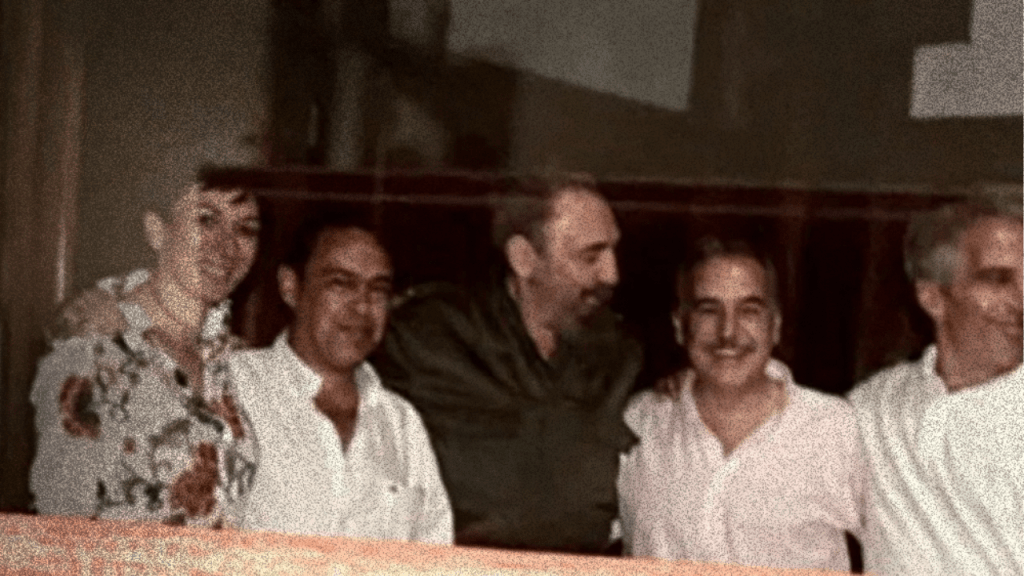
The Fidel Castro–Epstein photo documents a brief 2003 meeting, not ideological alignment, policy influence, or evidence of socialist corruption.
A photograph of Fidel Castro alongside Ghislaine Maxwell — and, in some framings, alongside Jeffrey Epstein — has circulated online with increasing frequency, routinely stripped of context and deployed as political ammunition. The framing varies: sometimes it is used to suggest that Cuban socialism was ideologically compromised, sometimes to label Castro a “social fascist,” sometimes simply to associate socialist politics with predatory elite power through proximity.
The tactic is familiar. An image is extracted from its history, placed beside an accusation, and allowed to do rhetorical work that no actual evidence could support. Insinuation substitutes for analysis. Moral shock displaces historical inquiry.
This substitution of moral shock for material analysis is not unique to this photograph. The same rhetorical mechanism — extracting an emotionally charged frame from its structural context and deploying it as a pre-emptive substitute for evidence — operates across political discourse wherever the goal is managing perception rather than producing understanding.
Let’s be clear. Denying or questioning claims about Castro’s role in this episode is not an attempt to downplay Jeffrey Epstein’s crimes, which stand independently of this discussion. Epstein’s trafficking and abuse do not become more or less real depending on who he was photographed with or what political insinuations are attached to them. The question here is not moral equivalence or reputational laundering, but evidentiary precision and material outcome.
What it is, is an attempt to apply the same standard of evidence to this photograph that should be applied to any political claim: what do the documents actually show, what do they not show, and what does the gap between evidence and assertion reveal about how power manages meaning?
What the Evidence Actually Establishes
The photograph — the most widely circulated version showing Ghislaine Maxwell posing with Castro — was found framed on the wall of Epstein’s Palm Beach mansion during a 2005 police raid. A separate photograph of Epstein and Maxwell together also appears in the raid footage. Video from that raid was later made public. The photographs were real and Epstein displayed them as trophies alongside other images of powerful figures he had encountered. The Maxwell–Castro photograph was also displayed in Epstein’s Manhattan townhouse.
The context for the images has been established through multiple sources.
In March 2003, former Colombian President Andrés Pastrana traveled to Havana for a meeting with Fidel Castro. Epstein and Ghislaine Maxwell accompanied the trip. Pastrana confirmed this in a public statement in 2019 after his name appeared on Epstein’s flight records: “A trip of mine on his plane to Nassau, Bahamas, to transfer to the final destination of Havana, Cuba, invited by President Fidel Castro, has appeared. Mr. Jeffrey Epstein left Cuba one or two days later; I remained on the island.”
Ghislaine Maxwell’s testimony, released as part of the DOJ document disclosure in August 2025, corroborated this account — confirming she traveled to Cuba with Epstein and Pastrana, whom she said she had met at an event in Dublin.
Key facts from the documented record:
Confirmed: A meeting between Epstein, Maxwell, Pastrana, and Castro took place in March 2003. Castro personally extended the invitation — Pastrana’s statement says the trip was made “at Castro’s invitation,” not solely at Pastrana’s initiative. Epstein left Cuba within one or two days. Maxwell was present. The Cuba leg of the journey does not appear in FAA flight records, likely because it was conducted in a separate Cuba-approved aircraft — and because, as attorney Robert Muse told the Miami Herald, the trip was “probably unlawful travel” under the Bush administration’s strict Cuba travel restrictions for Americans.
Confirmed absent: Cuba appears nowhere in victim testimony as a site of Epstein’s trafficking operations. No flight log, DOJ document, or court record places any of Epstein’s victims in Cuba. No evidence exists of business partnerships, joint ventures, recurring access, or policy influence between Epstein and the Cuban state.
Genuinely uncertain: The purpose of Epstein’s presence. Miami Herald journalist Fabiola Santiago and other reporters have raised the documented hypothesis — not proven, but serious — that Epstein, already under law enforcement investigation for sex crimes since 2002, may have explored Cuba as a potential refuge. The US–Cuba extradition treaty, in place since 1904, has been functionally unenforced for decades; Cuba has historically harbored American fugitives without honoring extradition requests, making it a practical sanctuary from US law enforcement regardless of the treaty’s nominal existence. This hypothesis is plausible given the timeline and Epstein’s known pattern of protecting himself through leverage and escape routes. It cannot be confirmed from available evidence, and it implicates Epstein’s motivations, not the Cuban government’s.
Where the Original Framing Overstates Its Case
The account of this visit that circulates in left-friendly spaces tends to minimize Epstein’s role: presenting him as a mere “tag-along,” a peripheral figure who attached himself to a Pastrana diplomatic meeting without real standing. This framing is more comfortable than the evidence supports.
The claim that Castro personally invited Epstein rests almost entirely on the testimony of former Colombian president Andrés Pastrana. Pastrana was not a leftist and had little political incentive to protect Castro’s reputation; if anything, he had reason to frame the encounter in the most damaging way possible.
Epstein’s own behavior reinforces his desire to signal access: he framed the photograph from the meeting and displayed it alongside other markers of elite proximity. That does not, however, establish the nature of the invitation itself, only that the meeting occurred.
Maxwell’s presence is likewise significant and often selectively emphasized. By 2003 she was already central to Epstein’s operations, and her presence on the trip is confirmed by her own testimony.
A photograph of Maxwell with Castro is the image most widely circulated.
Being precise about these facts does not validate insinuations of ideological or moral alignment. It sharpens the materialist analysis. Epstein and Maxwell sought proximity to power wherever it could be found, across ideological lines, because proximity was their currency.
That Cuba appeared briefly on that map is unremarkable. That it produced no sustained access, no business ties, no policy influence, and no durable leverage is the outcome that actually matters.
What “Social Fascism” Actually Means and Why It Doesn’t Apply
The “social fascism” accusation circulating around this photograph is not just wrong. It is analytically incoherent.
Social fascism — as a political concept with actual theoretical content — describes a specific configuration: the fusion of authoritarian state power with capitalist interests, the accommodation of private oligarchic influence within or alongside state institutions, and the suppression of genuine socialist transformation in favor of reactionary stability serving capital. It implies ideological convergence, structural alignment, and sustained collaboration between state power and elite private capital.
Demonstrating social fascism would require evidence that Epstein shaped Cuban economic policy, secured privatization arrangements, embedded financial interests within Cuban institutions, or exerted sustained influence over state decisions. None of that exists. A single meeting that produced no business relationship, no recurring access, and no documented policy effect does not constitute structural alignment by any standard of analysis.
The accusation collapses under its own evidentiary requirements.
What the photograph actually demonstrates — when read with the full context — is closer to the opposite of the accusation. Epstein sought leverage everywhere. He found it among American presidents, British royals, intelligence-adjacent financiers, academic institutions, and private jet clients across the ideological spectrum. In Cuba, he found none. He left within 48 hours. He never returned in any documented capacity. The meeting produced a photograph on his wall — not a business partner, not a policy concession, not a refuge.
The absence of outcomes is data.
The Asymmetry of Evidence Standards
What is most revealing about how this photograph is deployed is the asymmetry of the evidentiary standards applied.
Epstein’s documented, sustained relationships with US political figures — multiple flights with Bill Clinton, long-term social contact with Donald Trump, documented interactions with Prince Andrew, relationships with Harvard academics, embedded access to US intelligence-adjacent networks — receive substantially less “guilty by association” treatment than a single 48-hour visit to Cuba.
This asymmetry is not accidental. It reflects the structural function of the insinuation: not to expose Epstein’s network or understand how predatory power operates, but to attach the scandal’s moral weight to a pre-selected ideological target. Using Epstein’s image to attack Cuban socialism does not advance understanding of how elite predation works. It redirects outrage from the capitalist systems that enabled, protected, and for decades failed to prosecute Epstein, toward a convenient political adversary.
The systems that enabled Epstein were the systems he navigated successfully for decades: US financial deregulation, elite social networks where money bought silence, a legal system that gave him a non-prosecution agreement in 2008 that allowed him to continue operating, intelligence-adjacent relationships that may have provided protection. These are the structures that a serious analysis of Epstein’s power would examine.
The photograph of Castro is a distraction from that examination.
This asymmetric application of evidentiary standards to Cuba is a recurring feature of how the country is discussed in Western political discourse. Statistics and images involving Cuba are routinely stripped of every structural condition that produced them and deployed as self-evident indictments — while the US role in creating those conditions disappears from the frame entirely.
Proximity, Outcomes, and What Evidence Actually Proves
Power is demonstrated by outcomes, not appearances.
Epstein collected photographs with powerful people across the globe — the Pope, heads of state, academics, royalty, financiers. Most of these encounters were precisely what they appeared to be: brief, transactional meetings in which Epstein sought to convert proximity into social capital. Some succeeded in ways that protected him for years. Cuba did not.
The correct analysis is not “the photograph is meaningless” — it documents a real meeting with real participants. The correct analysis is: what did the meeting produce? What influence did it generate? What ongoing relationship did it establish?
The answers are: none documented, none documented, none documented.
The claim that this non-outcome reveals “social fascism” or ideological corruption requires abandoning the evidentiary standards we apply to any other political accusation. If brief diplomatic encounters were sufficient to indict a political system, no state that has ever negotiated with adversaries or received foreign visitors could withstand scrutiny.
That is not analysis. It is the application of a standard reserved for ideologically convenient targets.
What This Kind of Image Deployment Tells Us
The weaponization of contextless images to produce political insinuation is not specific to this photograph. It is a systematic feature of how attention-economy discourse functions.
The mechanism is consistent: extract an image from its history, place it alongside an emotionally charged association, and allow moral shock to do the work that evidence cannot. Context is treated as apology. Complexity is dismissed as defensiveness. The demand for evidentiary standards is framed as sympathy for the accused.
This mechanism operates across contexts and at every scale. Language and image selection consistently serve to foreclose the analytical questions that would complicate the preferred narrative — replacing evidentiary standards with emotional momentum.
The dismissal of evidentiary standards as mere defensiveness has institutional precedents far more serious than social media insinuation. The US state’s own classified documents reveal an institutional assumption that public outrage can be engineered through fabricated context — and that the demand for evidence will be overridden by emotional momentum before anyone stops to check.
In this case, the outrage is borrowed from Epstein’s genuine crimes and redirected toward a political target. The effect — whether intended or not — is to make it harder to examine the actual systems that produced and protected Epstein for decades, by focusing moral attention on a meeting that produced no lasting effect.
Restoring context is not the same as excusing. It is the precondition for understanding.
The photograph shows a meeting that happened. The evidence shows that meeting produced nothing. The insinuation claims that nothing is actually something. That is the gap where the analysis should be applied.
Sources
- Fox News — “Photos seen in Jeffrey Epstein mansion raid apparently showed Fidel Castro, Pope John Paul II” (2005 Palm Beach raid video, Maxwell–Castro photograph confirmed): https://www.foxnews.com/us/jeffrey-epstein-fidel-castro-pope-john-paul-ii-florida-mansion
- The Daily Beast — “Police Video Shows Jeffrey Epstein’s Palm Beach Lair’s Nude Photos and Mysterious Clues” (Maxwell–Castro photo also in Manhattan townhouse, Maxwell DOJ testimony August 2025): https://www.thedailybeast.com/police-video-reveals-jeffrey-epsteins-palm-beach-lairs-nude-photos-and-mysterious-clues/
- CBS12 / Miami Herald wire — “Fidel Castro invited Jeffrey Epstein to Cuba, former Colombian president says” (Pastrana full statement, March 2003 date): https://cbs12.com/news/local/fidel-castro-invited-jeffrey-epstein-to-cuba-former-colombian-president-says/
- Colombia Reports — “US confirms ties between Colombia’s ex-president and Jeffrey Epstein” (Maxwell DOJ testimony August 2025, confirmed travel to Cuba with Epstein and Pastrana, met Pastrana “in a pub in Dublin”): https://colombiareports.com/us-confirms-ties-between-colombias-ex-president-and-jeffrey-epstein/
- Miami Herald / inkl — “Epstein traveled to Cuba at Castro’s invitation, ex-Colombian president says” (Cuba leg absent from FAA records, attorney Robert Muse “probably unlawful travel” quote, Fabiola Santiago refuge hypothesis): https://www.inkl.com/news/epstein-traveled-to-cuba-at-castro-s-invitation-ex-colombian-president-says
- Epstein Web Tracker — “Fidel Castro” research page (Fabiola Santiago hypothesis, no proven long-term relationship, Epstein’s sustained US political relationships documented): https://epsteinweb.org/fidel-castro/
- Wikipedia — “American fugitives in Cuba” (US–Cuba extradition treaty since 1904, functionally unenforced, Cuba’s pattern of harboring US fugitives): https://en.wikipedia.org/wiki/American_fugitives_in_Cuba
- AOL — “Jeffrey Epstein showed off photos with Fidel Castro and Pope John Paul II” (photographs displayed as trophies, Palm Beach mansion): https://www.aol.com/jeffrey-epstein-showed-off-photos-023314983.html
- Resumen Latinoamericano — “Cuba: La foto que no prueba nada — Fidel Castro y la visita de Jeffrey Epstein a la isla acompañando a Pastrana” (single meeting produced no policy effect, evidentiary asymmetry analysis): https://www.resumenlatinoamericano.org/2026/02/21/cuba-la-foto-que-no-prueba-nada-fidel-castro-y-la-visita-de-jeffrey-epstein-a-la-isla-acompanando-a-pastrana
- Wikipedia — “Epstein files” (2008 non-prosecution agreement, scope of DOJ document releases): https://en.wikipedia.org/wiki/Epstein_files
- Latin America News — “A photo and a trip: what is known about the meeting of Jeffrey Epstein and Fidel Castro” (flight route NJ→Palm Beach→Nassau March 20–21 2003, Cuba leg in separate Cuba-approved aircraft): https://latin-american.news/a-photo-and-a-trip-what-is-known-about-the-meeting-of-jeffrey-epstein-and-fidel-castro/
- Cuba Center / Miami Herald — “CubaBrief: Epstein, Castro are a match made in hell” (Fabiola Santiago full column, extradition/refuge analysis, law enforcement investigation launched 2002): https://cubacenter.org/cuba-brief-archives/2019/08/20/cubabrief-epstein-castro-are-a-match-made-in-hell/



 Spark Solidarity