
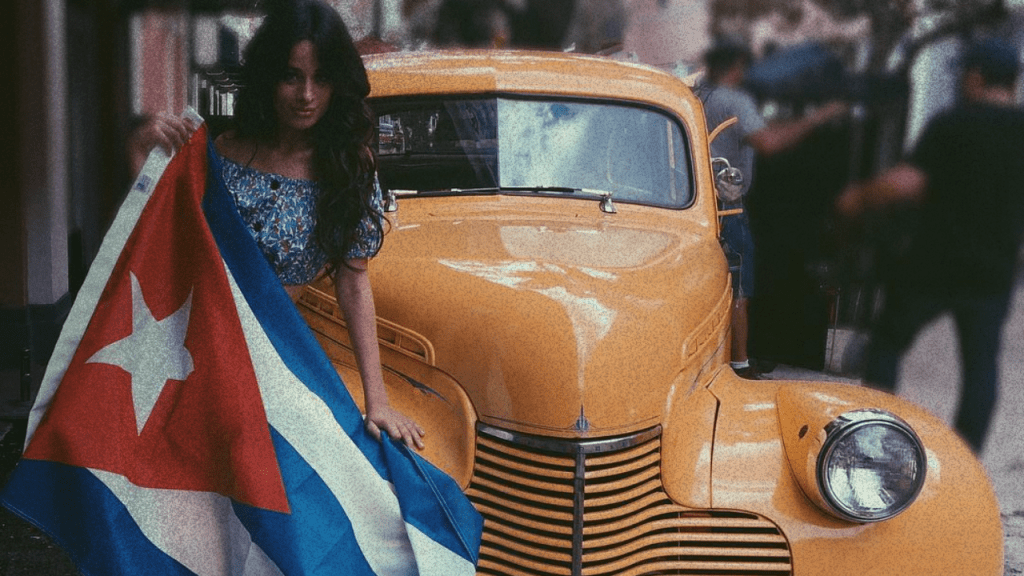
Camila Cabello’s Cuba post described real suffering while erasing the U.S. embargo and oil blockade that intensified the crisis it condemned.
On February 20, 2026, Camila Cabello posted to her 63 million Instagram followers about Cuba. The post was personal and emotional. She described relatives surviving on remittance boxes of medicine, people searching for food in trash heaps, young protesters imprisoned or disappeared, and a country she called “67 years of a failing dictatorship and an oppressive regime.” She directed followers to donate to Caritas Cuba, a Catholic humanitarian organization.
Two days later, U.S. Under Secretary for External Assistance Jeremy Lewin publicly thanked her: “Thank you Camila Cabello for highlighting the humanitarian work of Cáritas, which has collaborated with us over the past few weeks to provide the largest direct humanitarian response from the United States to Cuba in decades.”
Read that sentence carefully. The same U.S. government whose January 2026 seizure of Venezuelan oil tankers had cut off roughly 50 percent of Cuba’s oil supply, triggering the island’s deepest energy crisis since the Special Period — that government was thanking a pop star for amplifying its humanitarian branding. The entity producing the emergency was positioning itself as the relief organization.
This is what political laundering looks like in practice. You do not need bad faith to serve as a delivery mechanism. You need only sincerity, visibility, and a frame that omits the most important facts.
The substitution of emotional framing for structural analysis is a recurring feature of how political discourse manages inconvenient complexity. As documented in an analysis of the politics of perception management on anti-Semitism, moral shock consistently functions to replace material analysis with symbolic theater — producing the appearance of engagement while foreclosing the questions that would complicate the preferred narrative.
What the “Regime” Frame Conceals
The word “regime” does an enormous amount of work in political discourse while appearing to do very little. It collapses decades of history, international pressure, and material constraint into a single internal villain. Once the villain is named, the story writes itself. Scarcity becomes incompetence. Shortages become proof of ideological failure. Suffering becomes self-inflicted.
This framing has been applied to Iraq, Iran, Libya, Venezuela, and North Korea — every state that has resisted integration into U.S.-led economic and political order. What makes Cuba distinctive is the duration. There has been no reset, no normalization, no post-war recovery. The longest sanctions regime in modern history began in 1962 and has never ended. It has been modified, tightened, codified into law, and internationalized — but never lifted.
Cabello’s post contained no mention of the embargo. It described conditions that are unambiguously real — food shortages, blackouts extending beyond ten hours daily in Havana and twenty hours in other provinces, hospital supply failures, fuel collapse — while attributing them entirely to internal governance. The material forces shaping those conditions disappeared.
That disappearance is not neutral. It is the precondition for the U.S. government’s thank-you note.
This disappearing act has a long history in how Cuba is discussed in Western political discourse. As documented in an analysis of Cuba’s incarceration rate and the siege state, statistics and conditions involving Cuba are routinely stripped of the structural forces that produced them — the embargo, the regime-change infrastructure, the sanctions architecture — and presented as self-evident proof of ideological failure.
The Mallory Doctrine: Intent in Their Own Words
The U.S. embargo against Cuba is not a symbolic protest. It is an economic war whose intent was spelled out in plain language by U.S. officials before it was even formally declared.
On April 6, 1960, Deputy Assistant Secretary of State for Inter-American Affairs Lester D. Mallory wrote an internal memorandum — since declassified and published by the National Security Archive and the U.S. State Department’s own historical archive — explaining the rationale for economic pressure against Cuba. Mallory observed that Fidel Castro enjoyed the majority support of the Cuban population. Since there was no viable internal opposition, the only mechanism of destabilization was economic. His proposed solution: a course of action that would make “the greatest inroads in denying money and supplies to Cuba, to decrease monetary and real wages, to bring about hunger, desperation, and the overthrow of the government.”
This document is not a fringe source or a foreign government’s allegation. It is a U.S. State Department memorandum, written by a senior official, stating explicitly that the goal of economic policy toward Cuba was to produce hunger and desperation in the civilian population until the government fell.
President Kennedy formalized the full trade embargo on February 3, 1962. The embargo has been strengthened multiple times since — most significantly by the Helms-Burton Act of 1996, which codified the embargo into statute (removing presidential authority to lift it unilaterally), threatened third-country companies doing business with Cuba with lawsuits in U.S. courts, and barred executives of foreign firms from entering the United States. The Council of Europe, the European Union, Britain, Canada, and Mexico all condemned the Act as an illegal exercise of extraterritorial jurisdiction. It remains in force. In January 2025, the Trump administration intensified sanctions further under a “total pressure” strategy, re-designating Cuba as a state sponsor of terrorism and imposing additional financial restrictions.
The effect is structural. Cuba pays more for imports, waits longer for deliveries, relies on inefficient trade routes, and is routinely denied access to technologies with any U.S. component. Banks face penalties for processing Cuban transactions. Medical suppliers hesitate over equipment with minor U.S. parts. Credit markets are closed. Software developer Eduardo Perez described losing months of thesis work when the code repository GitLab suddenly restricted Cuban access. PayPal: access denied. Amazon: unable to process. Apple App Store: unavailable.
When critics acknowledge that sanctions devastated Iraq’s healthcare system or worsened conditions in Venezuela, the causal logic is accepted without controversy. Sanctions kill. When the subject is Cuba, that logic is set aside. The embargo becomes a footnote, and responsibility is assigned to “socialism” as an abstract moral failure. That inconsistency is not accidental. It is ideological.
The Crisis Cabello Described — and the One She Didn’t
The conditions Cabello described are real and current. Cuba is in the grip of its most severe energy crisis in decades. Since 2024, Cuba’s national electrical grid has collapsed multiple times, leaving ten million people without power for fifteen to sixteen hours, in some regions for weeks. The blackouts are caused by decades of underinvestment in aging thermal infrastructure — underinvestment that is itself partly a function of the embargo’s restriction of capital access and equipment procurement.
But the crisis sharpened dramatically at the end of 2025, for reasons that are directly relevant to this conversation. Cuba depends on imported oil. Venezuela had been supplying approximately 27,000 to 32,000 barrels per day — roughly half of Cuba’s oil deficit. On December 12, 2025, the U.S. Treasury seized the Venezuelan oil tanker Skipper and sanctioned additional carriers supplying Cuba. Then, on January 3, 2026, U.S. forces seized Venezuelan President Nicolás Maduro. Venezuelan oil shipments to Cuba effectively ceased.
As of February 2026, according to The New York Times, the United States was enforcing what it called its “first effective blockade of Cuba since the Cuban Missile Crisis.” Executive Order 14380, signed January 29, 2026, imposed additional tariffs on any country supplying oil to Cuba. Mexico — which had stepped in as Cuba’s primary supplier — suspended shipments. Canada’s Air Canada suspended Cuba flights citing fuel shortages. Eastern provinces of Cuba suffered total blackouts. On February 17, 2026, only 44 of Havana’s 106 garbage trucks had fuel to operate, as refuse piled on street corners.
Camila Cabello’s post appeared on February 20, 2026, during the acute phase of this oil blockade. Prism Reports described it directly: “This is about cutting off what makes the island’s electricity grid work or barely work as is. This is an attempt to paralyze the rhythms of everyday life.”
The suffering described in her post — the food spoiling, the water shortages, the medical collapse — was being actively intensified, in real time, by the U.S. government whose official then thanked her. That is the context she did not provide. That is what the “regime” frame erased.
The oil blockade enforced against Cuba is not an isolated policy. It is an extension of the same hemispheric strategy documented in an analysis of the quiet mechanics of U.S. intervention in Venezuela — where the seizure of Maduro and the disruption of Venezuelan oil exports to Cuba were part of a coordinated escalation across the Caribbean, designed to produce the conditions its architects could then present as humanitarian emergencies requiring outside assistance.
What Cuba Built Under Siege, and Why That Is Hard to Explain Away
If the story ended with scarcity, critics might stop there. But Cuba’s social outcomes contradict the simple failure narrative in ways that rarely receive honest examination.
According to the Pan American Health Organization, Cuba’s life expectancy at birth in 2024 was 78.3 years — higher than the regional average for the Americas and, notably, higher than the United States, where life expectancy sits around 77.5 years. RAND Corporation concluded that Cuba achieves comparable outcomes to the U.S. on life expectancy and infant mortality at less than one-tenth of U.S. healthcare costs. The U.S. is the wealthiest nation in human history, spending more on healthcare than any other country. Cuba is a sanctioned island blocked from global credit markets. That the outcomes converge — or that Cuba surpasses the U.S. — demands explanation that goes beyond ideology.
On literacy, Cuba’s rate is 99.9 percent. The AMA’s Journal of Ethics noted that Cuba ranks 13th in the world in literacy — the United States ranks 125th, with a rate of approximately 86 percent. Education functions as a public good independent of zip code, parental income, or local tax base. That is a political choice made under conditions of severe material constraint.
These outcomes do not make Cuba utopian. They make the state’s priorities legible. The Cuban government made specific allocations of scarce resources toward human development — toward primary care, prevention, and universal access — under conditions explicitly designed by the Mallory Doctrine to produce scarcity. The outcomes reflect those priorities. If “socialism had failed” in the simplistic sense critics imply, they would not exist.
The Class Composition of Exile Testimony
Critics invariably respond to this analysis with exile testimony. Stories of repression, imprisonment, hunger, and desperation are real and should not be mocked. But they cannot substitute for structural analysis.
The earliest waves of Cuban exiles were disproportionately drawn from the landowning and professional classes displaced by the 1959 revolution. Their material interests were transformed by expropriation. Later waves reflected economic hardship exacerbated by sanctions. These experiences are valid; they are also embedded in a Cold War political economy in which U.S. media, political institutions, and exile organizations systematically amplified particular accounts while suppressing others.
Personal testimony describes effects. It does not establish causality. An individual’s experience of scarcity does not answer the question of why scarcity exists or identify the forces producing it. Moral arguments built entirely on anecdote — however sincere — are easily weaponized. They can be deployed to justify policies that worsen the very suffering they describe. That has happened repeatedly: in Iraq, in Libya, in Venezuela.
Why the Blockade Never Ends: The Structural Logic
If Cuban socialism had simply failed, it would not require sixty-seven years of economic warfare to confirm it. Systems that are structurally unworkable collapse. They do not require generational sanctions, financial blacklisting, shipping restrictions, third-country penalties, and active oil tanker seizures enforced across seven decades.
A 1982 CIA internal assessment of the embargo concluded that after twenty years, sanctions “have not met any of their objectives.” The Cuban economy did not collapse in the 1960s, 1970s, or 1980s. It did not collapse after the fall of the Soviet Union — when Cuba lost approximately $65 billion in credits and subsidies and its GDP contracted dramatically. It survived the Special Period. It survived four decades of Helms-Burton. Cuba’s president, Miguel Díaz-Canel, said after Maduro’s capture: “Cuba does not attack; it has been attacked by the U.S. for 66 years, and it does not threaten; it prepares, ready to defend the homeland to the last drop of blood.”
That survival is what demanded escalation. Not Cuba’s failure — its endurance. The Trump administration has stated explicitly that its goal is regime change on the island by end of 2026, with Secretary Rubio and others calling on Cuba to “make a deal before it’s too late.”
The embargo persists not because it proved failure, but because failure did not occur naturally and must be induced. That inversion — containment as admission of endurance — is almost never acknowledged in coverage of Cuba. The “regime” frame makes it invisible.
Celebrity Moralizing as Political Infrastructure
This brings us back to the post.
When Cabello condemned Cuba without mentioning the embargo, the effect was not neutral commentary. It reproduced the foundational narrative of U.S. foreign policy — that Cuba’s suffering is self-generated, that the United States is a distant observer, that the correct response is humanitarian charity rather than political accountability — while wearing the credibility of personal grief and diasporic authenticity.
The U.S. government’s immediate public endorsement of her message is the clearest possible signal of whose interests the frame served. The entity enforcing the oil blockade thanked the celebrity for describing the oil blockade’s effects while locating their cause in the Cuban state alone. The logic is circular and complete. The system cannot appear in its own alibi.
None of this requires Cabello to be a propagandist. Propaganda does not require intent. It requires reach, sincerity, and omission. Her 63 million Instagram followers received a frame that aligns cleanly with Washington’s position — not because she was directed by anyone, but because that frame is the water of mainstream U.S. culture. It is the default. Challenging it requires active effort. Her post required none.
That is how political laundering works at the level of culture. Power does not announce itself. It inhabits the emotions of people who are genuinely suffering and who genuinely care about those who are suffering further away. The politics arrive pre-loaded in the frame.
What Honest Engagement With Cuba Looks Like
It is entirely possible to criticize the Cuban government. Political repression is real. Limits on dissent are real. Bureaucratic dysfunction is real. The imprisonment of protesters, some as young as thirteen, is documented and wrong.
What is not possible is to do any of that honestly while treating the Mallory Doctrine as a footnote, the oil blockade as coincidental background, and the embargo as secondary context.
An honest analysis begins with the material reality: sixty-seven years of explicitly intended economic warfare, codified into statute, enforced against third countries, and currently escalated to an active oil blockade — all of which a former U.S. Secretary of State characterized as “insane.” It evaluates Cuban governance within that constraint rather than against idealized abstractions. It asks why life expectancy and literacy outcomes in Cuba exceed those of the United States, and what that means for narratives of simple systemic failure. It asks why the government that produced the Mallory Memo is the same one now thanking celebrities for its humanitarian branding.
Anything less is narrative alignment with imperial policy, sincerely felt or not.
Camila Cabello did not create this frame. She was born into it, shaped by it, and — in this moment — amplified it across sixty-three million accounts. The backlash she received was not an attempt to silence Cuban suffering. It was, at its most coherent, an insistence that Cuba exists in the real world, shaped by real power, and cannot be understood as a morality tale in which the United States plays no role.
The Mallory Memo said the quiet part out loud in 1960. The oil blockade is saying it again in 2026. The celebrity post, the government thank-you note, and the absent context are how the sentence gets finished for mass consumption.
Sources
- Cabello Instagram post, February 20, 2026 — Billboard
- Full post text — Latin Times
- U.S. Under Secretary Lewin thanks Cabello — CiberCuba
- Lester D. Mallory memorandum, April 6, 1960 — National Security Archive, George Washington University
- Mallory memo primary source — U.S. State Department Office of the Historian
- Cuba Embargoed: 60th Anniversary — National Security Archive (includes CIA 1982 assessment)
- Sixty Years of the Embargo — Responsible Statecraft
- Helms-Burton Act — Wikipedia
- U.S. embargo against Cuba — Wikipedia
- Sixty years, daily lives — NBC News
- Cuba health equity — AMA Journal of Ethics
- Cuba life expectancy 2024 — Pan American Health Organization
- Doing more with less — RAND Corporation
- Cuba electricity crisis — IEEE Spectrum
- 2024-2025 Cuba blackouts — Wikipedia
- 2026 Cuban crisis (oil blockade) — Wikipedia
- Venezuelan oil seizure, tanker Skipper — Evrimagaci/Reuters
- Cuba oil crisis post-Maduro capture — NBC News
- Cuba energy crisis worsens — OilPrice.com
- Cuba blockade, everyday life — Prism Reports, February 19, 2026
- Cabello backlash — Geo.tv
- Havana Times on Cabello post
 Spark Solidarity