
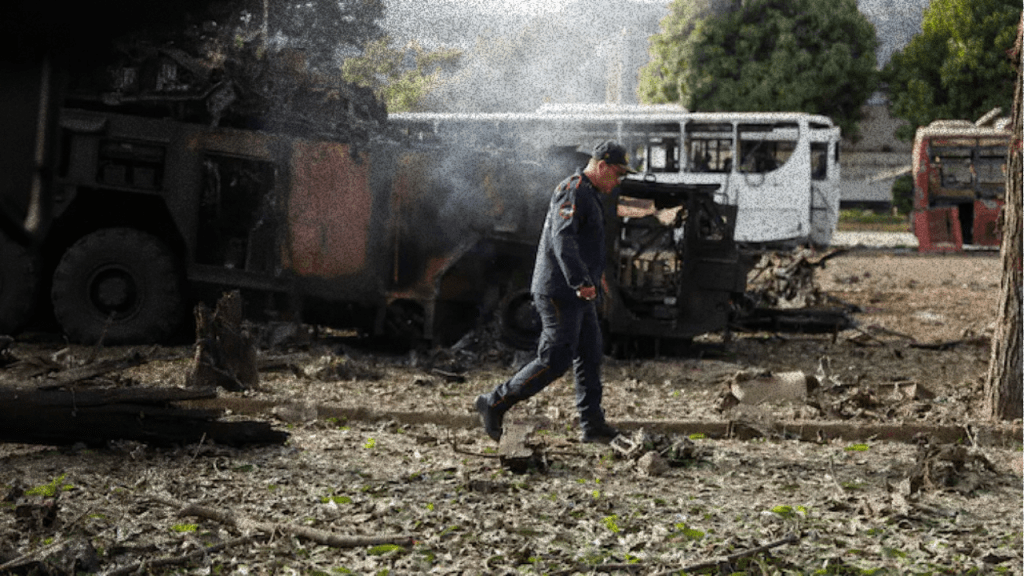
The U.S. seized Venezuela’s president and framed regime change as law enforcement while media avoided the word invasion and oil markets surged.
In the pre-dawn hours of January 3, 2026, something happened that the English language could not quite hold.
U.S. special operations forces bombed military targets across northern Venezuela. Helicopters descended on the presidential compound in Caracas at 2:01 a.m. Nicolás Maduro and his wife Cilia Flores were seized and flown out — to USS Iwo Jima, then to Guantánamo Bay, then to New York City, where they appeared in Manhattan federal court two days later in handcuffs.
Trump posted a photograph to Truth Social of the blindfolded Venezuelan president aboard a U.S. Navy ship in a grey tracksuit.
Standing at Mar-a-Lago, Trump praised what he called “one of the most stunning, effective and powerful displays of American military might and competence in American history.” He told reporters the United States would “run” Venezuela until a proper transition could be arranged.
What this was, exactly, depended entirely on who was speaking.
The Trump administration called it a “massive joint military and law enforcement raid.” Pete Hegseth’s framing was procedural: a narcotics enforcement action, not a war. Mainstream broadcasters reached for “dramatic escalation,” a phrase that communicated gravity without committing to a legal category. No major anchor said, plainly, that the United States had invaded a sovereign country, seized its sitting president, and announced it would govern the country until further notice.
The word that would have been most accurate — invasion — was the word no one used.
This refusal was not semantic confusion. It was precision. Because the moment you choose a word, you choose a set of legal consequences. Call it an invasion, and the UN Charter applies. Call it a kidnapping, and criminal liability attaches to the perpetrators. Call it an “operation,” and accountability dissolves into process.
The UN Secretary-General António Guterres stated that he was “deeply concerned that the rules of international law have not been respected” and that what occurred “constitutes a dangerous precedent.” UN human rights experts at OHCHR called it “a grave, manifest and deliberate violation” of Article 2(4) of the UN Charter — the prohibition on the use of force against the territorial integrity of any state — and noted it may constitute “the international crime of aggression.”
Chatham House’s international law program concluded there was no valid legal framework: no UNSC mandate, no act of self-defense, no basis in international law for the transfer of a sitting head of state to foreign custody. Stanford, Berkeley, and Yale law professors reached identical conclusions.
The language instability was not a failure of journalism. It was a success of power.
The Pretext and Its Refutation
The administration’s justification was narco-terrorism. Maduro and his wife were under a 2020 indictment for cocaine trafficking conspiracy. Trump had spent months framing Venezuela as a narco-state sending drugs and gang members — specifically Tren de Aragua — to “terrorize American communities.”
What the administration did not mention is that its own intelligence said the opposite.
FactCheck.org reported, citing John Bellinger — the former legal adviser to the Department of State and NSC under George W. Bush — that the Trump administration’s National Intelligence Council had concluded in an April 2025 assessment that the Maduro regime “probably does not have a policy of cooperating with Tren de Aragua and is not directing TDA movement to and operations in the United States.”
The administration’s own intelligence community had debunked the central justification for the operation — months before the operation occurred.
Al Jazeera confirmed this: “Trump’s own intelligence agencies have said there is no evidence that Maduro is linked to Tren de Aragua, and US data show that Venezuela is not a major source of contraband narcotics entering the US.”
The narcotics pretext was not a legal justification. It was a rhetorical frame — one that, as Berkeley Law Professor Saira Mohamed put it, “calling these killings self-defense in a non-international armed conflict doesn’t make it so. There is no self-defense; there was no armed conflict with these individuals; there was just a series of killings.”
More than 100 people had already been killed in preceding U.S. strikes on “drug boats” in the Caribbean before the January 3 operation — boats the administration claimed carried narcotics, without evidence presented to any court.
The gap between stated justification and operational function was visible in the architecture of the intervention itself. As documented in an earlier analysis of the quiet mechanics of modern intervention in Venezuela, the legal and rhetorical framing of U.S. operations in Latin America consistently serves to absorb what is actually a sovereignty violation into a procedural register that forecloses accountability before it can form.
The Real Reason: Three Hundred Billion Barrels
Within hours of announcing Maduro’s capture, Trump stated at Mar-a-Lago: “We’re going to have our very large United States oil companies — the biggest anywhere in the world — go in, spend billions of dollars, fix the badly broken infrastructure, and start making money for the country.”
Venezuela is home to the largest proven oil reserves on Earth: 303 billion barrels, approximately 17% of global total, according to CNBC. The country was producing only around 800,000 barrels per day at the time of the operation — a fraction of its potential — after decades of sanctions and underinvestment.
The political economy of this “operation” is not hidden. It is stated in the press conference.
ExxonMobil and ConocoPhillips had their Venezuelan assets nationalized under Hugo Chávez in 2007. International arbitration courts subsequently ordered Venezuela to pay ConocoPhillips more than $10 billion and ExxonMobil more than $1 billion — awards Venezuela has never paid. CNBC reported that shares of ExxonMobil, ConocoPhillips, and Chevron rose after the operation as investors anticipated the three companies “will cash in.” PDVSA bonds surged 30%.
Energy Secretary Chris Wright was designated the administration’s point person for rebuilding Venezuela’s oil infrastructure. He met with ExxonMobil and ConocoPhillips executives days after the operation. Trump told NBC News the oil companies would “get reimbursed by us or through revenue.”
The narco-terrorism framing served a function: it provided a law-enforcement register that avoided activating the vocabulary of invasion and resource seizure. But the political economy was explicit from the first press conference. Venezuela had oil. The U.S. now controlled Venezuela. American companies would extract the oil.
This is the Monroe Doctrine expressed in oil company contracts.
The market confirmed what the press conference stated. As documented in a prior analysis of how the Venezuela intervention proves oil scarcity is political, energy markets priced the operation not as a law enforcement action but as a resource acquisition — ExxonMobil and ConocoPhillips stock rising in real time as investors anticipated the restoration of nationalized assets.
How the Media Managed Meaning in Real Time
What is most analytically valuable about the coverage of Operation Absolute Resolve is not that it lied. It is that it managed meaning — systematically, at the level of tone and language choice — while events were still unfolding.
NBC’s coverage employed what can be called “distance theater.” Official White House framing — “drug boats,” “narco-terrorists,” “law enforcement action” — was relayed in full, but always with a buffer: “officials say,” “the administration argues.” The journalist appeared neutral. The state’s narrative structured the entire account. The critical word — invasion — was never deployed.
The uncertainty introduced by phrases like “unconfirmed strikes” and “sources say” did not function as skepticism directed upward toward power. It functioned as cushioning. It kept agency just out of frame — present enough to feel, never fixed enough to assign. By the time formal confirmation arrived, narrative momentum had already established the event as a development, not a rupture.
The humanitarian frame performed a complementary function. Blackouts in Caracas. Migration flows. Infrastructure collapse. All real, all presented as pre-existing conditions of Venezuelan dysfunction rather than direct effects of military strikes and decades of U.S. sanctions. Suffering was rendered as scenery — the unchanging backdrop against which “developments” unfold.
This is depoliticization at the level of atmosphere. When violence enters a landscape already coded as broken, it reads as disturbance in bad weather rather than a decision made by identifiable actors with identifiable interests.
Liberal dissent was permitted — but only downstream. Analysts were invited to warn about “what happens next”: the Libya comparison, the succession struggle, the absence of a transition plan. These are real concerns. But they were raised only after force was treated as a settled fact. The debate shifted from whether the act was lawful to whether it was well-executed. Coercion became a premise. The corridor of acceptable critique closed the moment the analyst sat down.
The Legal Consensus the Coverage Ignored
While anchors reached for “escalation” and experts debated transition planning, international law moved more quickly to a conclusion.
At the UN Security Council emergency meeting convened within days of the operation, the 125-member Non-Aligned Movement identified it as a violation of the UN Charter. Russia — given, as Chatham House noted, “the unedifying opportunity to present itself as a defender of the international prohibition on the use of force” despite its own illegal invasion of Ukraine — condemned it as an “act of armed aggression.” China called it “hegemonic behavior” that “seriously violates international law.” Colombia, Brazil, Mexico, Chile, Spain, and Uruguay issued a joint statement expressing “profound concern and firm rejection.”
The OHCHR expert panel stated that the operation “may constitute the international crime of aggression attributable to the individual political and military leaders involved.”
Inside the United States, Democratic Senator Andy Kim stated publicly: “Secretaries Rubio and Hegseth looked every Senator in the eye a few weeks ago and said this wasn’t about regime change. I didn’t trust them then and we see now that they blatantly lied to Congress.”
None of this legal clarity received the airtime that “dramatic escalation” and “developing situation” did. International fracture — competing condemnations without unified enforcement — produced the narrative fog that allowed the act to harden into baseline reality before any reckoning could form.
This is the paradox of multipolarity as a cover for unilateral action. More voices, more frames, more condemnations — but no mechanism that stops the actor already in motion. Fracture doesn’t restrain empire. It buffers it.
This is the central contradiction of the multipolar moment. As argued in an analysis of the trap of waiting for multipolarity to act, more voices and more condemnations without enforcement mechanisms do not constrain U.S. unilateral action — they provide the noise cover under which it consolidates.
The Historical Lineage They Mentioned Once
The operation was compared, briefly, to the U.S. invasion of Panama in 1989 and the capture of Manuel Noriega — once a CIA asset, turned inconvenient, extracted and imprisoned in Miami. The analogy was largely left undeveloped in coverage.
It should not have been.
The Noriega precedent established a template: a regional leader is reframed as a criminal, indicted under U.S. domestic law, removed by military force, and prosecuted in U.S. courts — with sovereignty treated as inapplicable because the target has been designated illegitimate. What was exceptional in 1989 has now been repeated in 2026, at greater scale, with greater explicit acknowledgment of oil as a motivation.
After Maduro’s capture, Trump stated flatly that Cuba and Nicaragua would “also not survive” his administration. Rubio echoed this. The Monroe Doctrine, declared by James Monroe in 1823 and operationalized through U.S. military and covert interventions across Latin America for two centuries, was being declared openly as current policy — not as historical analysis but as forward-looking intent.
The coverage treated this as political messaging. It is a military doctrine.
Acclimation as the Goal
The piece under analysis ends with an important observation: the most dangerous outcome is not misinformation. It is acclimation.
Power no longer needs a population that believes the narrative. It needs one that adjusts to it. Familiarity is more durable than conviction. Once force becomes routine — once the seizure of a head of state and the announcement that the U.S. will “run” a country is absorbed as a “developing situation” and scrolled past — resistance becomes harder to organize because the outrage never fully crystallizes.
This is the function of what the piece correctly calls “mature propaganda.” The calm expert — the former diplomat speaking from Oxfordshire, citing doctrinal terms, pre-assigning guilt to the target — does not triumph through argument. She works through the production of normalcy. Decapitation strike. Command and control. Disable the apparatus. These are not metaphors. They are cognitive technologies for removing moral weight from state violence.
The reversal of causality is the tell: if violence escalates, blame attaches to those being coerced for having resisted. The actor with overwhelming military and economic power is absolved in advance. Resistance is the crime.
What the piece does not fully name — and what needs to be named — is that this is not a failure of journalism. It is journalism performing its structural function within a capitalist media system where access to official sources, advertising revenue, and institutional reputation all align against naming what is actually happening.
When the only major oil company operating in Venezuela before the strike is Chevron — and Chevron’s stock rises afterward — and the Energy Secretary is meeting with ExxonMobil executives the week after the operation — and Trump states publicly that U.S. companies will “start making money for the country” — the political economy of the coverage itself needs to be placed in the same frame as the political economy of the intervention.
The anchors who reached for “escalation” were not individually cowardly. They were structurally constrained — by the same logic that makes oil company contracts a more durable motivation for military operations than narco-terrorism indictments.
Acclimation is the product of that structure. And it is the most powerful thing that media management produces: not belief, not agreement, but the disappearance of the threshold between the extraordinary and the expected.
Sources
- Al Jazeera — How the US Attack on Venezuela, Abduction of Maduro Unfolded
- Al Jazeera — Trump Bombs Venezuela, US Captures Maduro: All We Know
- Al Jazeera — Fact-Checking Trump on Promised US Oil Company Investment in Venezuela
- UN News — US Actions in Venezuela “Constitute a Dangerous Precedent”: Guterres
- OHCHR — UN Experts Condemn US Aggression Against Venezuela
- Chatham House — The US Capture of President Nicolás Maduro and Attacks on Venezuela Have No Justification in International Law
- Just Security — International Law and the U.S. Military and Law Enforcement Operations in Venezuela
- Berkeley Law — Professor Saira Mohamed: International Law, Nicolás Maduro, Venezuela, United Nations
- FactCheck.org — Exploring the Legality Questions About Venezuela Military Strike
- CNBC — Trump Says U.S. Oil Companies Will Invest Billions in Venezuela After Maduro’s Overthrow
- CNBC — Maduro Overthrow Could Help These U.S. Oil Companies Recover Assets Seized by Venezuela
- NBC News — Trump Says the U.S. May Reimburse Oil Companies for Rebuilding Venezuela’s Infrastructure
- NPR — Trump Wants U.S. Oil Companies in Venezuela. Here’s What to Know
- TIME — How the World Is Reacting to the U.S. Capture of Nicolas Maduro
- TIME — How the U.S. Captured Venezuelan Leader Nicolas Maduro
- Wikipedia — 2026 United States Intervention in Venezuela
- Wikipedia — International Reactions to the 2026 United States Intervention in Venezuela

 Spark Solidarity