
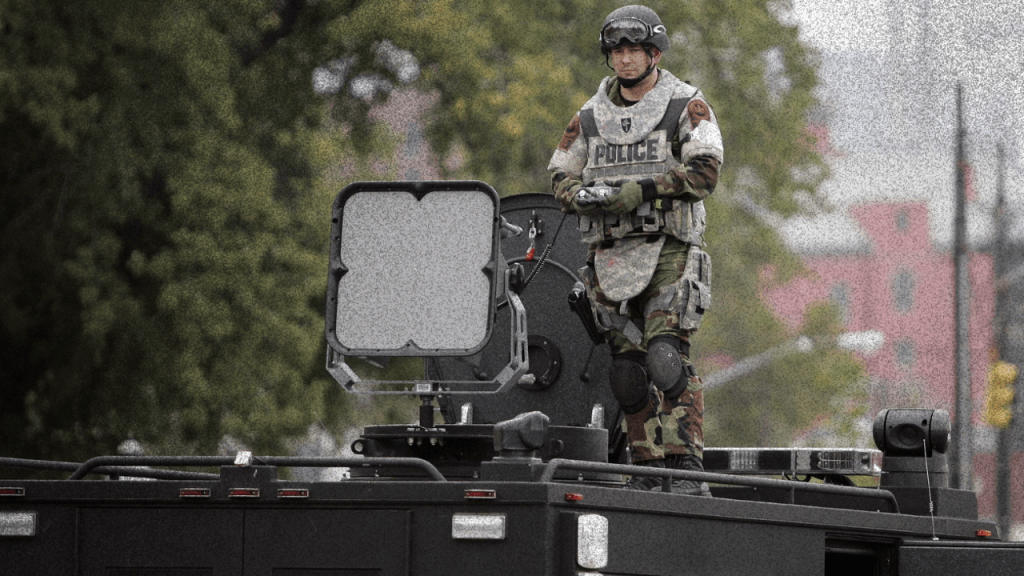
Deniable weapons use sound, microwaves, and electronic warfare to suppress resistance without bloodshed, reshaping protest control and regime change.
When a government sends soldiers into a crowd or a helicopter gunship over a capital city, the images that follow become political liabilities. The fire hoses of Birmingham, the napalm over Trang Bang, the Caracazo — moments of spectacular state violence have historically accelerated the movements they were meant to crush. The solution, developed over decades of American military investment and now diffusing into the arsenals of client and competitor states alike, is to make the force invisible or at least deniable. Pain without blood. Paralysis without corpses. Resistance that collapses before anyone can agree on what happened.
The toolkit for this is not classified. It is documented in Pentagon procurement records, contractor brochures, congressional testimony, and — in one remarkable case — a presidential boast to the New York Post. What follows is an account of four proven weapon classes, the doctrine that ties them together, and three case studies — Pittsburgh 2009, Belgrade 2025, and Caracas 2026 — that trace the same logic migrating from protest suppression to regime-change operations.
The Arsenal
The Long Range Acoustic Device focuses high-decibel sound into a narrow cone. In hailing mode it broadcasts voice commands. In weapon mode it delivers pain, disorientation, and a reflexive flight response. The device was originally developed following the USS Cole attack in 2000 and first used on US civilians on September 24, 2009, when Pittsburgh police deployed it against protesters at the G-20 summit. Karen Piper, then a visiting Carnegie Mellon professor, was a bystander who suffered permanent hearing loss and nerve damage. The ACLU of Pennsylvania sued on her behalf; Pittsburgh settled in 2012 for $72,000 to Piper and more than $200,000 total. Since Pittsburgh, LRADs have appeared at Ferguson, Standing Rock, Hong Kong, and, as detailed below, Belgrade.
The Active Denial System fires a 95 GHz millimeter-wave beam that heats water molecules in the top half-millimeter of skin to approximately 55 degrees Celsius in under two seconds. The pain is immediate and involuntary — the body moves before the brain decides. Public demonstrations began in January 2007 at Moody Air Force Base. The Marine Corps briefly deployed a prototype to Helmand Province in 2010 before withdrawing it for logistical reasons. The technology is mature. A truck-mounted version can clear a perimeter without firing a shot and leave no visible injuries for a camera to photograph.
High-power microwave payloads take the same physics airborne. In October 2012, Boeing and the Air Force Research Laboratory flight-tested CHAMP, a cruise-missile warhead that made repeated passes over test buildings and fried seven targets in a single run — desktop computers, power supplies, communications hardware. Ground-based systems now follow the same architecture. The company Epirus markets the Leonidas array for collapsing drone swarms by overloading circuit boards. Applied to a nation-state’s radar infrastructure, the same pulse logic can blind air defense for minutes — which, as Caracas demonstrated, is all a special operations team requires.
Classical electronic warfare and cyber tools are the oldest and most thoroughly documented component. The EA-18G Growler, the US Navy’s dedicated electronic-attack aircraft, jams early-warning radars and spoof surface-to-air missile systems into tracking phantom targets. Cyber teams exploit the resulting confusion to inject malware into air-defense networks or trip remote circuit breakers. This combination opened the NATO intervention in Libya in March 2011 and preceded the Syria strikes of 2018. None of it is speculation: joint doctrine manuals and contractor literature describe the steps in bureaucratic detail.
Pittsburgh to Standing Rock: The Domestic Migration
The pathway from battlefield to city square follows a consistent pattern. A technology enters the inventory under military procurement, gets field-tested against populations with limited legal recourse — indigenous communities, refugee camps, protest crowds — and spreads laterally once media attention fades and initial legal challenges are settled quietly.
The LRAD was on a military ship in 2000, at a G-20 protest in 2009, at the Dakota Access Pipeline blockade by 2016. Poland and Serbia procured LRAD variants for riot control budgets between 2021 and 2024; France acquired them in the same period. Each procurement is framed as a communication device, not a weapon — a legal sleight of hand that Pittsburgh’s municipal lawyers attempted and that a federal judge flatly rejected.
The same security apparatus that deployed the LRAD against Pittsburgh protesters in 2009 reconvened the following year in Toronto, where a billion-dollar operation against the G20 summit produced mass arrests, undercover infiltration, and manufactured spectacle — as documented in the analysis of the Toronto G20 protests as policing, spectacle, and power.
The domestic diffusion is not incidental to the imperial logic. It is the same logic. The function of these tools in a protest context is identical to their function in a regime-change context: manufacture the perception that resistance is impossible before organized defense can be mounted.
Case Study One: Belgrade, March 15, 2025
On March 15, 2025, an estimated 325,000 people gathered in Belgrade — one of the largest protests in Serbian history — to demand accountability for the November 2024 collapse of the Novi Sad railway station canopy, which had killed 15 people. The disaster was the product of years of state negligence and corruption under President Aleksandar Vučić’s government. During a silent tribute to the dead, at approximately 19:11 on Kralja Milana street, a sound swept through the crowd. Witnesses described it as a passing train or low-flying aircraft, lasting two to three seconds. People lurched, then hundreds surged outward in panic. Reports flooded Serbian hospitals in the following days: hearing loss, arrhythmia, nausea, disruption to pacemakers. Medical staff came under reported pressure to withhold records of those seeking treatment.
The Serbian government’s response was its own form of information warfare. Interior Minister Ivica Dačić first denied the police possessed any LRAD. When opposition politician Marinika Tepić published a photograph of an LRAD 450XL mounted on a Gendarmerie vehicle parked beside the National Assembly during the rally, Dačić changed his account: the police had purchased 16 LRADs from an American supplier in 2021, but none had been activated. President Vučić called reports of sonic weapon use a “wicked lie,” then announced he would invite both the US FBI and Russia’s FSB to investigate — a performance of transparency that produced no independent findings.
The forensic picture is ambiguous but not empty. The human rights organization Earshot, specializing in acoustic investigations, analyzed audio recordings from the event on June 17, 2025. Their preliminary findings were consistent with some form of directed sonic event but were not conclusive — compressed phone-microphone recordings introduce artifacts that complicate frequency attribution. The manufacturer Genasys stated publicly that the evidence it reviewed did not support LRAD use; NGOs Crta and Earshot separately raised the possibility of a Vortex Ring Gun, a device that produces concussive pressure waves without conventional sound. Whether Serbian security services possess such a device has not been established.
What is established: the Serbian government deployed a device it knew to be illegal under Serbian law to a protest of 325,000 people, lied about possessing it, and lied again when photographic evidence contradicted that denial. The European Court of Human Rights issued an interim measure in April 2025, directing Serbia to refrain from any sonic crowd-control deployment. Over half a million Serbians signed a petition demanding an independent international investigation. As of this writing, none has occurred.
Case Study Two: Caracas, January 3, 2026
The deployment of non-kinetic tools at maximum operational scale occurred during Operation Absolute Resolve, the US extraction of Nicolás Maduro from Caracas on January 3, 2026.
The geopolitical context and legal framework of that operation were analyzed in the previous piece in this series on the US capture of Maduro and the precedent it sets.
What the Belgrade case and the Pittsburgh genealogy illuminate is the doctrinal continuity between what was done in Venezuela and what has been tested on civilian populations for twenty years.
Trump confirmed the key fact himself. In a January 24 New York Post interview, the president was asked about reports that US forces had used a pulsed energy weapon during the raid. “The Discombobulator,” he said. “I’m not allowed to talk about it.” He continued: “They never got their rockets off. They had Russian and Chinese rockets, and they never got one off. We came in, they pressed buttons and nothing worked.” Venezuelan Defense Minister Vladimir Padrino López separately accused the US of using Venezuela as a weapons laboratory for “advanced military technologies” never before deployed on a battlefield.
Military analyst Elijah Magnier, writing for Al Jazeera, offered the most technically grounded open-source assessment: the described effects — Venezuelan air defense failing to respond, zero missile launches from a fortified compound — are entirely consistent with a combination of electronic warfare, network-layer cyberattack, and node suppression. None of it requires novel physics. “These terms are not technical and seem to be used as political labels for existing tools,” Magnier told Al Jazeera. “The most reasonable view is that this term refers to a group of known nonkinetic tools, not a new device.”
The convergence of radar spoofing, a CHAMP-style microwave payload or pre-planted network implants to black out power, and financial inducements to senior air-defense commanders produced the operational outcome: a fortified position that never fired a shot. The guards who reportedly experienced disorientation after sudden darkness are the Belgrade protesters at scale. The political function is identical. When your instruments stop working and the officers above you are unreachable, you assume the order to surrender has already been issued by someone else. That assumption — not the device that produced it — is the weapon.
The Doctrine
American military doctrine describes this as effects-based operations. The opening move targets sensors and decision cycles rather than bodies. With screens blank and radios silent, junior officers assume capitulation orders already exist. The hardware creates the precondition; rumor and confusion close the gap.
The sequence is consistent across scales. Electronic warfare, cyber intrusion, or microwave bursts blind the system. Acoustic pain or directed heat — which in sudden darkness feels inexplicable — breaks resistance at a sensory level. Minimum kinetic force, if any, means cameras record no massacre. The narrative that follows becomes contested before it can congeal into organized accountability.
The US national security apparatus’s documented history of designing operations to produce deniable outcomes — constructing the pretext after deciding on the action — is examined in the analysis of Operation Northwoods and the logic of manufactured war, which shows the Joint Chiefs formally proposing staged attacks on American civilians specifically to generate the political conditions for intervention against Cuba.
Weather limits some of these tools. Millimeter-wave beams scatter in rain. Microwave signals attenuate in fog. Rotorcraft need calm air. Commanders wait for dry conditions not because storms amplify the weapons but because storms complicate insertion. The physics is constraint, not amplification.
The Political Economy of Deniability
These weapons market themselves as humane because they rarely produce bodies. That framing obscures their structural function. A government can break up a labor action, a sovereignty movement, or a head of state without the political cost of visible massacre, and then credibly deny anything happened. Oversight bodies struggle because acoustic pulses and microwave discharges leave no shrapnel, no powder burns, no traceable rounds. Hearing loss is treated in domestic courts as incidental to lawful crowd control — a question Pittsburgh settled in 2012 that New York was still adjudicating in 2017.
The UN framework for less-lethal weapons has not kept pace with this technology. Meanwhile procurement trickles downward: from Pentagon to NATO ally to regional authoritarian, with US-based manufacturers selling the hardware and US-trained doctrine explaining the application.
The line from Pittsburgh 2009 to Belgrade 2025 to Caracas 2026 is not coincidence. It is a technology transfer, moving through the same channels as every other component of the American security apparatus’s relationship with client and competitor states. The LRAD mounted on the Gendarmerie vehicle beside Serbia’s National Assembly was purchased from an American vendor with procurement processes modeled on American precedent and deployed against a population demanding accountability from a government Washington has not moved to sanction. The weapon that made Venezuela’s air defense press buttons that didn’t work is the militarized version of the device that took Karen Piper’s hearing in Pittsburgh sixteen years earlier.
Empire is not running occult technology. It is running known physics with an information management strategy layered on top. The tools are documented. The doctrine is in the manuals. The gaps — medical records from Belgrade, engineering specifications from the Caracas raid, classified deployment logs — are identifiable targets for investigative journalism and human rights litigation. Naming the strategy is the first condition of contesting it.
Sources
- ACLU of Pennsylvania — “Piper v. City of Pittsburgh, et al.” https://www.aclupa.org/cases/piper-v-city-pittsburgh-et-al/
- ACLU of Pennsylvania — “City of Pittsburgh Settles G-20 Lawsuits,” November 14, 2012. https://www.aclupa.org/press-releases/city-pittsburgh-settles-g-20-lawsuits/
- Al Jazeera — “The ‘Discombobulator’: Did US Use ‘Secret Weapon’ in Maduro Abduction?” January 26, 2026. https://www.aljazeera.com/features/2026/1/26/the-discombobulator-did-us-use-secret-weapon-in-maduro-abduction
- AP/PBS NewsHour — “Trump Says U.S. Used Secret ‘Discombobulator’ on Venezuelan Equipment During Maduro Raid,” January 25, 2026. https://www.pbs.org/newshour/nation/trump-says-u-s-used-secret-discombobulator-on-venezuelan-equipment-during-maduro-raid
- Border Violence Monitoring Network — “Statement on the Use of Sonic Weapons in Serbia,” April 1, 2025. https://borderviolence.eu/reports/statement-on-the-use-of-sonic-weapons-in-serbia
- European Western Balkans — “Despite Denials, Serbian Gov’t Proven to Have Deployed Sonic Devices on 15 March Protest,” March 20, 2025. https://europeanwesternbalkans.com/2025/03/20/despite-denials-serbian-govt-proven-to-have-deployed-sonic-devices-on-15-march-protest/
- EJIL: Talk! — “ECtHR Grants Interim Measure Concerning Serbia,” May 6, 2025. https://www.ejiltalk.org/ecthr-grants-interim-measure-concerning-serbia-controversies-in-the-possible-use-of-sonic-weapons-against-protesters/
- Fast Company — “Piercing Sound Can Be Excessive Police Force, Federal Court Rules.” https://www.fastcompany.com/40585221/piercing-sound-can-be-excessive-police-force-federal-court-rules
- The Indypendent — “The Sonic Cannon, the Pain Ray and the Irony of the American Revolution,” February 2012. https://indypendent.org/2012/02/the-sonic-cannon-the-pain-ray-and-the-irony-of-the-american-revolution/
- Wikipedia — “2025 Belgrade Stampede” (for Earshot investigation date and ECtHR interim measure timeline). https://en.wikipedia.org/wiki/2025_Belgrade_stampede






 Spark Solidarity