
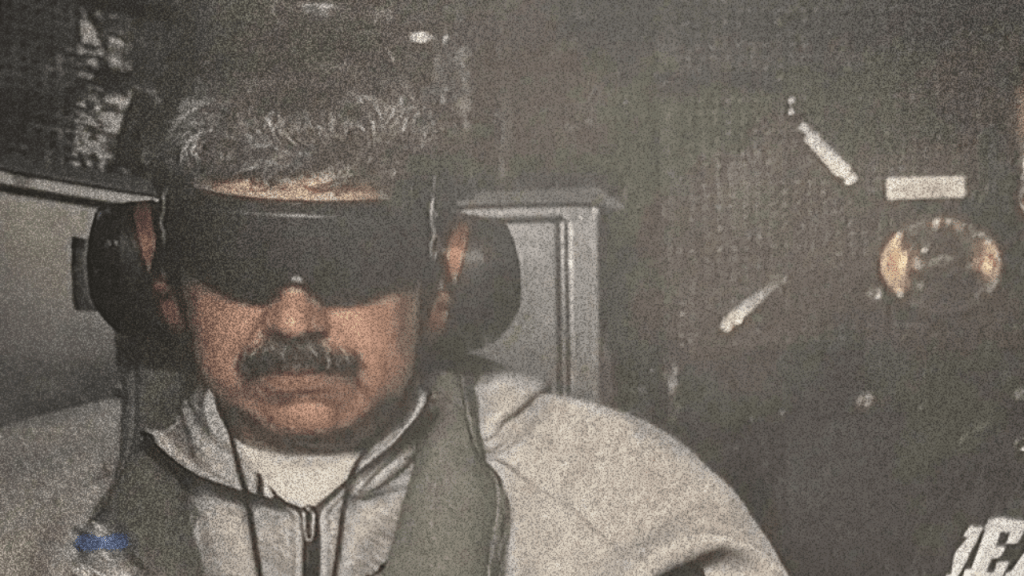
The U.S. capture of Maduro reframes military seizure as law enforcement, setting a precedent for extraterritorial regime removal by force.
In the early hours of January 3, 2026, the United States executed a military operation in Caracas that resulted in the capture of Venezuelan President Nicolás Maduro and his wife, Cilia Flores. The operation was called Operation Absolute Resolve. It involved more than 150 aircraft launched from 20 bases across the Western Hemisphere. Delta Force conducted the ground extraction. The CIA provided the ground intelligence.
The operation was not improvised. In August 2025, the CIA covertly installed a team inside Venezuela to track Maduro’s patterns, locations, and movements — what he ate, where he slept, what he wore, the details of his pets. A CIA source operating within the Venezuelan government provided additional real-time intelligence on his whereabouts. Months of planning included constructing a mockup of Maduro’s compound for rehearsal purposes. Before the final order was given, the operation was delayed multiple times waiting for favorable weather.
When the helicopters flew in at 100 feet above the water, the broader Venezuelan military did not mount a coordinated response. The reason is documented by analysts: the US deployed electronic warfare assets that paralyzed Venezuela’s command and control systems and disrupted the power grid, while diversionary strikes elsewhere in the country gave the Venezuelan military a false impression of the operation’s target. Venezuela’s air defenses — 53 long- and medium-range systems, hundreds of anti-aircraft cannons — were suppressed by F-22s and F-35s. The main resistance came from Maduro’s personal Cuban security contingent: Cuba confirmed 32 of its military and intelligence personnel were killed in the operation. One US helicopter was hit but remained flyable. No US casualties were reported.
Maduro and Flores were transferred to the USS Iwo Jima and flown to New York. On January 5, they entered not guilty pleas to narco-terrorism and cocaine trafficking charges before US District Judge Alvin Hellerstein. Venezuela’s Supreme Court ordered Delcy Rodríguez to assume powers as acting president.
Indictment as Narrative, Not Law
The charges against Maduro allege narco-terrorism conspiracy, cocaine importation conspiracy, and weapons possession. Attorney General Pam Bondi described Maduro as “one of the world’s most notorious narco-traffickers.” These accusations function primarily as political instruments, not legal ones.
This is legitimacy-by-indictment: the conversion of a political act — the forcible removal of a sitting head of state from his own capital — into a procedural one. Once framed as an arrest rather than a seizure, the moral terrain shifts. Force becomes law enforcement. A military operation becomes a drug bust.
UN Special Rapporteur Margaret Satterthwaite stated this clearly: “There’s a very clear limit on enforcement jurisdiction internationally, and that is that one state cannot enforce its law on the territory of another state unless that state gives its consent.” The UN Secretary General said the action raised “grave” concerns that “rules of international law have not been respected” and could set a precedent for future relations between states.
The US government’s response is to cite the Noriega precedent — the 1989 invasion of Panama that deposed Manuel Noriega, who was subsequently convicted in a US court on drug charges. That precedent was legally contested on every ground Maduro’s defenders are now raising: unlawful seizure, head-of-state immunity, forcible extraterritorial capture. Noriega lost on all counts. The courts granted the executive what it wanted. This is the precedent: not that extraterritorial capture is legal, but that US courts will not stop it.
The indictment also included one notable internal contradiction. The charges are not designed to withstand adversarial scrutiny — they follow the same pattern examined in the analysis of how the narco-terrorism frame structures US discourse on Latin America, which documents how criminal framing reduces complex political economies to moral frameworks that serve imperial interests, producing the informational conditions under which military and economic coercion appears as law enforcement rather than power.
Oil, Reserves, and the False Security Problem
Trump was explicit about the motivation. He focused on oil repeatedly in his post-operation press conference, declining to rule out a more robust US military presence and framing the operation partly as a means to “unlock” Venezuelan reserves for global markets. Hungarian Prime Minister Viktor Orbán called it “good news” specifically because Venezuelan oil would now be available. The oil logic was not subtext. It was stated openly.
Venezuela has the largest proven oil reserves on Earth. That resource has not been produceable at scale for years — sanctions, economic crisis, and underinvestment have reduced output to approximately one million barrels per day, roughly 0.8% of global crude production. The strategic significance is about reserve position over decades, not current output.
But this framing exposes a deeper problem. Securing oil access through military force creates a false sense of security around a resource whose long-term value is structurally declining. The world is not running out of oil. It is running out of time to build energy systems that don’t depend on it. Control over Venezuelan reserves does not solve that problem — it papers over it. Military success becomes an argument for postponing structural transition. Dominance over supply substitutes for planning. Coercion replaces adaptation.
Even if oil is the prize, fixation on it as a prize is itself a symptom of strategic failure. What is being secured is not the future. It is the ability to avoid building one.
The Succession Problem and What It Reveals About US Objectives
Before the operation, the Trump administration had engaged in secret talks with Maduro’s government about Venezuela’s oil reserves and had identified Delcy Rodríguez as someone the US could work with. Trump said after the operation that Rodríguez would “do what we think is necessary to make Venezuela great again.” This framing — cooperative successor already identified — tells us what the operation was actually trying to achieve.
Washington did not want regime collapse. It wanted regime adjustment: a leadership change that preserved institutional stability while altering political alignment. That is management logic, not liberation logic. It explains why Trump showed little interest in the Venezuelan opposition or its Nobel Peace Prize-winning leader María Corina Machado, dismissing her by saying she lacked “the respect within the country.” Machado represented democratic legitimacy but also uncertainty. Rodríguez represented continuity and a known negotiating partner.
The problem is that Rodríguez immediately declared Venezuela had been “savagely attacked” and insisted “there is only one president in Venezuela and his name is Nicolás Maduro.” She subsequently visited Russia. The management scenario — capture Maduro, work through his successor, stabilize the country on US terms — is not unfolding on the timetable Washington assumed. As one CSIS analysis put it: “A government of Maduro loyalists will not willingly follow directions from Washington.” The military operation was executed brilliantly. The political theory behind it appears not to have survived contact with reality.
The Moral Fracture in the Response
International reactions followed a predictable geographic and political split. Brazil, Chile, China, France, Iran, Mexico, Russia, South Africa, and Spain condemned the operation. Argentina, Germany, Israel, Peru, and Ukraine broadly praised it. The UN Security Council convened at the request of China, Colombia, and Russia. No material action followed from any condemnation. Paper solidarity is the international community’s default posture when the US acts decisively in its own hemisphere.
On the ground in Venezuela, the picture is more complicated than either celebration or mass resistance. Caracas was quiet on the day after the operation, with businesses closed and few vehicles moving. There was no mass uprising, no spontaneous jubilation in the streets of the capital. In parts of the Venezuelan diaspora — Miami, Canary Islands, Colombian border towns — there were celebrations.
That contrast carries moral weight. It is easy to accept deaths as a “price worth paying” when those deaths will be paid by others. Venezuelan diaspora communities have real grievances against Maduro’s government — including the violent suppression of opposition, arbitrary detention, and the economic collapse that displaced millions. Those grievances are legitimate. They do not settle the question of whether a US military operation in a sovereign country, executed without congressional authorization and in violation of international law, is the appropriate remedy — or whether the people who will live with the consequences endorsed the method.
Democratic Senator Mark Warner asked directly: “Does this mean any large country can indict the ruler of a smaller adjacent country and take that person out?” The question answers itself. The answer is yes, if that large country has enough military force and is willing to act unilaterally. The US has demonstrated this. Others have taken note.
The Precedent Is the Point
If Operation Absolute Resolve is understood as a success — and militarily, it was — it becomes a template. A model for removing an uncooperative leader without prolonged occupation, through intelligence penetration, electronic warfare, and a surgical extraction force. It confirms that the Noriega model scales.
It demonstrates that air defense systems do not protect against F-22s and F-35s operating with months of intelligence preparation. It shows that cyber operations can paralyze a country’s military command structure in real time.
The US national security apparatus’s documented history of constructing legal and narrative pretexts for operations it had already decided to execute is examined in the analysis of Operation Northwoods and the logic of manufactured war, which shows the Joint Chiefs formally proposing staged attacks on American civilians to justify invading Cuba — establishing that the template precedes the pretext, not the other way around.
Warner’s concern was echoed by Maduro’s son: “If we normalize the kidnapping of a head of state, no country is safe. Today it’s Venezuela. Tomorrow it could be any nation that refuses to submit.” This framing is self-interested — Maduro’s record of human rights abuses, political repression, and election theft is real and documented. But the structural point survives the self-interest. The precedent does not come with a guarantee it will only be applied to leaders who deserve it by any reasonable standard.
Hubris grows from ease. When an operation this complex succeeds this cleanly, power assumes repeatability. The danger is not that such operations succeed everywhere. It is that the belief in their ease encourages attempts where conditions are very different, where the intelligence penetration is shallower, where the target is better protected, where the political aftermath is more chaotic, where other great powers are more directly involved.
The longer view is darker still. Each intervention justified by energy security or drug enforcement delays structural reckoning with why US policy keeps producing these situations. Venezuela did not become this way by accident. Decades of sanctions, covert pressure, and the prioritization of compliance over democratic process are part of the history. The operation that removed Maduro was planned with extraordinary skill. Whether it was wise is a different question entirely — and one the administration has not answered, because its theory of the political transition that follows has already begun to fail.
Sources
- Wikipedia — “2026 United States intervention in Venezuela”: https://en.wikipedia.org/wiki/2026_United_States_strikes_in_Venezuela
- CNN — “From order to extraction: Inside the US capture of Nicolás Maduro”: https://www.cnn.com/2026/01/03/politics/nicolas-maduro-capture-venezuela
- NBC News — “How the US captured Maduro: A CIA team, steel doors and a fateful phone call”: https://www.nbcnews.com/politics/donald-trump/us-venezuela-strike-nicolas-maduro-captured-how-timeline-trump-rcna252041
- The Conversation — “How Maduro’s capture went down — a military strategist explains”: https://theconversation.com/how-maduros-capture-went-down-a-military-strategist-explains-what-goes-into-a-successful-special-op-272671
- PBS NewsHour — Maduro first US court appearance live updates: https://www.pbs.org/newshour/politics/live-updates-removed-venezuelan-leader-maduro-makes-first-appearance-in-u-s-court-after-capture
- CBS News — “Trump says US is ‘in charge’ of Venezuela”: https://www.cbsnews.com/live-updates/venezuela-us-military-strikes-maduro-trump/
- Al Jazeera — “Abduction of Venezuela’s Maduro illegal despite US charges, experts say”: https://www.aljazeera.com/news/2026/1/8/abduction-of-venezuelas-maduro-illegal-despite-us-charges-experts-say
- UK House of Commons Library — “The US capture of Nicolás Maduro”: https://commonslibrary.parliament.uk/research-briefings/cbp-10452/
- Wikipedia — “Prosecution of Nicolás Maduro and Cilia Flores”: https://en.wikipedia.org/wiki/Prosecution_of_Nicol%C3%A1s_Maduro_and_Cilia_Flores
- CNN — Venezuela live updates January 3-4, 2026: https://www.cnn.com/world/live-news/venezuela-explosions-caracas-intl-hnk-01-03-26
- CSIS — “The Maduro Raid: A Military Victory with No Viable Endgame”: https://www.csis.org/analysis/maduro-raid-military-victory-no-viable-endgame
- Just Security — “US Intelligence in a Post-Maduro Venezuela”: https://www.justsecurity.org/128064/us-intelligence-post-maduro-venezuela/

 Spark Solidarity