
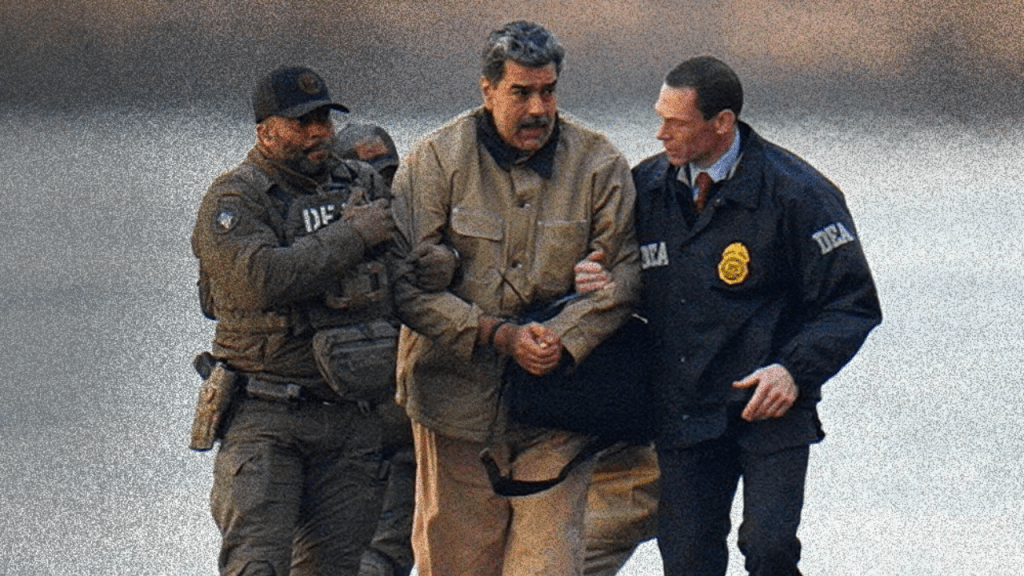
The U.S. capture of Maduro shows how military force is retroactively framed as law enforcement, collapsing sovereignty into procedure and power.
The operation that removed Nicolás Maduro from Venezuela has been presented to the public as a matter of law rather than power. Officials have described it as a long-delayed enforcement action, the culmination of an indictment finally carried out, and a demonstration that no leader is beyond accountability.
The language is careful and procedural, chosen to convey normalcy and restraint. It invites the reader to imagine courtrooms, warrants, and jurisdiction, rather than aircraft, command centers, and armed units crossing borders.
That framing is not incidental. It is the mechanism through which the act is made intelligible and acceptable. What occurred cannot be adequately described as law enforcement, nor as a routine extension of legal authority.
Airspace was violated, intelligence assets — a CIA team had tracked Maduro’s movements for months, a replica of his compound was built for training — and armed personnel acted with impunity inside sovereign territory. This was not law reaching outward. It was law being displaced by force and reconstructed afterward as procedure.
The distinction matters because language shapes how violence is absorbed. When an act of force is narrated as enforcement, it does not register as rupture. It registers as correction. Something out of alignment is brought back into order, and the continuity of the system is preserved. The purpose of the vocabulary is not to describe what happened, but to ensure that what happened does not destabilize the broader structure in which it occurs.
Whether Maduro is guilty of the charges against him is irrelevant to this logic. Guilt does not authorize the movement of armies. It does not convert soldiers into police or weapons into warrants.
The deeper claim being asserted is that force can be rendered lawful after the fact so long as the state exercising it controls the institutions that explain, justify, and normalize the outcome.
Once that claim is accepted, sovereignty no longer functions as a boundary. It becomes a condition, revocable under the right procedural language.
This is not a novel practice. It echoes the 1989 invasion of Panama to seize Manuel Noriega on similar narco-trafficking indictments, a precedent legal scholars and analysts have cited explicitly in assessing the Venezuela operation. But the confidence with which the current version is performed is revealing. Rules are still cited, but no longer as restraints on action. They are invoked to make action legible, routine, and survivable for the system that depends on continuity.
Coercion as Policy
Understanding the operation requires abandoning the assumption that it was intended to govern outcomes. It was not. The Congressional Research Service noted that Secretary of State Marco Rubio has stated that while restoring democracy remains a long-term goal, coercing the current government to address U.S. security, migration, and energy concerns is the immediate aim. There is no plan to administer Venezuela, no appetite for reconstruction, and no intention to absorb the political, financial, or moral costs that genuine control would entail. What is being exercised is leverage, not ownership.
This form of coercion is designed to travel light. Venezuela’s Vice President Delcy Rodríguez was sworn in as acting president on January 5 — existing institutions left standing, elites nominally in place, bureaucracies continuing to operate. The difference is not immediately visible. It exists in the background condition under which decisions are now made. As Crisis Group observed, it is “hard to recall a previous occasion in Latin American or indeed world history when one country has sought to manage the affairs of another without any physical presence.” Authority continues, but under threat. Compliance becomes the price of tolerance.
Trump told reporters the U.S. would “run Venezuela” until a “safe, proper, and judicious transition” took place, and warned Rodríguez that if she doesn’t comply, she will “pay a very big price, probably bigger than Maduro.” He also threatened “a second, bigger wave” of military force if his demands are not met.
The result is a specific and deliberate category of rule. Venezuela is neither sovereign nor occupied. It is not collapsing, but it is not free to consolidate. Decisions are made locally, but always under the awareness that enforcement can return. Responsibility for outcomes is displaced downward, while ultimate authority remains external. This is not a transitional phase. It is a holding pattern.
Instability under these conditions is not a failure of strategy. It is the mechanism. A state kept off balance is easier to pressure, easier to bargain over, and harder to mobilize against external demands. Disorder becomes leverage. Suffering becomes background noise. At scale — in a large, complex society with politicized institutions, armed non-state actors, and deep internal fractures — this strategy does not resolve crises. It multiplies them.
The structural conditions that make this form of coercion possible — why sovereignty functions as a revocable condition rather than a boundary for states outside Western alignment — are examined in the analysis of how Cuba exposes the limits of liberal democracy.
Legality as Theater
The most revealing feature of the operation is not the force deployed, but the care taken in how it is described. Every justification leans heavily on legality. The seizure is called an arrest. The operation is described as law enforcement. Domestic indictments are treated as though they naturally traverse borders. Executive authority is invoked as if it dissolves external limits. This language is not careless. It is choreography.
The deeper history of how states use procedural language and managed narrative to absorb acts of force without destabilizing the broader system — and what that mechanism looks like from inside the institutions applying it — is examined in the analysis of perception management and how states control the narrative after violence.
Legal scholars and politicians have questioned whether the operation was lawful under international law. The prohibition on the use of force in the UN Charter is explicit. Military action on foreign territory is permitted only under narrowly defined conditions that do not apply here. A domestic indictment does not create an international police power. It does not pierce sovereignty. These principles apply regardless of the individual targeted, because international law governs relations between states, not the moral character of leaders.
In court, Maduro described himself as a “prisoner of war” and said he had been “kidnapped” by U.S. forces from his home. He and Flores pleaded not guilty.
The absence of formal international consequence does not reflect legality. It reflects hierarchy. Enforcement mechanisms are filtered through power. Rules remain on the books, but their application is selective. This is not hypocrisy, which implies belief betrayed. It is formalism: law retained as structure and language while emptied of its constraining force. The rituals remain. The citations are recited. The appearance of order is preserved.
Decapitation Without Transition
The most destabilizing consequence of the operation is not the removal of Maduro, but the fact that almost everything else remains intact. The Venezuelan state did not collapse. Its military leadership persists. Party structures remain. Ministries continue to function. On paper, this continuity suggests stability. In practice, the center of authority has been severed without replacement.
When the symbolic and practical anchor of a political system is removed, legitimacy thins and clarity dissolves. Chains of command still exist, but their enforceability becomes contingent. Orders can be issued, but their authority depends increasingly on interpretation, loyalty, and fear. Every actor operates with incomplete information about who ultimately decides outcomes and how long the current arrangement will last.
In this environment, hedging becomes rational behavior. Political and economic elites diversify loyalties. Security services fragment into overlapping alignments. Armed groups exploit uncertainty at the margins. Authority becomes situational. Violence becomes negotiable. Continuity without legitimacy preserves the shell of governance while hollowing out its core.
Venezuela’s Interior Minister reported more than 100 people killed in the operation; Cuba announced that 32 of its citizens died while “carrying out missions” for its armed forces. Seven U.S. service members were injured.
Oil as Symbol, Not Strategy
Oil has dominated the public explanation for this intervention because it is legible. It offers a concrete prize that renders coercion transactional rather than imperial. Taken seriously as an economic strategy, it explains very little.
Venezuela holds the world’s largest proven oil reserves — approximately 300 billion barrels — but produces only around 800,000 to 1 million barrels per day, less than 1% of global output. Infrastructure is severely degraded. Experts say significantly boosting production could cost upward of $100 billion and take at least a decade. Political risk is extreme. Venezuelan crude is heavy and sour — useful for industrial products like diesel and jet fuel, not easily refined for gasoline.
Markets understood this. Oil prices had been softening in the lead-up to the capture, and the immediate market reaction was muted — no supply shock occurred. Oil company stocks surged on Monday — Chevron jumped 5.1%, oil services firms added 10% or more — but this was equity speculation on future access, not a reaction to present supply. As Al Jazeera’s analysis noted, the absence of a market spike “allows the US intervention to be framed as a clean, surgical and necessary act. It masks the long-term reality.”
Oil, in this context, explains the narrative rather than the operation. It provides a language through which power explains itself. The underlying objective is the enforcement of compliance rather than extraction.
Power That Can Strike but Not Stick
What this moment ultimately reveals is not renewed strength, but exposure. Force once consolidated power by buying time for outcomes to harden into something governable. That is no longer what force does. Now it accelerates contradiction. Action comes early because waiting feels dangerous. Enforcement replaces persuasion because persuasion no longer works. What appears as decisiveness is the narrowing of options made visible.
Analysts at Rystad Energy compared post-capture Venezuela to post-Gaddafi Libya — a state where the removal of a leader produced not stability but prolonged disarray that discouraged foreign investment and froze economic recovery for years. That comparison is not incidental. It is the most likely baseline outcome of decapitation without transition infrastructure.
The global counter-alignment that operations like this accelerate — and why waiting for multipolarity to mature before acting politically is itself a strategic error — is examined in the analysis of the trap of waiting for multipolarity to act.
Meanwhile, American military power remains formidable. That is not in question. But the capacity to strike is not the capacity to rule, and removal is not resolution. Outcomes no longer hold. Legitimacy decays. Instability moves inward as much as it radiates outward. What remains is not a new order, but another deferral — an effort to preserve relevance through discipline rather than consent.
The system continues, not because its contradictions are resolved, but because they are deferred. That strategy buys time. It does not buy permanence.
Sources
- NBC News — How the U.S. captured Maduro: A CIA team, steel doors and a fateful phone call, Jan. 3-4, 2026: https://www.nbcnews.com/politics/donald-trump/us-venezuela-strike-nicolas-maduro-captured-how-timeline-trump-rcna252041
- Congress.gov / Congressional Research Service — U.S. Capture of Venezuela’s Nicolás Maduro: Considerations for Congress: https://www.congress.gov/crs-product/IN12618
- House of Commons Library — The US capture of Nicolás Maduro: https://commonslibrary.parliament.uk/research-briefings/cbp-10452/
- CNN — January 3, 2026 — Maduro in US custody (liveblog): https://www.cnn.com/world/live-news/venezuela-explosions-caracas-intl-hnk-01-03-26
- CNBC — Venezuela says 100 killed in U.S. military operation that captured Maduro, Jan. 7, 2026: https://www.cnbc.com/2026/01/07/us-venezuela-military-operation-maduro-injuries-casualties.html
- International Crisis Group — Venezuela after Maduro: Transaction or Transition?, Jan. 9, 2026: https://www.crisisgroup.org/latin-america-caribbean/venezuela-united-states/venezuela-after-maduro-transaction-or-transition
- CBS News — Oil company stock prices rise after U.S. capture of Maduro, Jan. 5-6, 2026: https://www.cbsnews.com/news/venezuela-maduro-trump-oil-stock-prices-chevron-cvx/
- Al Jazeera — Venezuela after Maduro: Oil, power and the limits of intervention, Jan. 5, 2026: https://www.aljazeera.com/news/2026/1/5/venezuela-after-maduro-oil-power-and-the-limits-of-intervention
- Yahoo Finance / Rystad Energy — How Maduro’s capture affects oil markets, Jan. 5, 2026: https://finance.yahoo.com/news/how-maduros-capture-affects-oil-markets-will-depend-on-venezuelas-political-climate-173333866.html
- State Street Global Advisors — Venezuela after Maduro: Oil, global power, and the ripple effects for markets, Jan. 5, 2026: https://www.ssga.com/us/en/institutional/insights/venezuela-after-maduro
- Wikipedia — 2026 United States intervention in Venezuela: https://en.wikipedia.org/wiki/2026_United_States_intervention_in_Venezuela

 Spark Solidarity