
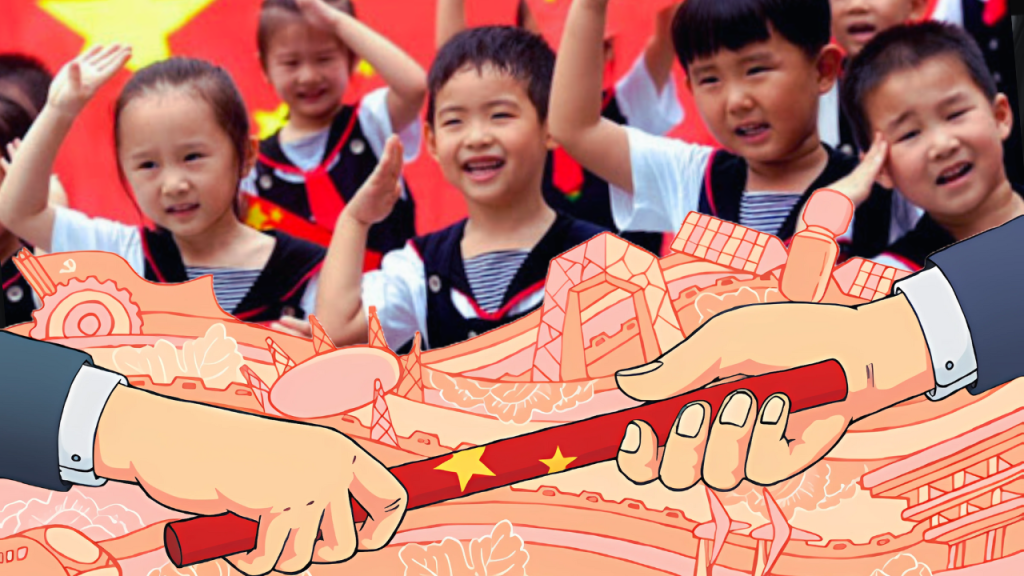
China’s 2050 plan outlines a two-stage path to modernization and common prosperity, revealing real gains, real contradictions, and unresolved tensions.
On October 18, 2017, Xi Jinping delivered his report to the 19th National Congress of the Communist Party of China, laying out the most comprehensive long-term development plan in the CPC’s history. The central commitment: transform China into a “great modern socialist country that is prosperous, strong, democratic, culturally advanced, harmonious, and beautiful” by the middle of the 21st century.
The plan has two stages. The first, from 2020 to 2035, aims to “basically realize socialist modernization” — achieving global leadership in innovation, strengthening rule of law institutions, significantly expanding the middle class, and substantially closing urban-rural development gaps. The second stage, from 2035 to 2050, builds on that foundation toward what the congress documents describe as “common prosperity for everyone” and China becoming “a global leader in terms of composite national strength and international influence.”
The framing is deliberate. 2049 marks the centenary of the People’s Republic. The CPC was founded in 1921 — the 2021 centenary was the symbolic checkpoint for completing the first developmental stage. The endpoint of 2050 closes a century of revolutionary history. Whether the plan delivers on these terms is a separate question from what the plan actually says — and the two questions are consistently conflated in both Western and uncritical pro-CPC commentary alike.
Where This Comes From: A Compressed History
The 2050 roadmap is not an invention of Xi Jinping’s era. It is the current iteration of a development logic that has been evolving since 1949.
Mao Zedong’s early policies — rapid industrialization, collectivization, land redistribution — aimed to build a socialist state from an agrarian baseline. The Great Leap Forward (1958–1962) and the Cultural Revolution (1966–1976) produced severe economic disruption and social upheaval. By the time of Mao’s death in 1976, China required a fundamental course correction.
Deng Xiaoping provided it. Beginning in the late 1970s, Deng introduced market-oriented reforms under the framework of “socialism with Chinese characteristics” — allowing foreign investment, establishing special economic zones, and permitting private enterprise, while maintaining CPC political monopoly. Deng’s rationale was explicitly developmental: market mechanisms were tools to address poverty and close the gap with industrialized nations, not an abandonment of the socialist project. The results, measured in material terms, are difficult to dispute. According to a joint report by the World Bank and China’s Ministry of Finance, the number of people in China living below the international extreme poverty line fell by close to 800 million over the four decades since 1978, accounting for approximately three-quarters of global poverty reduction in that period.
That figure carries its own methodological debates. A competing analysis published in New Political Economy argues that World Bank purchasing power parity calculations obscure the fact that China’s socialist period before reforms had already achieved unusually low extreme poverty rates by developing-world standards — that socialist provision of food, shelter, and services at controlled prices meant the pre-reform baseline was stronger than the Bank’s methodology captures, and that the market transition may have initially worsened conditions for the rural poor before improving them. This dispute matters for how the reform era is evaluated, and this piece returns to it below.
Under Jiang Zemin, China joined the World Trade Organization in 2001, accelerating its integration into global markets. Under Hu Jintao, who emphasized a “harmonious society” framework, China continued rapid expansion while wrestling with rising inequality and environmental degradation. These tensions — between growth and distribution, between industrialization and sustainability — are precisely what Xi’s 2050 plan claims to address.
What the Two-Stage Plan Actually Commits To
The full text of Xi’s 19th Congress report is a public document, and it is worth being precise about what it says rather than relying on summaries.
By 2035, the plan commits to: China’s economic and technological strength increasing significantly with the country becoming “a global leader in innovation”; the rights of citizens to participate and develop as equals being “adequately protected” with rule of law “basically in place” across government, country, and society; a considerably larger middle-income population with significantly reduced urban-rural and regional disparities; and national defense modernization “basically completed.”
By 2050, the goals escalate: China becomes a global leader in composite national strength and international influence; “common prosperity for everyone is basically achieved”; and “the Chinese people enjoy happier, safer, and healthier lives.” The congress report also commits the People’s Liberation Army to becoming “a first-tier force” — language that signals not just defensive capability but global military standing.
Xinhua’s official report on the congress notes that this was the first time the CPC had set forth a post-2020 strategic plan to make China a “great” country, and that the plan accelerated what had previously been targets set for mid-century — moving the socialist modernization goal forward by approximately 15 years from the original three-step strategy Deng Xiaoping proposed in 1987. This represents a genuine confidence claim, not rhetorical ambition. It also raises the stakes: the CPC has committed to specific, dateable benchmarks against which its performance can be measured.
The Real Tensions the Plan Has to Navigate
Technological Self-Sufficiency
China’s dependence on foreign semiconductor technology, software, and key industrial inputs has been a persistent structural vulnerability. The plan’s emphasis on becoming a “global leader in innovation” is not aspirational rhetoric — it is a direct response to the exposure that US technology export controls and sanctions have revealed. The tension is between the pace of indigenous development and the cost of operating without full access to global technology markets during the transition period. This is not a tension the plan resolves; it names it as a goal and leaves the method open.
The imperial pressure shaping what developmental paths are available to states outside the Western core — of which US semiconductor export controls represent the contemporary form — is examined across the imperialism analysis on this site.
Wealth Inequality
China’s poverty reduction record is genuine and historically unprecedented in scale. What it does not resolve is inequality above the poverty line. The Gini coefficient rose dramatically through the reform era and, despite some moderation, remains high. Xi’s “common prosperity” agenda — launched more explicitly after 2021 — represents an attempt to address this through targeted redistribution, restrictions on private capital accumulation in sectors like tech and education, and rural revitalization programs. Whether these measures can reverse decades of stratification without disrupting the investment dynamics that produced growth is the central unresolved question in any honest assessment of the plan.
Environmental Commitments
China is simultaneously the world’s largest emitter of CO₂ and its largest manufacturer of solar panels and wind turbines. It has committed to peak emissions before 2030 and carbon neutrality by 2060. These commitments are real but operate in tension with continued coal dependency and ongoing industrial expansion. The 2050 “beautiful China” environmental vision requires resolving this contradiction at scale, not merely managing it at the margins.
Military Modernization and Global Posture
As the 19th Congress report makes explicit, Xi’s goals include a “basically completed” PLA modernization by 2035 and a “first-tier” military force by 2050. The report’s language — that the military must “regard combat capability as the criterion to meet in all its work” — signals a departure from the defensive posture framing that characterized earlier CPC military doctrine. The CPC frames this as sovereignty protection; its critics read it as force projection. Both readings can be simultaneously accurate. The Belt and Road Initiative — China’s infrastructure investment program spanning Asia, Africa, and Latin America — extends this question from military into economic and diplomatic terrain, and the plan treats it as continuous with national development strategy rather than a separate foreign policy program.
The Poverty Reduction Record: What It Proves and What It Doesn’t
The Tricontinental Institute for Social Research’s detailed study of China’s poverty elimination program documents the mechanisms that made the scale of reduction possible: three million CPC cadres dispatched to poor villages forming 255,000 residential teams; party secretaries made accountable for poverty reduction outcomes across five levels of government; 1.1 million kilometers of new rural roads; 4G internet coverage extended to 98% of poor villages; and the dibao social transfer system expanded to cover all rural areas by 2007.
These are not market outcomes. They are the product of directed state capacity deployed at scale over a sustained period. That this capacity existed alongside growing inequality, a billionaire class, and significant private sector dominance is the central contradiction the “socialism with Chinese characteristics” framework has to account for — and which its critics on both the right and the anti-revisionist left point to as disqualifying.
The methodological challenge raised in New Political Economy matters here: if China’s socialist period before 1978 had already achieved low extreme poverty rates through non-market provision, then the reform era’s poverty reduction numbers partly reflect people emerging from conditions created or worsened by the transition itself. This doesn’t erase the material improvement since — it complicates the causal story, which is presented too cleanly in both CPC promotional material and in Western development economics.
Is China Building Socialism?
This is the question that generates the most heat and the least analytical precision.
The classical definition centers on social ownership of the means of production under democratic control. By that standard, contemporary China — with its large private sector, billionaire class, Gini coefficient above 0.46, and single-party political structure with no independent worker or popular control over state direction — does not straightforwardly qualify.
The CPC’s counter-argument is developmental: China is in a transitional stage, using market mechanisms to develop productive forces that will eventually enable higher forms of social organization. This logic is internally consistent and has historical precedent in debates within Marxist political economy going back to Lenin’s New Economic Policy. It also cannot be falsified in the short term, which is both its analytical weakness and its political convenience.
What exists in China is probably best described as a state-directed developmental economy with socialist institutional characteristics — strong public ownership in strategic sectors, extensive social provision, party-led long-term planning — combined with substantial private capital, market mechanisms, and significant stratification. Whether this constitutes socialism in any meaningful sense depends on what criteria you apply and which trajectory you project forward.
The structural distinctions between state-directed development and liberal capitalism are examined across the global capitalism analysis on this site, including the state-capital coordination that Western discourse exempts from the scrutiny it applies to socialist developmental models.
What China clearly is not is liberal capitalism. State institutions steer investment. Long-term planning overrides short-term market signals in strategic sectors. Social provision — education, healthcare, poverty alleviation — is treated as a state responsibility rather than a market outcome. These are real distinctions with real material consequences, and dismissing them because they coexist with inequality misses something important about how different political economies actually function.
The honest position is that the debate cannot be resolved by assertion from either direction. China’s model is doing things that capitalist markets do not do, and failing to do things that classical socialism would require. Observers who need a clean verdict will not find one. Observers interested in what actually produces material outcomes at scale will find the Chinese case genuinely instructive regardless of how it is ultimately labeled.
What Western Discourse Gets Wrong
The dominant frame in Western media treats China’s long-term planning primarily as a threat vector — a story about military expansion, technological competition, and authoritarian governance. This framing is not fabricated, but it is systematically incomplete.
It consistently underweights the material record: the scale of poverty reduction, the infrastructure investment, the social provision. It treats state-led development as inherently suspect while exempting Western state-capital coordination — defense contracting, agricultural subsidies, financial sector bailouts — from equivalent scrutiny.
It consistently underweights the material record: the scale of poverty reduction, the infrastructure investment, the social provision. It treats state-led development as inherently suspect while exempting Western state-capital coordination — defense contracting, agricultural subsidies, financial sector bailouts — from equivalent scrutiny — a selective evidentiary standard examined in the analysis of what actually happened at Tiananmen Square, where US embassy cables, BBC correspondent accounts, and Chilean diplomatic records were sidelined in favor of a narrative that served Cold War political needs regardless of what the evidence showed.
This narrative tends to resolve genuine complexity into strategic threat rhetoric, which serves the political needs of Western ruling classes regardless of whether it illuminates what is actually happening in China.
The counter-tendency in uncritical pro-China commentary is its mirror image: treating every CPC policy announcement as genuine socialist achievement while ignoring inequality data, labor rights deficits, and the persistent distance between official commitment and material outcome for workers rather than aggregate statistics.
The more useful analytical position is neither. China’s 2050 plan is a real document with specific commitments, real institutional capacity behind some of them, and real structural obstacles to others. Evaluating it requires the same evidentiary standards applied to any state’s development program: what does the record show, what do structural conditions make likely, and where does the gap between declared intention and material outcome require explanation?
That analysis does not produce a verdict of “socialist success” or “capitalist failure.” It produces a complex picture of a state using heterodox tools toward declared ends, under conditions of external pressure and internal contradiction, on a timeline that does not close until 2050.
The outcome remains genuinely open.
Sources
- China Daily / 19th CPC National Congress full text — Xi Jinping’s report, two-stage plan language, exact goals for 2035 and 2050, “prosperous, strong, democratic, culturally advanced, harmonious, and beautiful”: https://www.chinadaily.com.cn/china/19thcpcnationalcongress/2017-11/04/content_34115212.htm
- Xinhua — “China Focus: Xi unveils plan to make China ‘great modern socialist country’ by mid-21st century” (October 18, 2017 announcement, 15-year acceleration of previous schedule, “first-tier force” by 2050): http://www.xinhuanet.com/english/2017-10/18/c_136688933.htm
- Xinhua — “The global significance of China’s poverty alleviation” (2049 centenary framing, Xi’s “complete victory” declaration, one person escaping poverty every three seconds): https://english.news.cn/20241208/2def28fe43924eaebfa174e7fed1e7f3/c.html
- Asia Times — “Xi outlines his vision to achieve ‘China Dream’ by 2050” (October 18, 2017 congress opening, specific language on 2035 and 2050 stages): https://asiatimes.com/2017/10/xi-outlines-vision-achieve-china-dream-2050/
- World Bank — “Lifting 800 Million People Out of Poverty: New Report Looks at Lessons from China’s Experience” (joint World Bank/China Ministry of Finance report, 800 million figure, ~75% of global poverty reduction): https://www.worldbank.org/en/news/press-release/2022/04/01/lifting-800-million-people-out-of-poverty-new-report-looks-at-lessons-from-china-s-experience
- Tricontinental: Institute for Social Research — “Serve the People: The Eradication of Extreme Poverty in China” (materialist analysis of poverty elimination, three million cadres deployed, 255,000 village teams, state mechanism documentation): https://thetricontinental.org/studies-1-socialist-construction/
- People’s Dispatch — “China declares end of absolute poverty a decade ahead of UN schedule” (770 million lifted since 1979, 70%+ of global poverty reduction, CPC poverty alleviation mechanisms, dibao expansion): https://peoplesdispatch.org/2021/02/27/china-declares-end-of-absolute-poverty-in-the-country-a-decade-ahead-of-the-un-schedule/
- The Conversation — “China’s capitalist reforms are said to have moved 800 million out of poverty — new data suggests the opposite” (peer-reviewed methodological critique of World Bank PPP calculations, socialist-era baseline poverty rates, New Political Economy analysis): https://theconversation.com/chinas-capitalist-reforms-are-said-to-have-moved-800-million-out-of-extreme-poverty-new-data-suggests-the-opposite-216621
- Springer Nature / Angang Hu — “2050 China: Strategic Goals and Two Stages” (Deng’s original three-step strategy, Xi’s acceleration of modernization targets, academic analysis of roadmap phasing): https://link.springer.com/chapter/10.1007/978-981-15-9833-3_4
- Wikipedia — “Poverty in China” (methodology notes, rural/urban poverty distribution, 2020 absolute poverty elimination declaration, historical poverty rate data): https://en.wikipedia.org/wiki/Poverty_in_China




 Spark Solidarity