Operation Northwoods reveals how U.S. military leaders planned false flag terror, media manipulation, and fake casualties to justify invading Cuba.
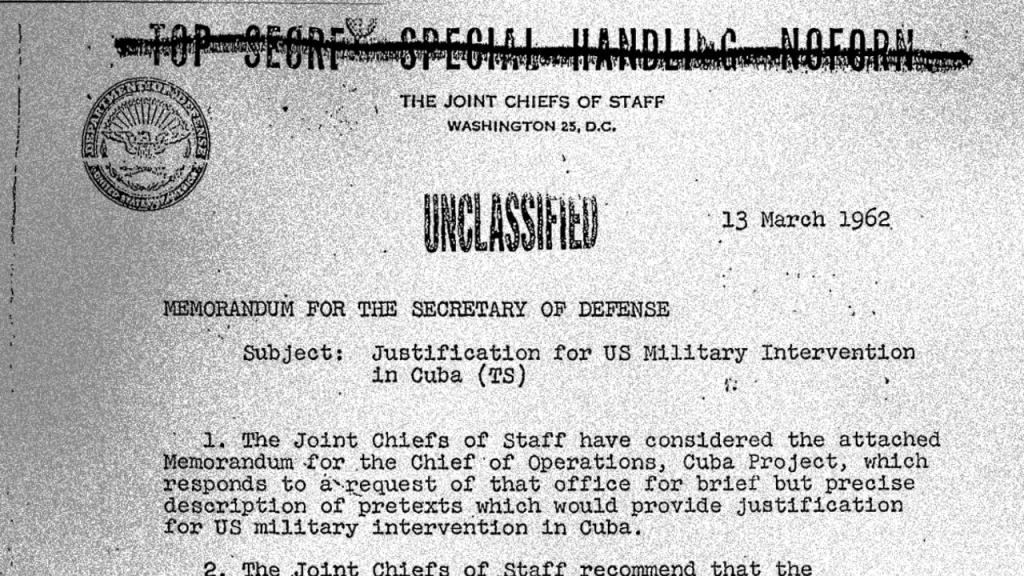
On March 13, 1962, a document was presented to Secretary of Defense Robert McNamara bearing the signatures of the Joint Chiefs of Staff.
It proposed, in bureaucratic language stripped of all moral register, that the United States government stage terrorist attacks on its own citizens and military personnel, fabricate Cuban aggression, manufacture civilian casualties, and use the resulting public outrage — amplified by a press it assumed would transmit without question — to justify an invasion of Cuba.
It was called “Justification for U.S. Military Intervention in Cuba.”
What it described was a systematic program of state deception against the American public: faking the shoot-down of a civilian airliner. Staging bombings in Miami and Washington D.C. Sinking boats carrying Cuban refugees. Blowing up a U.S. ship at Guantánamo Bay. Manufacturing casualty figures for newspapers to print.
The document’s authors anticipated the press’s function with clinical precision: “casualty lists in U.S. newspapers would cause a helpful wave of national indignation.”
Death as a communications strategy. The emotional response of the public calculated in advance. The media as the delivery mechanism.
President Kennedy rejected the plan. Chairman of the Joint Chiefs General Lyman Lemnitzer was subsequently denied a second term. The document was classified for thirty-five years, declassified by the JFK Assassination Records Review Board in 1997, and brought to wide public attention by investigative journalist James Bamford in his 2001 book Body of Secrets.
What it reveals is not a historical aberration. It is an institutional logic — one that predates Northwoods and survives it.
What the Document Actually Proposed
Operation Northwoods was not a fringe proposal or the work of one rogue officer. It was presented by the entire Joint Chiefs of Staff — the heads of every branch of the U.S. Armed Forces — as a serious menu of operational options.
The specific proposals included:
Faking the crash of a civilian airliner over Cuba and blaming it on the Cuban Air Force, to be “widely publicized” as an act of aggression. Remote-controlling military aircraft painted as civilian planes. Staging “Communist Cuban terror” in American cities — including specific mention of Miami and Washington D.C. — using fake attacks that would appear to be Castro-organized. Manufacturing evidence of Cuban interference with the U.S. space program; a sub-document called Operation Dirty Trick proposed that if John Glenn’s Mercury orbit failed, fabricated evidence would “prove” Cuba was responsible for electronic sabotage.
The document’s language throughout treats publicity not as a side effect but as an operational requirement. “Widely publicized incidents” appears repeatedly. The plan assumed newspapers would print fabricated casualty figures without investigating their origin. It assumed broadcasters would relay the narrative as presented. The media was treated as infrastructure — reliable, transmissive, exploitable.
This assumption was not naive. It was based on a decade of institutional experience.
Why the Assumption Was Rational: The CIA-Media Relationship
The planners of Operation Northwoods did not assume media cooperation because they misunderstood how journalism worked. They assumed it because they had spent years demonstrating that it was available.
The 1975 Senate Church Committee — the congressional investigation into intelligence abuses — documented that the CIA had established “official but secret relationships” with at least fifty American journalists. Its published report confirmed that the CIA had “cultivated relationships with private institutions, including the press,” using those relationships to shape coverage and suppress unfavorable stories.
Carl Bernstein, investigating the same territory for Rolling Stone in 1977, went further. His 25,000-word documented investigation “The CIA and the Media” found that over a 25-year period, more than 400 U.S. press members had secretly carried out assignments for the CIA. The list included the New York Times, CBS, Time magazine, and the Washington Post. Bernstein’s most important finding was structural: “rarely was a news agency used to provide cover for CIA operatives abroad without the knowledge and consent of either its principal owner, publisher or senior editor.” This was not infiltration of a resistant press. It was a cooperative arrangement between institutional elites who shared the same Cold War worldview and the same class interests.
Former CIA Director William Colby, pressed on this by the Church Committee, responded: “Let’s not pick on some poor reporters, for God’s sake.”
The point is not that any specific journalist was briefed on Northwoods. The point is structural: by 1962, the CIA had demonstrated the ability to manage news coverage at scale. Media cooperation was a rational operational expectation. The planners were working with a proven capability, not a fantasy.
The Material Interest the Document Does Not Mention
Operation Northwoods is typically analyzed as an anti-communist operation — an extreme expression of Cold War ideology. That framing is accurate but incomplete.
Cuba had nationalized U.S. corporate assets after Castro’s 1959 revolution. Texaco, Esso, and Shell refineries were seized. United Fruit Company holdings were expropriated. Utilities, banks, and hundreds of U.S.-owned businesses were brought under state control. Billions of dollars in American capital were removed from private hands.
The Bay of Pigs invasion of April 1961 — the CIA-organized attempt to overthrow Castro that preceded Northwoods by less than a year — was not a purely ideological project. It was a project to restore the conditions under which American capital could operate in Cuba. When it failed, Operation Northwoods was drafted as the next attempt to create a pretext for completing what the Bay of Pigs had not.
The ideology of anti-communism was real. It was also useful — it provided a moral register that obscured the specific economic interests that a Cuban regime change would serve. The planners of Northwoods were not simply defending freedom. They were designing a mechanism to restore access to a country that had removed American corporations from its economy.
This is the materialist context that turns Operation Northwoods from an extreme historical curiosity into a coherent expression of how imperial states actually protect the interests of capital.
The corporate interests driving U.S. hostility toward Cuba did not end with the Bay of Pigs. As documented in an analysis of Cuba’s incarceration rate and the siege state, the same economic warfare infrastructure — embargo, regime-change funding, diplomatic isolation — has operated continuously from 1962 to the present, producing the security conditions it claims to merely respond to.
Kennedy’s Rejection: Tactical, Not Purely Moral
The standard account of Operation Northwoods credits Kennedy’s rejection to principled moral objection. The full archival record is more complicated.
A November 2025 investigation in The Conversation, drawing on declassified Kennedy Library documents, revealed that Robert F. Kennedy — as Attorney General and the president’s closest adviser — was himself an early advocate of false flag pretexts for Cuba operations. In April 1961, at the height of the Bay of Pigs collapse, RFK suggested fabricating an attack on the Guantánamo Naval Base as a pretext for intervention.
More directly: the JCS did not draft Northwoods independently. They drafted it in response to instructions from Operation Mongoose — the Cuba destabilization program run from within the Kennedy administration by General Edward Lansdale. The March 5, 1962 meeting minutes show RFK’s group explicitly asked the State Department to prepare “a list of various situations which would serve as a plausible pretext for intervention” in Cuba. The JCS were responding to that request when they produced Northwoods.
JFK rejected the final plan — that is documented and clear. Kennedy said “bluntly that we were not discussing the use of U.S. military force.” His rejection was real. But it was tactical as much as moral: the Cuban Missile Crisis was months away, the Bay of Pigs failure was politically raw, and proposals this visible and extreme were operationally reckless.
The institutions that produced Northwoods — including the Kennedy White House — continued to produce false pretexts. The Gulf of Tonkin incident of August 1964, which provided the legislative basis for the Vietnam War, was based on a fabricated or deliberately misrepresented naval exchange. The second “attack” on August 4 almost certainly did not occur as described; declassified NSA documents confirm that Secretary McNamara — the same official who received Northwoods — knew the evidence was ambiguous and chose to proceed.
The logic did not end with Kennedy’s rejection. It continued.
The Gulf of Tonkin pretext was not an isolated improvisation. As documented in an analysis of U.S. plans to invade Afghanistan before 9/11, the pattern of deciding on military action first and manufacturing the justification second is a structural feature of U.S. imperial policy — not an aberration produced by exceptional circumstances.
The Structural Pattern: From Northwoods to the Present
Operation Northwoods is most useful not as an isolated historical document but as evidence of a recurring state pattern: manufacture a credible threat, manage the media’s transmission of that threat, produce the public response required for military or political action.
The pattern runs from Northwoods (1962) through Gulf of Tonkin (1964) through the WMD intelligence manufactured to justify the Iraq invasion (2002–03) — where U.S. and British intelligence agencies produced assessments about weapons of mass destruction that their own analysts knew were unreliable, transmitted through a compliant press that largely failed to interrogate them — through to the narco-terrorism pretext deployed against Venezuela in January 2026.
In the Venezuela case, the Trump administration’s own National Intelligence Council had concluded in an April 2025 assessment that the Maduro regime “probably does not have a policy of cooperating with Tren de Aragua and is not directing TDA movement to and operations in the United States.” The pretext was fabricated — not by staging incidents, as Northwoods proposed, but by asserting a connection the government’s own intelligence had already assessed as unsupported. The media transmitted it anyway, cushioned in the language of “officials say” and “the administration argues,” never pausing to note that the same administration’s own intelligence had said the opposite.
The delivery mechanism has evolved. The structural logic is identical.
The narco-terrorism framing applied to Venezuela sits within a broader architecture of manufactured threat. As documented in an analysis of how the cartel narrative functions as ideological construction, the “cartel” as popularly understood serves the same structural function as earlier pretexts — absorbing complex political economies into a single criminal actor that justifies military and economic intervention regardless of what the evidence actually shows.
What the Tone Reveals
The most important thing about Operation Northwoods is not its content. It is its register.
There is no moral hesitation anywhere in the document. No recognition that fabricating the deaths of American civilians represents a fundamental betrayal of democratic governance. No acknowledgment that staging terrorism in Washington D.C. to manufacture public consent for war is a crime against the people the authors were theoretically serving.
The proposals are written with bureaucratic calm. Casualty lists in newspapers. Widely publicized incidents. Helpful waves of national indignation. The language of administration, not of atrocity.
This tone is not incidental. It reveals something important about how institutional power thinks when it is not being observed: that truth is subordinate to strategy, that the public is a target audience to be managed rather than a sovereign body to be served, and that democratic consent — if inconvenient — is an obstacle to be engineered around rather than a principle to be honored.
Walter Lippmann wrote in 1922 that “the manufacture of consent” had become “a self-conscious art and regular organ of popular government.” Noam Chomsky and Edward Herman, in Manufacturing Consent (1988), documented how that manufacture operated not through state command but through structural alignment — the ownership, advertising dependence, sourcing practices, and ideological assumptions of corporate media producing systematic bias without requiring any orders to be given.
Operation Northwoods represents the coercive endpoint of that same logic: what happens when the manufacture of consent is consciously designed rather than structurally produced, and when the media is not a collaborator shaped by shared interests but an instrument to be directly mobilized for state violence.
The declassified document survives in the National Archives. It is available. It can be read.
What it tells us — and what the institutional continuity from 1962 through Tonkin through Iraq through Venezuela confirms — is that the danger it represents was never simply that a bad plan was written down once. The danger is that the thinking behind it was recorded without irony, approved internally, and never required the institutions that produced it to fundamentally reckon with what they had contemplated.
Rejection is not reckoning.
The plan failed. The logic persisted.
Sources
- Wikipedia — Operation Northwoods
- ABC News — U.S. Military Wanted to Provoke War With Cuba
- Mary Ferrell Foundation — Operation Northwoods Primary Documents
- The Conversation — What Robert F. Kennedy Jr. Didn’t Tell You About Operation Northwoods (November 2025)
- Carl Bernstein — The CIA and the Media, Rolling Stone, October 20, 1977
- Wikipedia — Operation Mockingbird
- Wikipedia — Church Committee
- ProleWiki — Operation Mockingbird


 Spark Solidarity