
Cuba’s democratic process produced outcomes liberal democracy blocks, revealing how capital vetoes reform.
Liberal democracy does not fail when capital overrides electoral outcomes. It succeeds. The system is functioning precisely as designed: to stabilize capitalism by managing participation rather than empowering it, to permit elections when they pose no structural threat, and to neutralize them when they do. The mechanism of neutralization is rarely a coup. It is quieter, more effective, and almost invisible — until you watch it happen in real time.
Three cases from 2022 clarify the structure with unusual precision. In Chile, a constitutional process launched by mass popular pressure was demolished by a coordinated campaign of media-driven economic fear — without a single tank, without any formal suspension of democratic procedure. In Canada, no such campaign was necessary, because the system is so thoroughly aligned with capital that extraordinary intervention is structurally redundant. In Cuba, the absence of a capital veto produced a democratic outcome that liberal discourse cannot account for without contradiction.
These are not isolated events. They are a diagnostic series.
Chile: Capital Discipline in Real Time
The constitutional process in Chile began not as a political initiative from above but as a concession wrung from power from below. The estallido social — the social explosion of October 2019 — was driven by the accumulated weight of privatized healthcare, education delivered through debt, pensions that condemned workers to poverty in old age, and water rights secured as private property under a constitution written under the Pinochet dictatorship in 1980. Facing the threat of ongoing unrest, the government agreed to a constitutional rewrite process. Nearly 78 percent of Chileans voted in October 2020 to begin it, demanding that the document defining their country be written by someone other than the military government that had tortured and disappeared thousands.
What followed was, by the procedural standards of liberal democracy, genuinely participatory. A 155-member Constitutional Convention was elected with gender parity and reserved seats for Indigenous delegates. Over ten months, the convention produced a 388-article draft that guaranteed universal healthcare, nationalized public education, recognized the rights of nature, protected Indigenous territorial autonomy, and curtailed the extreme market governance encoded in the Pinochet document. The draft was widely recognized as one of the most progressive constitutional texts in history.
Capital’s response was not to wait for the vote. It was to make the vote irrelevant before it happened.
Two media conglomerates — El Mercurio and Copesa — control over 90 percent of Chile’s print media. El Mercurio is not simply a conservative outlet. Its longtime owner Agustín Edwards personally lobbied the Nixon White House to intervene against Salvador Allende, became a documented CIA collaborator, and his newspaper played what the CIA itself described as “a significant role in setting the stage” for the 1973 coup. Copesa owns La Tercera, which along with El Mercurio has been academically documented to carry ideological bias in favor of the Chilean right across multiple electoral cycles. These are not neutral information platforms. They are the political infrastructure through which capital communicates to voters.
That infrastructure activated decisively against the 2022 draft. As the convention produced its document, major outlet coverage framed the process as chaotic, extremist, and economically reckless. Disinformation proliferated at industrial scale: false claims circulated that the government would confiscate private homes, that the police would be disarmed, that Indigenous autonomy provisions would fracture national territory. Academic research later documented that news consumption directly affected voting behavior through the mechanism of misinformation acceptance, with the major outlets functioning as, in the researchers’ phrase, “soundboards of misinformation.” Members of the U.S. House of Representatives wrote an open letter to Facebook, Twitter, and TikTok in September 2022 expressing “grave and urgent concerns about disinformation” circulating against the convention, noting that attacks “often use hate speech to target women and Indigenous leaders of the Convention.”
Capital intervened through economics as well as information. The Chilean peso lost more than twenty percent of its value between June and July 2022, with financial analysts explicitly citing constitutional uncertainty as a contributing factor. International law firm Jones Day published a document in August 2022 warning foreign investors about potential expropriation, mining freezes, and reduced compensation awards under the proposed text. Chile’s current account deficit left the peso heavily reliant on foreign capital inflows, giving investment-class signaling direct leverage over household economic anxiety. One week before the vote, the IMF announced an $18.5 billion Flexible Credit Line for Chile — institutional reassurance for markets, timed to the referendum, conditioned on the country’s “very strong policy frameworks.” The signal was clear: stability was available, but reform was the risk.
The function of concentrated media as political infrastructure is not limited to Chile. As documented in an analysis of how the cartel frame structures U.S. discourse on Mexico, Western media systems consistently reduce complex political economies to moral frameworks that serve imperial interests — producing the informational conditions under which capital discipline operates without requiring explicit coordination.
This is the mechanism: fear produced through economic signals, mediated by capital-aligned media, encoded as voter preference by polling instruments that feed anxiety back as data. Voters were not convinced the constitution was defective.
They were told — repeatedly, through every major media outlet, through currency movements and investor warnings — that approving it would trigger economic punishment for which they would be held personally responsible.
The result: 62 percent rejected the draft, 38 percent approved. The Pinochet constitution remained in force. No formal democratic procedure was violated. Democracy performed its function exactly as designed.
The story did not end there. In 2023, a second constitutional process produced a far-right draft, which was also rejected — this time by 56 percent. The Pinochet constitutional structure survived two challenges from opposite directions. This is not coincidence. The high quorum requirements for constitutional change — a feature of the Pinochet text explicitly designed to entrench market governance against democratic revision — effectively gave right-wing parties a structural veto over reform for decades. Capital does not need to win every argument. It only needs to maintain the conditions under which the arrangements that matter cannot be changed.
The Pattern and Its Infrastructure
Chile is the clean case. But it is not exceptional. The pattern repeats across the Global South with structural consistency: a reform movement achieves electoral momentum; international capital and concentrated domestic media react with risk narratives; economic signals discipline voters; reform is defeated or diluted; mainstream analysis attributes the outcome to voters’ organic preferences or the reformers’ strategic overreach.
This pattern has institutional scaffolding that deserves naming. The International Monetary Fund and World Bank function as structural enforcers of capital discipline in the Global South, conditioning access to credit on market-friendly policy frameworks and rating sovereign creditworthiness in ways that directly penalize reform agendas. Capital mobility functions as perpetual leverage: any government contemplating redistribution or nationalization must manage not only the immediate reaction of domestic financial actors but the threat of credit rating downgrades, investment withdrawal, and currency pressure from internationally mobile capital that owes no democratic accountability to anyone.
The asymmetry this creates is not incidental. Far-right economic programs align with investor preferences by design, which is why far-right candidates rarely face the same currency pressure, coordinated media risk narratives, or investment warnings that left-reform candidates face. The playing field is not neutral between two political directions. It tilts structurally toward the one that leaves property relations intact.
When electoral discipline is insufficient, the security apparatus provides the backstop. As documented in an analysis of the Toronto G20 protests, a billion-dollar security operation was deployed to protect heads of state as they formalized the austerity frameworks that would distribute the cost of the 2008 financial crisis onto working people — with mass arrests, undercover infiltration, and manufactured spectacle ensuring that disruption of those decisions was treated as criminal rather than democratic.
Canada: When the System Doesn’t Need to Intervene
Canada is frequently cited as evidence that liberal democracy functions smoothly — peaceful transfers of power, stable institutions, no dramatic capital intervention episodes. This is accurate as far as it goes. What it omits is why the system is so stable.
The answer is not civic virtue or political culture. It is structural alignment between political institutions and capital interests deep enough that extraordinary intervention is unnecessary. The range of political possibility is constrained before any election is held. Canada’s two major governing parties disagree at the margins on social policy while maintaining identical commitments to extractive industry, continental market integration, and the enforcement of colonial property regimes over Indigenous land. No mainstream federal party has proposed nationalizing natural resources, ending corporate capture of regulatory agencies, or implementing the redistribution that would alter the fundamental distribution of property. Elections in this context are preference surveys within a pre-approved zone. The capital veto is not exercised because it never needs to be.
Where the enforcement function of the Canadian state becomes most legible is precisely where capital meets Indigenous resistance to extraction. The Wet’suwet’en Nation’s Hereditary Chiefs — whose authority over 22,000 square kilometres of unceded territory was recognized by the Supreme Court of Canada in its 1997 Delgamuukw decision — have never consented to the Coastal GasLink pipeline, a TC Energy project running through their territory to serve liquefied natural gas export markets. Canada endorsed the UN Declaration on the Rights of Indigenous Peoples in 2021 and adopted it into federal law. UNDRIP requires free, prior, and informed consent for major development projects affecting Indigenous territory. The Wet’suwet’en Hereditary Chiefs withheld that consent.
The Canadian state’s response was to spend more than $25 million deploying militarized RCMP units to enforce TC Energy’s court injunction. Between 2019 and 2023, police conducted four large-scale raids on Wet’suwet’en territory, arresting approximately 75 land defenders. RCMP officers arrived equipped with semi-automatic rifles, helicopters, dog units, and, in one documented instance, a chainsaw used to cut through the door of a home while officers pointed weapons at unarmed people inside. Internal government documents obtained through access-to-information legislation referred to Wet’suwet’en Hereditary Chiefs as “aboriginal extremists.” The UN Committee on the Elimination of Racial Discrimination called on Canada to halt construction and withdraw police from Wet’suwet’en territory. Canada did not respond to the committee’s letter. The pipeline was built. Amnesty International subsequently declared a Wet’suwet’en Hereditary Chief a prisoner of conscience — the first person held by Canada to receive that designation. A B.C. judge, while upholding convictions against land defenders for contempt, acknowledged that RCMP conduct during the November 2021 raid included anti-Indigenous racist behaviour that violated the Canadian Charter of Rights and Freedoms.
This is not reconciliation being imperfectly implemented. This is a capitalist state deploying its coercive apparatus to enforce TC Energy’s property claims against Indigenous peoples exercising rights the Supreme Court and international law both recognize. The rule of law in this context is not neutral. It is the juridical form of colonial dispossession, with courts granting injunctions that authorize armed enforcement. Framing this as a legal process gone slightly wrong is the ideological labour required to sustain the system’s legitimacy.
Low voter turnout in Canada is not civic apathy. When participation cannot threaten the arrangements that matter — when courts enforce pipeline injunctions, when structural dispossession of Indigenous peoples continues regardless of which party governs, when the policy corridor between parties excludes the questions most pressing to people’s material lives — disengagement is a rational political assessment.
Cuba: Participation Without the Veto
Cuba is dismissed in liberal discourse as authoritarian, and the dismissal performs a specific function: it prevents serious examination of what happens when capital is removed from the democratic decision-making mechanism. The dismissal must be examined with the same analytical discipline applied to all political claims — what evidence supports it, what does it conceal, and who benefits from its persistence.
The Cuban state has real constraints any serious left analysis must name. Cuba is a single-party state with press restrictions. Political opposition operates within narrow limits. The 2022 anti-government protests following acute economic deterioration — caused in significant part by the U.S. oil blockade — were met with arrests.
These are documented facts, and acknowledging them does not validate the “authoritarian” frame. It is the condition of honest materialist analysis.
The economic deterioration that produced those protests did not emerge from internal Cuban policy failure. As documented in an analysis of Cuba’s incarceration rate and the siege state, the embargo and its associated sanctions architecture function as a permanent external disciplinary mechanism — the same kind of economic punishment delivered to Chilean voters through currency pressure, but applied continuously and without a referendum to neutralize.
The 2022 Family Code referendum functions as a controlled case illustrating the outcomes of democratic deliberation in the absence of a capital veto.
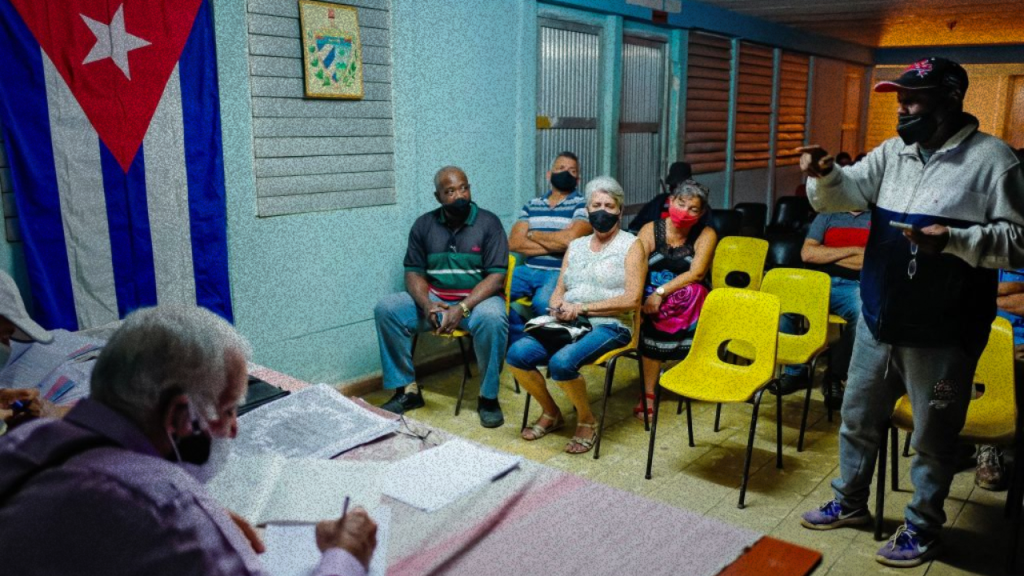
The process began not with a campaign announcement but with a public drafting procedure. Between February and April 2022, 6,481,200 Cubans participated in more than 79,000 neighborhood meetings, generating 336,595 documented interventions. The result was substantive: 49.15 percent of the articles in the draft were changed based on public feedback. The process ran through 25 distinct versions before a final text was submitted to a national referendum on September 25, 2022. More than two-thirds of voters — approximately four million people — approved the code, which legalized same-sex marriage and adoption, expanded protections for the elderly and people with disabilities, enshrined reproductive rights, prohibited child marriage, and restructured domestic care obligations toward gender equity. Progressive International described it as the most progressive Family Code in the world, noting that “nowhere in the world has a family law been submitted for public consultation and subject to a referendum.”
What is analytically decisive is the mechanism. No investor confidence narrative could discipline voters. No currency crisis could be engineered to signal economic punishment for approving expanded family rights. The multinational mining sector had no stake in blocking same-sex adoption. No CIA-linked media conglomerate controlled ninety percent of the press. The process, within its institutional constraints, produced a result that reflected deliberation rather than fear. The opposition — primarily from Cuba’s growing evangelical movement — was real, vocal, and free to express itself publicly. It lost.
The hostility this outcome generates in Western political commentary is not driven by concern for Cuban democratic deficits. It is driven by what the outcome implies about liberal democracy’s own. If capital’s veto power is what prevents genuine democratic results, then a process that removes that veto — even partially, even within a single-party state — will produce different outcomes. Cuba’s Family Code demonstrates this materially. The argument is not that Cuba has solved the problem of democracy. The argument is that it has identified one of democracy’s central structural obstacles — and, in this instance, removed it.
What the Comparison Reveals
Chile, Canada, and Cuba are not equivalent systems. The argument is not that Cuba provides an unqualified model for democratic organization. The argument is more specific: when you compare what participatory processes produce in the presence and absence of a capital veto, the results are not random. They follow structural logic.
In Chile, mass popular demand for redistribution — expressed through a 78-percent entry vote for constitutional change — was converted through capital’s disciplinary tools into majority rejection of the reform document. In Canada, capital discipline is embedded so deeply in institutional structures that armed police enforce pipeline injunctions against Indigenous peoples exercising rights recognized by the Supreme Court and international law. In Cuba, a participatory process without capital mediation produced the world’s most progressive Family Code, through 79,000 neighborhood meetings and 25 draft revisions, approved by a genuine popular supermajority.
The conclusion is not that liberal democracy needs reform, or that campaign finance regulation would solve the structural problem. The conclusion is that capital veto power over democratic outcomes is not an aberration of liberal democracy — it is its defining feature. Elections are permitted because they rarely threaten property relations. When they do, they are neutralized. The mechanism varies: here through currency pressure and CIA-linked media conglomerates, there through armed police and UNDRIP non-compliance, elsewhere through IMF conditionality and investment-risk ratings. The structural function is constant.
The persistent disengagement from electoral processes across liberal democracies is not a civic problem. It is a political reading. People sense the veto even when they cannot name it. They experience, concretely and repeatedly, that their participation does not produce the outcomes they seek.
Democracy either means collective control over material conditions, or it means managing who administers the existing distribution of property while that distribution remains beyond democratic reach. The evidence from 2022 alone — Chile’s constitutional defeat, Canada’s pipeline enforcement, Cuba’s Family Code approval — is sufficient to distinguish between the two.
Sources
- Al Jazeera — “Voting on Chile’s proposed constitution: What you need to know” (September 4, 2022): https://www.aljazeera.com/news/2022/9/4/vote-on-chiles-proposed-constitution-what-you-need-to-know
- Al Jazeera — “Canada police begin clearing Wet’suwet’en land defender camps” (February 6, 2020): https://www.aljazeera.com/news/2020/2/6/canada-police-begin-clearing-wetsuweten-land-defender-camps
- Amnesty International Canada — “Criminalization of Wet’suwet’en land defenders” (2023): https://amnesty.ca/wetsuweten-report/
- Amnesty International Canada — “Canada: Indigenous land defenders criminalized, surveilled and harassed” (2022): https://amnesty.ca/features/canada-indigenous-land-defenders-criminalized/
- Amnesty International — “International human rights organizations to monitor sentencing of Indigenous land defenders criminalized by Canada” (October 2025): https://www.amnesty.org/en/latest/press-release/2025/10/international-human-rights-organizations-to-monitor-sentencing-of-indigenous-land-defenders-criminalized-by-canada/
- Amnesty International UK — “Canada: Indigenous Land Defenders At Risk”: https://www.amnesty.org.uk/urgent-actions/indigenous-land-defenders-risk
- Belly of the Beast Cuba — “Families Code Referendum”: https://www.bellyofthebeastcuba.com/cuba-families-code
- Bloomberg — “Some Analysts Are Seeing a Currency Crisis in Chile’s Peso Slump” (July 14, 2022): https://www.bloomberg.com/news/articles/2022-07-14/some-analysts-are-seeing-a-currency-crisis-in-chile-s-peso-slump
- CBC News — “RCMP arrest 14, clear road on Wet’suwet’en territory” (November 18, 2021): https://www.cbc.ca/news/canada/british-columbia/rcmp-wet-suwet-en-pipeline-resistance-1.6254245
- CNN — “Chile rejects a progressive constitution with big changes” (September 5, 2022): https://www.cnn.com/2022/09/04/americas/chile-constitution-vote-intl/index.html
- Common Dreams — “In ‘Unprecedented Democratic Exercise,’ Cubans Approve Inclusive Family Code” (September 26, 2022): https://www.commondreams.org/news/2022/09/26/unprecedented-democratic-exercise-cubans-approve-inclusive-family-code
- Cubadebate (English) — “Cuba votes in referendum its new Family Code” (September 25, 2022): http://en.cubadebate.cu/news/2022/09/25/cuba-votes-referendum-its-new-family-code/
- Green Left — “Chile’s constitutional referendum undermined by right-wing disinformation campaign” (September 9, 2022): https://www.greenleft.org.au/content/chiles-constitutional-referendum-marked-right-wing-disinformation-campaign
- ING Think — “Chile’s IMF deal helps stabilise the peso” (August 30, 2022): https://think.ing.com/snaps/chile-peso-imf-fx
- Jones Day — “Chile’s Proposed Constitutional Changes to Natural Resources Rights Could Have Devastating Effects on Foreign Investors” (August 3, 2022): https://www.jonesday.com/en/insights/2022/08/chiles-proposed-constitutional-changes-to-natural-resources-rights
- Law and Inequality — “Cuba’s 2022 Family Code: A Different Model for Social Progress” (November 2, 2022): https://lawandinequality.org/2022/11/02/cubas-2022-family-code-a-different-model-for-social-progress/
- LSE Latin America and Caribbean — “Why we failed to approve the new Chilean constitution” (September 15, 2022): https://blogs.lse.ac.uk/latamcaribbean/2022/09/15/why-we-failed-to-approve-the-new-chilean-constitution/
- Media Manipulation Casebook — “Constitutional Vote In Chile Targeted By Coordinated Hashtag Campaign Before Election” (February 1, 2022): https://mediamanipulation.org/case-studies/constitutional-vote-chile-targeted-coordinated-hashtag-campaign-election/
- Morning Star — “Chile’s right is employing disinformation and lies to foment fear about the new constitution”: https://morningstaronline.co.uk/article/f/chile-right-is-employing-disinformation-and-lies-to-foment-fear
- NACLA — “Rejection of Chile’s Draft Constitution Serves a Blow to Progressive Government Agenda”: https://nacla.org/chile-constitution-rejection-boric/
- Narwhal — “RCMP patrol Wet’suwet’en territory despite UN calls for withdrawal” (February 22, 2021): https://thenarwhal.ca/rcmp-wetsuweten-territory-february-2021/
- Narwhal — “Coastal GasLink and Wet’suwet’en opposition: where things stand” (November 18, 2022): https://thenarwhal.ca/wetsuweten-coastal-gaslink-rcmp-overview/
- NPR — “Chile rejects a progressive constitution with big changes” (September 5, 2022): https://www.npr.org/2022/09/04/1121065756/chile-constitution-referendum
- Navia, P. — “El Mercurio Lies, and La Tercera Lies More: Political Bias in Newspaper Headlines in Chile, 1994–2010” (Bulletin of Latin American Research, 2015): https://onlinelibrary.wiley.com/doi/abs/10.1111/blar.12364
- Oxford Academic / Global Studies Quarterly — “Chilean Constitutional Convention: An Exercise for the Pluriverse” (2024): https://academic.oup.com/isagsq/article/4/3/ksae071/7876315
- Peoples Dispatch — “Cubans just ratified the world’s most progressive Family Code” (September 26, 2022): https://peoplesdispatch.org/2022/09/26/cubans-just-ratified-the-worlds-most-progressive-family-code/
- Phenomenal World — “Constitutional Odysseys” (December 2023): https://www.phenomenalworld.org/analysis/chile-constitution/
- Race and Equality — “Key points of the Cuban Family Code draft” (September 12, 2022): https://raceandequality.org/resources/key-points-of-the-cuban-family-code-draft-an-initiative-that-will-be-submitted-to-a-popular-consultation-on-september-25/
- Saldaña, Orchard et al. — “‘Your house won’t be yours anymore!’ Effects of Misinformation, News Use, and Media Trust on Chile’s Constitutional Referendum” (SAGE Journals, 2024): https://journals.sagepub.com/doi/10.1177/19401612241298853
- TeleSUR — “Final Version of Cuba’s Family Code Released in Official Gazette” (August 18, 2022): https://www.telesurenglish.net/news/Final-Version-of-Cubas-Family-Code-Released-in-Official-Gazette-20220818-0012.html
- Washington Post — “Chileans resoundingly reject new progressive constitution” (September 5, 2022): https://www.washingtonpost.com/world/chile-votes-on-proposed-constitution-with-big-changes/2022/09/04/63c048ea-2c06-11ed-a90a-fce4015dfc8f_story.html
- Wikipedia — “2022 Chilean constitutional referendum”: https://en.wikipedia.org/wiki/2022_Chilean_constitutional_referendum
- Wikipedia — “2022 Cuban Family Code referendum”: https://en.wikipedia.org/wiki/2022_Cuban_Family_Code_referendum






 Spark Solidarity