
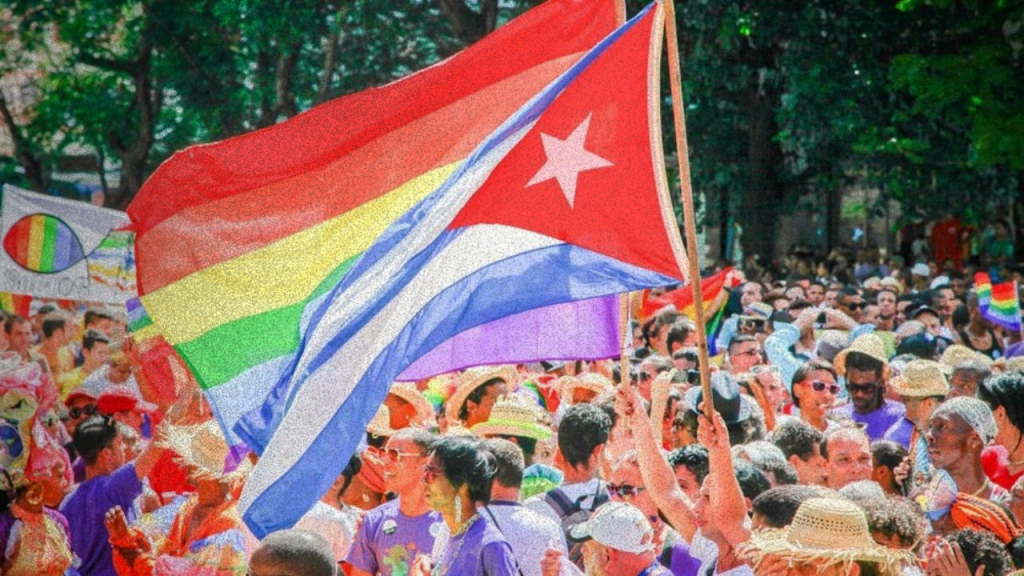
Cuba’s LGBTQ+ protections are national and constitutional, while U.S. rights vary by state and are being rolled back through law.
There is a comparison that reliably short-circuits discussion: queer and trans people have stronger legal protections in Cuba than in large parts of the United States. The response is almost always the same. Within one or two sentences, someone invokes authoritarianism, mentions political prisoners, or produces the word “dictatorship” as though it settles the matter.
What it actually does is change the subject. The question being asked is about laws — about what the state permits, protects, and criminalizes for vulnerable people. The deflection is about institutional form. Those are different questions, and conflating them is not an argument. It is a reflex.
This piece examines the laws. It draws on comparative indexes, statutory records, and documented policy outcomes. The finding is not surprising to those who have looked at the data: by several credible measures, Cuba’s legal framework for LGBTQ+ people is more consistent and comprehensive than that of a significant portion of the United States. This is not rhetoric. It is what the law says.
What “Freedom” Measures When You Are Vulnerable
Most global freedom indexes measure things that matter to elites: electoral competition, party pluralism, press licensing structures, property rights. These are not irrelevant, but they tell you very little about whether a trans teenager can access healthcare, whether a same-sex couple has adoption rights, or whether a non-binary person can change their legal documents without surgical requirements.
When freedom is defined materially — as the ability to exist without state-sanctioned harm, to access care, to form a recognized family, to hold legal identity — the comparison changes. A country with fewer parties but enforceable protections can be more free, in the ways that matter most to marginalized people, than a country with abundant elections and contracting rights.
This is not a semantic game. It is the foundation of any honest comparison. The question becomes: what does the law actually allow, prohibit, and guarantee for the people most likely to be targeted by it?
The same methodological move — replacing material outcomes with ideological abstraction — has been documented across other comparative measures, including the analysis of US and Cuban life expectancy, which shows a sanctioned island matching the richest country on Earth on the one number that reflects how a system actually treats its population.
What the Data Tracks
The most widely cited comparative dataset in this area is Equaldex, which tracks LGBTQ+ legal rights globally across categories including marriage, adoption, gender recognition, healthcare access, conversion therapy bans, and bodily autonomy. It does not measure cultural attitudes or political rhetoric. It measures laws — what is legally permitted, prohibited, or protected in each jurisdiction.
Equaldex is transparent in its methodology and updatable as laws change. Its Legal Index tracks 13 distinct issue areas and weights them by significance. In cases where a country’s laws vary by region — as in the United States, where marriage, healthcare, and discrimination protections differ enormously by state — the index averages across all jurisdictions equally. That averaging is, if anything, generous to the United States. It credits progressive state laws equally with states that have enacted outright bans.
Even with that methodological advantage, Cuba consistently outscores the United States on the Legal Index.
The gap is explained by a structural difference. Cuba’s protections are national, uniform, and embedded in the constitution. Cuba is one of only eleven countries globally that have coded LGBTQ+ anti-discrimination protections directly into their constitutional framework — alongside Bolivia, Ecuador, Malta, Portugal, Sweden, and a handful of others. The United States is not on that list. In Cuba, no province or municipality can simply decide that anti-discrimination law does not apply locally. In the United States, federalism makes that kind of fragmentation routine.
Cuba’s Legal Transformation
The most significant recent development in Cuba’s LGBTQ+ legal framework was the 2022 Family Code. Approved by national referendum, the code legalized same-sex marriage and adoption nationwide, recognized diverse family structures based on care and commitment rather than bloodline, expanded protections against gender-based violence, and strengthened legal standing for caregivers, elders, and people with disabilities. For queer and trans Cubans, this meant full legal recognition without provincial carve-outs or judicial uncertainty.
The 2022 code built on reforms that had been accumulating for years. Cuba has offered legal gender recognition without mandatory surgery since reforms implemented through the 2022 Family Code framework — surgery requirements, previously a barrier, were removed as part of that process. Gender-affirming care is available within Cuba’s public health system. Conversion therapy — the practice of attempting to change sexual orientation or gender identity — has no legal standing. Anti-discrimination protections apply in employment, housing, and public services at the national level.
These protections are enforceable. They do not depend on which county a person lives in, which political party controls the state legislature, or whether the current administration has decided to enforce federal law.
The American Patchwork
The United States operates under a fundamentally different structure. Federalism distributes power over healthcare, family law, education, and civil rights enforcement to states. In theory, this allows flexibility. In practice, it allows targeted rollback.
The numbers are concrete. As of July 2025, 27 states had enacted bans on gender-affirming care for transgender minors, with approximately 40 percent of trans youth between the ages of 13 and 17 living in affected states. In a number of those states, providing care carries criminal penalties for physicians. In some, parents who support their trans children in accessing care face legal risk. In just under two years, the number of states with such laws increased more than fivefold — from four states in June 2022 to twenty-three by early 2024, with additional states following since.
This is not a fringe phenomenon. It is coordinated legislation, passed in states controlling large portions of the US population, targeting a specific population’s access to medically endorsed care. Every major US medical organization — the American Medical Association, the American Academy of Pediatrics, the Endocrine Society, the American Psychological Association — supports gender-affirming care as evidence-based and medically necessary. The legislative wave has proceeded regardless.
Beyond healthcare, trans people in multiple states face legal restrictions on bathroom access, sports participation, and school identification. In some states, teachers are legally required to notify parents if a student uses a name or pronouns different from those on their birth certificate. The map of who can safely exist, and where, shifts at every state border.
For queer and trans people, this instability is not a theoretical concern. It is the daily condition of living in a country where rights are geographically contingent, federally unguaranteed, and subject to reversal at every election cycle.
The History, Honestly
None of this requires pretending Cuba’s record has been consistent. It has not.
From November 1965 to July 1968, the Cuban government operated the UMAP camps — Military Units to Aid Production — forced agricultural labor facilities in Camagüey Province where gay men, Jehovah’s Witnesses, Catholic priests, and others deemed ideologically suspect were interned under brutal conditions. By some estimates, approximately 35,000 people passed through these camps. Beatings, forced labor, and psychological abuse were systematic. In a 2010 interview with La Jornada, Fidel Castro called the persecution of homosexuals “a great injustice, great injustice!” and accepted personal responsibility — though no formal state apology followed.
The UMAP camps were closed in 1968 under pressure from the Cuban Artists and Writers Union and international condemnation, but repression continued in other forms through the 1970s. Homosexuality was removed from the Cuban Penal Code only in 1979. CENESEX, the National Center for Sex Education, was founded in 1977 and began the sustained institutional work that would, over decades, shift both policy and public attitudes.
In 2019, the Cuban government cancelled the annual Havana Pride march and detained activists who attempted to organize an unsanctioned alternative.
That episode reflects the Cuban state’s broader intolerance for independent political mobilization, not a reversal of its approach to sexual or gender rights. Taken in isolation, it is often misread as evidence of queer repression. Placed alongside Cuba’s contemporary legal framework, it instead highlights a familiar tension between political control and social reform.
These facts matter, but so does proportion. Cuba’s transformation on LGBTQ+ rights is real and substantial, especially when measured at the level of law and material guarantees. That this shift occurred in a country that, within living memory, operated gay labor camps does not negate the present framework; it contextualizes it. If anything, the distance between that past and the current legal order makes the change more historically striking, not less.
The material conditions shaping Cuba’s policy environment — including the economic pressures that constrain both reform and repression — are examined in the analysis of Cuba’s incarceration rate and the siege state, which documents how the US embargo functions as a permanent disciplinary mechanism distorting every comparative metric applied to the island.
Why Regime Labels Are Not an Argument
At this point the discussion usually stalls. Critics stop engaging with the laws and begin repeating labels: authoritarian, dictatorship, not a real democracy. These are deployed as conversation-enders, not responses.
The move conflates two distinct questions. One is about political pluralism — multiparty systems, press freedom, electoral competition. The other is about who the law protects. They are related but not identical, and treating one as the automatic answer to the other prevents analysis.
A country can restrict political opposition and still provide legally enforceable protections for queer and trans people. Another country can hold elections every two years and still allow half its states to criminalize trans healthcare. Both things can be true simultaneously. Acknowledging this is not relativism. It is the minimum required for honest analysis.
Western freedom rankings tend to weight electoral competition heavily and treat social rights as secondary. That weighting reflects particular ideological commitments about what matters most. It produces rankings that predictably flatter liberal systems regardless of outcomes for marginalized populations. Treating those rankings as neutral science is itself an ideological choice.
Meanwhile, freedom rankings that predictably flatter liberal systems regardless of material outcomes are one expression of an ideological architecture with deeper institutional roots — as examined in the analysis of Canada’s Victims of Communism Memorial, which documented how a $7.5 million federal monument came within revision distance of formally honoring Nazi collaborators as victims of the system it was designed to condemn.
What the Comparison Requires
The argument being made here is narrow. It is not that Cuba should be held up as a model, or that its system should be exported, or that political repression is acceptable when it coexists with social protections. The argument is more precise: on the specific question of legal protections for queer, trans, and non-binary people, Cuba’s current framework is more consistent and comprehensive than that of a large and growing portion of the United States.
That statement survives the UMAP history. It survives the 2019 Pride cancellation. It survives the absence of competitive elections. It survives because it is about what the law currently says, not about the totality of either society.
The same intellectual honesty must apply in the other direction. Celebrating federal ideals while states criminalize trans healthcare is not realism. It is branding. The United States contains multiple legal regimes operating simultaneously, some protective and some actively hostile, and no federal framework has proven capable of stopping the hostile ones.
The Uncomfortable Conclusion
Freedom, assessed materially, is not a brand. It is a condition produced by law. For queer, trans, and non-binary people, that condition depends on the ability to access care, to hold legal identity, to form families that the state recognizes, and to move through the world without state-sanctioned targeting.
By those measures, Cuba’s legal framework currently outperforms a significant portion of the United States. It does so as a country with a documented and serious history of anti-gay persecution — which makes the comparison not a vindication of Cuba’s overall record, but a sharper indictment of a system that brands itself as the global standard for human freedom.
The uncomfortable conclusion is not that Cuba is a better country. It is that “better country” and “stronger protections for this specific population” can point in different directions. When they do, the people whose safety depends on those protections are the ones who pay for our unwillingness to look at the data.
Sources
- Equaldex — “LGBT Rights by Country & Travel Guide”: https://www.equaldex.com/
- Equaldex — “LGBT Equality Index”: https://www.equaldex.com/equality-index
- Equaldex — “Right to Change Legal Gender in Cuba” (Log Entry #2746): https://www.equaldex.com/log/2746
- World Population Review — “LGBT Rights by Country 2026” (Cuba among 11 countries with constitutional LGBTQ+ protections): https://worldpopulationreview.com/country-rankings/lgbt-rights-by-country
- Human Rights Campaign — “Map: Attacks on Gender Affirming Care by State” (27 states, July 2025): https://www.hrc.org/resources/attacks-on-gender-affirming-care-by-state-map
- KFF — “The Proliferation of State Actions Limiting Youth Access to Gender Affirming Care” (fivefold increase, June 2022–January 2024): https://www.kff.org/other-health/the-proliferation-of-state-actions-limiting-youth-access-to-gender-affirming-care/
- NPR — “In just a few years, half of all states passed bans on trans health care for kids” (July 2024): https://www.npr.org/sections/shots-health-news/2024/07/03/nx-s1-4986385/trans-kids-health-bans-gender-affirming-care
- Wikipedia — “Military Units to Aid Production”: https://en.wikipedia.org/wiki/Military_Units_to_Aid_Production
- Wikipedia — “LGBTQ rights in Cuba” (UMAP, Castro 2010 interview, 2019 Pride cancellation): https://en.wikipedia.org/wiki/LGBTQ_rights_in_Cuba
- COHA — “From Persecution to Acceptance? The History of LGBT Rights in Cuba” (CENESEX founding 1977, 1979 decriminalization): https://coha.org/from-persecution-to-acceptance-history-of-lgbt-in-cuba/
- CNN — “States that have passed laws restricting gender-affirming care for trans youth”: https://www.cnn.com/politics/state-ban-gender-affirming-care-transgender-dg
- Equaldex — “Same-sex marriage by country” (Cuba 2022): https://www.equaldex.com/issue/marriage





 Spark Solidarity