
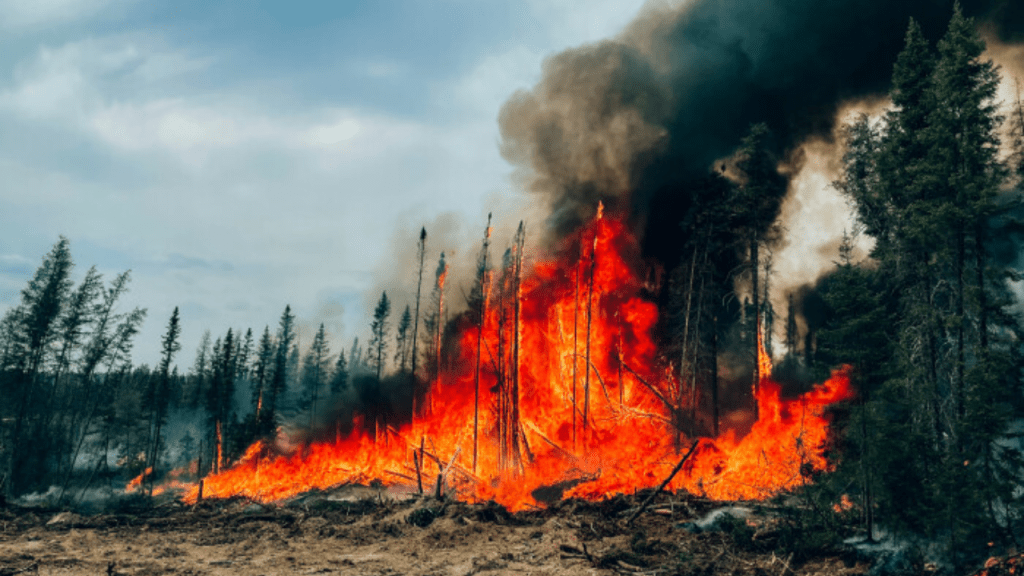
Over 4.3 million hectares have burned across Canada by July 2025, making this the second-worst wildfire season in recorded history.
By early July 2025, over 4.3 million hectares of land across Canada have gone up in flames—a staggering toll that makes this year’s wildfire season the second worst in recorded history.
With massive blazes tearing through provinces like British Columbia, Saskatchewan, and Manitoba, entire communities have been displaced, air quality has plummeted, and smoke has drifted across the U.S. border, disrupting daily life as far south as Minnesota. Experts say this is not just an emergency—it’s a preview of what’s to come in a world shaped by accelerating climate change.
The fires are overwhelming provincial resources and forcing public health officials, Indigenous leaders, and scientists to raise alarm bells. But as the flames spread and the smoke thickens, so too does the sense of abandonment among frontline communities asking: where is the federal response?
Manitoba in Emergency: Communities on the Front Lines
Nowhere is the situation more urgent than in Manitoba, where Premier Wab Kinew declared a second state of emergency on July 10, after fast-moving fires threatened multiple remote and rural areas.
The order triggered the mass evacuation of communities including Garden Hill First Nation and Snow Lake, with thousands forced to flee under increasingly chaotic conditions.
For many First Nations, this is not just a natural disaster but a failure of political will. Indigenous leaders have criticized the federal government for being slow to act, failing to coordinate support, and ignoring repeated warnings about the vulnerability of these regions. In Garden Hill, fire crews struggled to contain the flames as evacuation flights were delayed by heavy smoke, leaving elders and children trapped for hours.
“There are too many promises and not enough action,” said one local band councillor. “We need firefighting resources, housing for evacuees, and long-term planning—not just flyovers and press conferences.”
Smoke Without Borders: Air Quality Crisis Spreads
The destruction doesn’t stop with scorched earth. Smoke from these fires—dubbed “Can-smoke”—is now spreading across borders, blanketing towns and cities hundreds of kilometers away in a toxic haze. In Regina, Saskatchewan, a Canadian Football League game was postponed for the first time due to unsafe air quality. It’s a stark reminder that even areas far from the fires are being affected.
South of the border, Minnesota and other U.S. states are reporting haze and spikes in particulate matter, prompting health advisories for vulnerable populations. Cities like Minneapolis and Duluth have issued warnings for outdoor activity, while air quality apps have lit up red and purple across the Midwest.
The smoke doesn’t discriminate—it’s filling lungs and hospital beds across class and border lines. What starts in remote boreal forests is now becoming a transnational public health threat.
The Role of Climate Change
While individual fires may be sparked by lightning or human activity, the conditions fueling them are unmistakably linked to climate change. Canada is warming at twice the global average, and experts say rising temperatures, prolonged drought, and degraded forest ecosystems are turning once-manageable fires into runaway infernos.
“We’re seeing a fundamentally different fire regime,” says Dr. Amara Liu, a climate scientist at the University of British Columbia. “The fuel is drier, the heat is more intense, and the winds are unpredictable. These are the conditions that climate models warned us about, and now they’re here.”
Scientists point out that the fires are both a symptom and a driver of climate change. As trees burn, they release carbon into the atmosphere—making future fire seasons even worse.
Health and Environmental Consequences
The impacts on human health are immediate and widespread. Air quality monitoring platforms like IQAir have reported dangerously high levels of fine particulate matter (PM2.5) across Canada’s fire-affected provinces. These particles penetrate deep into the lungs and bloodstream, exacerbating conditions like asthma, bronchitis, and heart disease.
Hospitals in affected regions are already reporting increased visits from children, elders, and people with respiratory conditions. In some rural areas, clinics are overwhelmed or inaccessible due to road closures and evacuations.
The environmental consequences extend beyond human health. Wildlife habitats are being decimated, and the loss of vegetation increases the risk of landslides, soil erosion, and water contamination in the months to come. Many First Nations communities, whose traditional lands are being incinerated, are also experiencing cultural devastation as sacred spaces, traplines, and foraging zones go up in smoke.
What Comes Next: A Long, Hot Summer Ahead
Perhaps most alarming is the fact that we’re only halfway through the wildfire season. With weeks of dry, hot weather still ahead, public safety officials are warning that the worst may be yet to come. Fire bans are expanding, emergency crews are stretched thin, and coordination between federal and provincial governments remains patchy at best.
Emergency Management Minister Harjit Sajjan has promised additional funding and logistical support, but critics say reactive measures aren’t enough. There are renewed calls for a national firefighting strategy, Indigenous-led land stewardship programs, and major investments in climate resilience.
“This isn’t a one-off. This is the new normal,” said one firefighter near Fort McMurray. “And if we don’t start treating it that way, we’re going to lose a lot more than forests.”
A Wake-Up Call for the Nation
The 2025 wildfire season has already revealed how fragile Canada’s emergency infrastructure really is. It’s shown us that climate change isn’t just a future threat—it’s a present disaster, one that crosses borders, class lines, and political jurisdictions.
From the displaced residents of Garden Hill to the smoke-choked stadiums of Regina and the hazy skies over Minnesota, this summer’s fires demand more than sympathy or short-term aid. They demand a reckoning with climate inaction, a commitment to Indigenous leadership, and a reimagining of how Canada prepares for the crises yet to come.
The country is burning. The question now is who’s willing to do more than just watch it burn.


 Spark Solidarity