
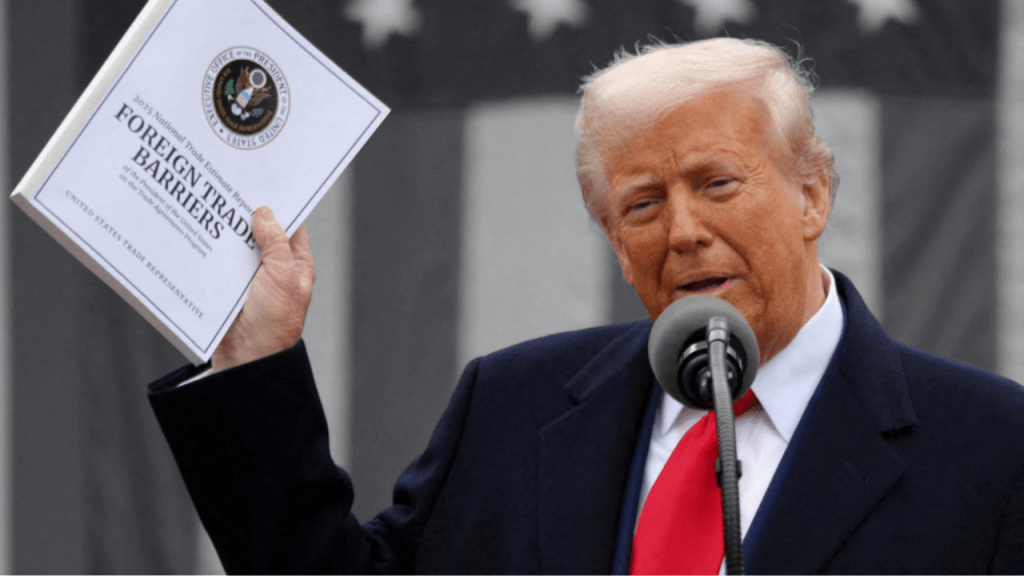
Trump’s 35% tariff on Canadian imports wasn’t a rupture in trade—it was a calculated humiliation, revealing the asymmetry Canada chose to ignore.
On July 10, 2025, U.S. President Donald Trump announced a 35% tariff on all Canadian imports, effective August 1.
The pretext? A reheated mix of grievances about “unfair trade” and Canada’s alleged failure to curtail fentanyl flows. As always, the rhetoric was crude, the spectacle deliberate.
But the logic was precise: this wasn’t policy. It was power projection—calculated humiliation disguised as enforcement.
Trump didn’t need facts to frame Canada as the economic parasite at the border. He needed a storyline that made subjugation look like correction.
And in that role, he excelled—casting Canada not as a partner in continental integration, but as a grifter in need of punishment.
Transactional, theatrical, punitive, this is Trump doing what the U.S. has always done to Canada, only now without the courtesy of pretending it’s mutual.
Markets got the message. The loonie dropped to a two-week low.
U.S. equity futures shuddered. Investors didn’t need a policy brief to understand what this meant: if Canada can be destabilized this quickly, it was never truly stable to begin with. The integration was shallow. The interdependence, one-sided.
Ottawa responded, as it always does, with the choreography of resistance and the posture of submission. Prime Minister Mark Carney called the tariffs “unwarranted economic aggression”—a phrase that might’ve meant something, if not followed immediately by appeals for deeper cooperation on fentanyl control and enforcement harmonization.
No countermeasures. No emergency response. No shift in posture. Just technocratic language meant to sound like resolve while avoiding any real confrontation.
But this moment isn’t a rupture—it’s a reveal. A forced unmasking of a long-standing, consensual asymmetry.
Canada didn’t lose its sovereignty last week. It traded it away years ago, quietly and proudly, in exchange for access and stability. The terms were always conditional. The hierarchy always implicit. Now it’s explicit.
This is not a crisis of relations—it’s their logical endpoint. Canada was never an equal partner. It was a junior firm in an imperial franchise. The 35% tariff didn’t break the deal. It merely reminded Canada that it was never holding the pen.
North American Integration Was Always About Hierarchy
The prevailing myth of the “rules-based order” held that Canada, the United States, and Mexico were equal participants in a mutually beneficial trade system. This was always a half-truth. From NAFTA’s inception in 1994 to the USMCA’s rebranding under Trump, the continental economic architecture has never operated on parity—it has functioned on hierarchy.
Canada’s economy—resource-rich, export-dependent, and strategically positioned—was tailored to fit a subordinate role: provide oil, lumber, electricity, and other essentials while importing American capital, consumer goods, and culture. In return, it received preferential access to the U.S. market—but only as long as that access served U.S. interests.
The system allowed Washington to retain maximum strategic flexibility, while binding its partners—Canada included—into a supply chain that could be restructured at will. Trade agreements didn’t constrain U.S. behavior; they constrained everyone else’s.
Canada’s Dependency Was an Elite Choice
What makes Canada’s vulnerability today so stark is that it was never inevitable. It was the result of conscious policy decisions made by Canadian elites.
In the 1990s, a bipartisan consensus emerged: the best way to secure prosperity was to anchor Canada’s economy as closely as possible to the American one, slashing industrial protections and liberalizing markets in the process.
This shift was institutionalized with NAFTA, which “fundamentally reshaped North American economic relations” through deep integration.
It didn’t come from public mandate—it was the culmination of elite-driven strategy. The Macdonald Commission, convened in the early 1980s, explicitly chose market mechanisms and a U.S. free‑trade deal as Canada’s future.
Provincial governments largely went along, despite early hesitations, under pressure from technocrats and corporate stakeholders .
The result: U.S. market access became a substitute for economic self-sufficiency, not a supplement to it.
Trump Doesn’t Break the System—He Clarifies It
It would be a mistake to treat this moment as a “Trump problem.” Trump’s tariff isn’t a departure from U.S. trade policy—it’s its natural evolution. He doesn’t disrupt the order; he strips it of its polite fictions. The threat was never that Trump would act outside the system—the threat was that he’d expose what the system actually is.
Under Obama or Biden, similar pressures existed: U.S. interests first, enforced through trade leverage. But they were cloaked in multilateralism and diplomatic language. Trump dispenses with that. He does not “return to normal”—he reveals that normal was never mutual.
What Canada is confronting is not just a belligerent U.S. administration—it is the design logic of North American capitalism: asymmetric interdependence in which smaller states exist at the mercy of larger ones, especially when crisis or electoral opportunism demands it.
Canada, Treated Like the Global South
What’s most striking is how closely Canada’s position now mirrors that of Global South countries under U.S. trade regimes. The structure is the same: the dominant power sets the terms, and the subordinate state is expected to comply or suffer consequences.
The difference is Canada still doesn’t recognize itself as peripheral. The country imagines it’s part of the imperial core—a liberal democracy in the inner circle of the West. But the tariff episode makes clear that proximity to power does not equal protection from it. Like many post-colonial states before it, Canada is now being asked to provide something—natural resources, border cooperation, symbolic alignment—in exchange for continued economic access.
This is the Global South playbook, simply applied with colder weather and better branding.
The Tariff Isn’t the Crisis—It’s the Proof
The 35% tariff should not be understood as a policy aberration. It’s a verdict on three decades of Canadian economic orthodoxy. A country that integrates itself so completely into another’s economic orbit must be prepared to live with the consequences, especially when that other country is governed by electoral cycles, economic nationalism, and a volatile leader.
Canada has spent decades mistaking stability for sovereignty. But stability built on dependency is always temporary. Now that the dependency has been turned into leverage, the myth falls apart.
What we are witnessing isn’t the collapse of the rules-based order. We are witnessing the moment the rules are used exactly as intended.
What Real Sovereignty Demands
If Canada wants to reclaim meaningful sovereignty, it cannot do so with talking points or fentanyl cooperation. It must confront the reality of its position in the global order. That would mean rebuilding industrial capacity, diversifying trade, and rethinking the neoliberal dogmas that got it here in the first place.
It would mean acknowledging that the problem isn’t Trump—it’s the structure that empowers him. It’s the global capitalist system in which polite democracies become instruments of extraction, and national sovereignty becomes a branding exercise for states that no longer make their own decisions.
Without that reckoning, Canada will remain what it is today: a polite subordinate in someone else’s empire, shocked—again—that the handshake was always conditional.




 Spark Solidarity