
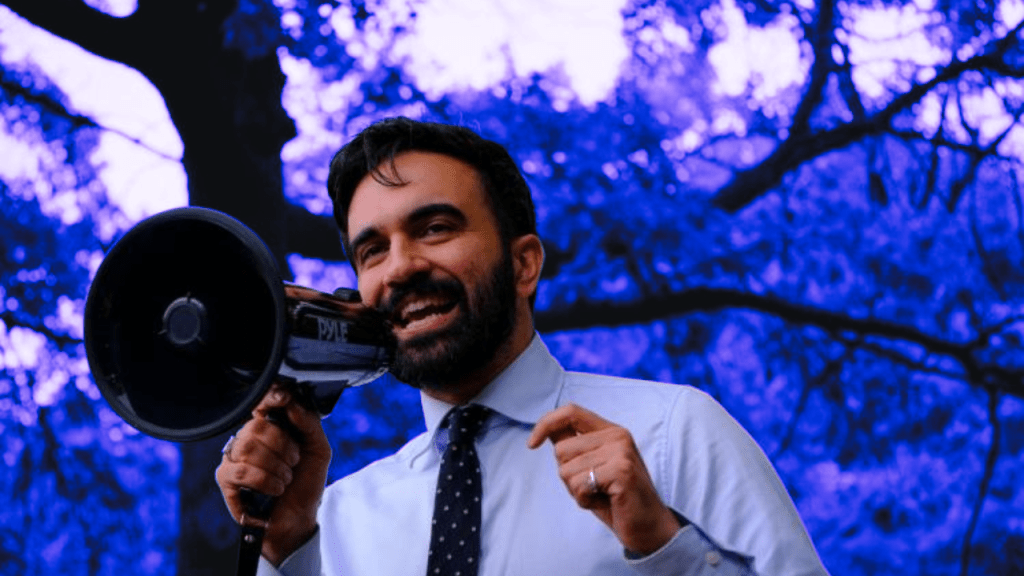
Critics of Zohran Mamdani’s run misunderstand how power works in U.S. politics—he’s not hijacking the Democrats, he’s beating them at their own game.
The people complaining about Zohran Mamdani representing the Democrats should probably stop and think about what that even means.
In a primary-based system, “representing” the party isn’t a role handed down by leadership—it’s won at the ballot box. And Mamdani, by running a competitive campaign for New York City mayor on an openly leftist platform, isn’t hijacking the party; he’s using its own machinery better than the people currently in charge.
The backlash he’s facing—accusations of being divisive, unelectable, or out of touch—reflects a deeper anxiety: that a candidate like Mamdani could actually win.
Because if he does, it will expose a truth that Democratic elites have spent years denying: popular support still exists for a progressive agenda, and it’s waiting for someone to activate it. This isn’t about symbolism. It’s about strategy. And Zohran is showing exactly how the left can still use electoral politics—at least locally—to create leverage.
The Primary Is the Party
In the United States, political parties aren’t rigid ideological institutions. They’re fluid coalitions. That’s especially true of the Democratic Party, where there’s no real membership, no binding platform, and no centralized enforcement of norms. Whoever wins the primary becomes the Democrat in that race—full stop.
That means party identity isn’t dictated by insiders. It’s defined by whoever can capture a coalition of voters. Mamdani understands this. His mayoral campaign isn’t some performative protest—it’s a calculated bid to take control of a power node the party itself left open. And it’s working: he’s gone from long-shot to frontrunner status, while the sitting mayor, Eric Adams, is so threatened by his rise that he’s reportedly considering courting Republican endorsements to stop him.
That right there is the game. A single high-profile primary—what we might call an “election of influence”—can reshape the incentives of an entire political ecosystem. If Mamdani wins, or even comes close, every consultant and donor in the city will walk away having learned a simple lesson: you can run left and still win in Democratic strongholds.
Running Left Moves the Goalposts
Critics keep calling Mamdani’s platform “unrealistic.” But that just means it hasn’t been legitimized by a win yet. Because once a policy appears on a viable primary platform, it immediately becomes part of the party’s issue space.
We’ve seen this before: Bernie Sanders didn’t win the presidency, but his 2016 and 2020 runs dragged the Democratic conversation toward the left.
By 2020, Joe Biden was publicly backing a $15 minimum wage and tuition-free community college—positions that were considered fringe just four years earlier. Similarly, Alexandria Ocasio-Cortez’s upset in 2018 mainstreamed the Green New Deal almost overnight.
Mamdani is now applying that same ratchet effect at the city level. His platform—fare-free buses, a wealth tax, massive social-housing expansion—isn’t just about this race.
It’s about setting the agenda for every other candidate in New York. Once the electorate sees those demands attached to a viable campaign, even centrist Democrats will have to start echoing them to stay relevant.
Coalition-Building Is the Real Poll
Another thing Mamdani’s campaign exposes is the lie that “there just aren’t enough progressives.” That narrative has always rested on the idea that the electorate is fixed, and that leftist candidates are somehow alienating a moderate majority. But in reality, the electorate is malleable—and Mamdani is reshaping it.
He’s stitching together a broad, intergenerational, multiethnic coalition: Muslim and South Asian communities, Gen Z leftists, disillusioned ex-Adams voters. This isn’t a boutique protest vote. It’s a working-class movement with serious numbers behind it. Each new bloc that joins proves the same point: the problem was never that progressive voters didn’t exist. It’s that no one was speaking to them.
This is the opposite of “dividing the party.” It’s what actual coalition-building looks like—starting with the communities most impacted by austerity, policing, and economic inequality, and giving them a real stake in power.
Why the Critics Are Wrong
Let’s quickly run through the most common attacks.
“He’s not a team player.” In a primary system, the voters decide who the team is. Party loyalty isn’t about falling in line—it’s about winning support.
“He’ll scare off moderates.” If that were true, Adams wouldn’t be begging Republicans to save him. The real fear isn’t that Mamdani is too far left. It’s that he’s too popular.
“His ideas aren’t realistic.” That’s what they said about Social Security. About Medicare. About public schools. Political realism changes the moment someone proves a policy can win.
Local Politics Is the Last Crack in the Wall
Let’s be honest: electoralism, as a national strategy for the left, is mostly dead. The federal government is captured by corporate interests, redistricted into oblivion, and insulated by a media ecosystem that treats any deviation from the neoliberal center as extremism. But there’s still space—small, fleeting, and fiercely contested—at the municipal level.
City governments control housing, public transit, policing, sanitation, and schools. They’re where budgets can shift and policies can actually change lives. That’s why races like Mamdani’s matter. Not because they offer salvation through the ballot box, but because they open up terrain where material conditions can still be shaped through political struggle.
If electoral politics has any remaining use for the left, it’s here: local, high-salience races where popular organizing can still bend the system, even if only slightly.
This Is Strategy, Not Spectacle
The people upset about Zohran Mamdani “representing” the Democrats are missing the point entirely. He’s not trying to be a brand ambassador. He’s running to win—and to shift the conditions under which everyone else has to operate. That’s not a betrayal of the party. That’s how parties change, if they change at all.
We should be clear-eyed about the limits of electoral politics. But we should also recognize moments where strategy meets opportunity. Mamdani’s campaign isn’t a fluke. It’s a signal: that when progressives organize, mobilize new coalitions, and contest power directly, they can’t be ignored.
This isn’t about faith in the system. It’s about forcing the system to respond. And that makes this one of the most important races in America right now.





 Spark Solidarity