
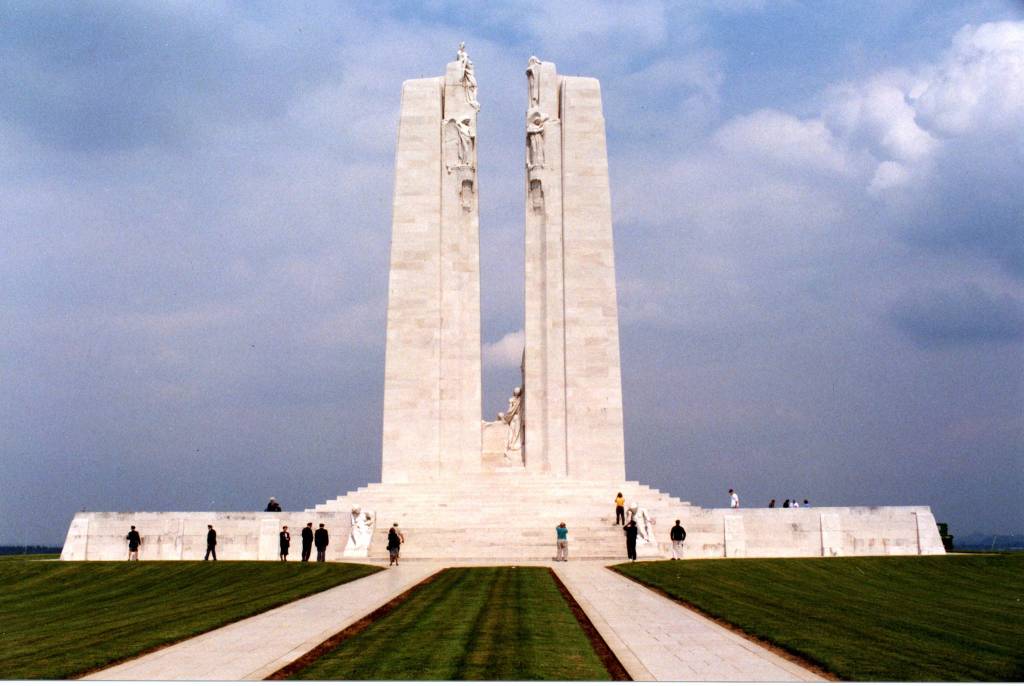
King Charles’s nod to Vimy Ridge wasn’t just history, it was a reminder of how Canada’s national myth recasts colonial obedience as independence.
When King Charles mentioned Vimy Ridge in his recent Throne Speech, it wasn’t an offhand reference. It was a deliberate nod to one of Canada’s most enduring national myths.
The story of Vimy Ridge is retold endlessly in classrooms, on monuments, and at ceremonies: that April 1917 was the moment when Canada came of age, when it proved itself as a nation on the world stage. Politicians, educators, and monarchs alike recycle this narrative as a unifying origin story.
But this story is less about independence than it is about obedience. Vimy Ridge was not the moment Canada became sovereign. It was the moment Canadians bled for an empire that still expected their loyalty and demanded their sacrifice. The framing of Vimy as a “birth of a nation” is not simply bad history; it is an act of mythmaking that launders colonial subjugation into patriotic pride.
To understand why this narrative endures — and why King Charles invoked it — we need to strip away the legend and confront the reality: Vimy Ridge was a British imperial operation retrofitted into a Canadian founding myth.
The Official Story of Vimy Ridge
The Vimy story is told in familiar terms. Four Canadian divisions, fighting together for the first time, seized the ridge after other armies had failed. This supposed triumph is celebrated as proof that Canadians were no longer just colonial subjects — they had become a people with their own destiny.
It is no accident that this framing stuck. A story of sacrifice and unity offers a powerful emotional anchor. Politicians speak of Vimy as the place where Canada was “born” because it wraps the grief of loss in the pride of achievement. The rows of graves become more than reminders of the first world war’s brutality — they are cast as milestones on the road to nationhood.
Yet this official story is a carefully curated illusion.
The Historical Reality
The reality of Vimy Ridge looks very different from the myth.
The Canadian Corps did not act independently. They fought under the command of British General Julian Byng, who dictated the overall plan.
The battle itself was not a stand-alone Canadian venture but part of the larger Battle of Arras, coordinated with French offensives and involving British divisions fighting directly alongside Canadian troops.
Most crucially, Canada at the time had no independent foreign policy. It was still a dominion, legally subordinate to Britain, with no seat at the table in shaping overall strategy. Decisions about war, peace, and sacrifice were made in London, not Ottawa.
Far from being a uniquely Canadian moment of sovereignty, Vimy was a British imperial operation from top to bottom — an operation in which tens of thousands of Canadians were ordered to die for goals they had no say in defining.
From Battle to Myth: Retro-Fitting a Founding Story
So why did Vimy Ridge become elevated into Canada’s sacred national narrative?
The answer lies not in 1917 but in the decades that followed. The sheer number of Canadian casualties gave the battle symbolic weight.
As Canada began searching for a distinct identity, Vimy provided a ready-made story: a moment of shared sacrifice that could be recast as a collective triumph.
But this was not a clean break from empire. Canada remained tied to the Crown, its institutions still subordinate to British rule. The myth of Vimy allowed Canada to claim an origin point without confronting the reality of colonial dependence.
In effect, Vimy was retrofitted into a founding story. It is a history that tells Canadians that their nationhood was earned not through independence or revolution but through obedient sacrifice under British command. It transformed needless bloodshed into the currency of national legitimacy.
Colonial Subjugation Rebranded as Independence
This is what makes Vimy such a powerful — and dangerous — myth. It rebrands subjugation as liberation.
Canadians are told that at Vimy, they proved themselves as a nation. But what did they prove, and to whom? They proved their willingness to die for the empire. They demonstrated loyalty to the Crown, not independence from it. And for this obedience, Canada was patted on the head — granted symbolic recognition while remaining firmly within the imperial system.
The myth of Vimy, then, is not one of nationhood achieved but of loyalty rewarded. It teaches Canadians that their identity was earned through submission, that sovereignty can be bestowed by empire rather than seized by the people themselves.
This is why the Vimy narrative remains central to Canadian memory. It masks subordination in the language of freedom. It turns imperial bloodletting into a supposed baptism of self-determination.
Modern Function: Propaganda and Reputation Washing
If this were simply about the past, it might not matter so much. But the Vimy myth lives on because it continues to serve political purposes today.
When King Charles invokes Vimy, he is not simply honoring veterans. He is reasserting the monarchy’s relevance, wrapping colonial loyalty in national pride. Politicians across parties do the same. By repeating the story of Vimy, they participate in a ritual that reputation-washes both the monarchy and the political class that sustains it.
Vimy functions as propaganda. It allows Canada to imagine it has outgrown colonialism without ever having to confront it. It flatters Canadians into thinking loyalty was liberation, that obedience was independence. And it ensures that the Crown remains a fixture of Canadian political life, not as a symbol of subjugation but as the supposed guarantor of freedom.
Baptized in Imperial Blood
Vimy Ridge was not where Canada was born. It was where it was baptized in imperial blood. The soldiers who died there did not win Canada independence; they were sacrificed in a battle planned in London for objectives that served the empire.
To continue repeating the story of Vimy as Canada’s “founding moment” is to mistake loyalty for liberation, obedience for sovereignty. It is to deny the reality that Canada remained, and remains, a monarchy — a nation still bowing to the very institution that demanded its sacrifice.
If we want to be honest about who we are, we must reject myths that disguise subjugation as progress. Canada does not owe its identity to Vimy Ridge. It owes it to the people who have struggled, and continue to struggle, for real self-determination — a struggle that cannot be won by dying for empire but only by confronting it.


 Spark Solidarity