
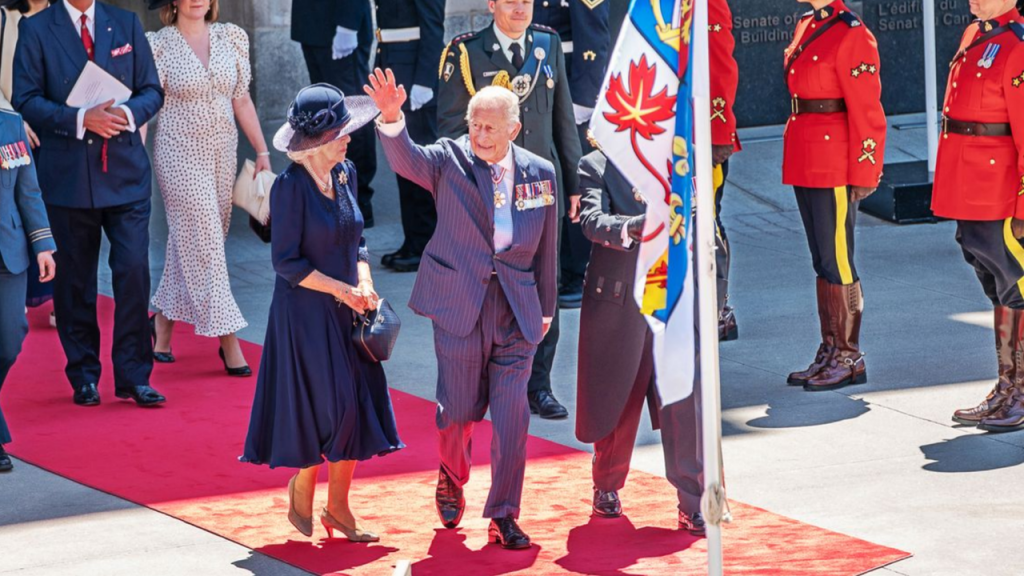
King Charles’s throne speech in Ottawa highlighted Canada’s paradox: a state that calls itself democratic while swearing allegiance to a monarch.
When King Charles delivered the throne speech in Canada’s Senate, he did so not as an elected leader but as a hereditary sovereign whose authority derives from birthright. Members of Parliament — the “commoners” — were ceremonially escorted into the chamber, a ritual inherited from Westminster that marks the formal opening of a democratic legislature by a figure nobody voted for.
The optics are familiar: guards in full regalia, cameras rolling, politicians rising to their feet. It is described as tradition, pageantry, or continuity. But it also reflects a paradox at the core of Canada’s political system: a state that calls itself democratic while swearing allegiance to a monarch overseas.
The moment drew little protest inside Ottawa. But the Bloc Québécois was not present. Their absence was a reminder that while much of English Canada treats the monarchy as a harmless ritual, Quebec’s political memory recognizes it as something else: a foreign colonial institution, imposed at gunpoint, that once defined who could rule and who would be ruled.
From Conquest to Constitution
The monarchy’s presence in Canada began not with ceremonial speeches but with military force. In 1759, British troops defeated the French at the Battle of the Plains of Abraham, beginning the conquest of Quebec.
Four years later, the Royal Proclamation of 1763 carved up Indigenous lands into Crown territory without consultation, entrenching a legal doctrine of dispossession that remains contested to this day.
In 1837, French Canadian rebels — the Patriotes — rose against British colonial rule. The rebellion was crushed, and Lord Durham’s subsequent report prescribed a program of assimilation. His words were blunt: French Canadians should be “made English.” From then on, the Crown became the formal vehicle through which colonial authority was imposed — in law, in governance, and in culture.
This history is not a footnote. The Crown was never neutral; it was an instrument of conquest and assimilation. The powdered wigs and robes that endure in Canadian institutions are reminders of that origin.
Quebec’s Distance from the Crown
Quebec’s estrangement from the monarchy accelerated in the 20th century. The Quiet Revolution of the 1960s secularized public life, built provincial institutions, and carried the slogan “maîtres chez nous” — masters in our own house.
The monarchy, with its rituals of deference to a foreign ruler, became increasingly obsolete in Quebec’s political imagination.
In 2022, the National Assembly passed legislation removing the requirement for elected officials to swear allegiance to the monarch. Members now pledge loyalty to the people of Quebec, not to a dynasty in London.
Public opinion reflects this shift. Only 14 percent of Quebecers say they want the monarchy to continue for generations, according to polling. The Bloc Québécois’s absence from Charles’s speech was not a gesture of rudeness but of consistency. In Quebec, the Crown is not tradition — it is colonial memory.
Powers and Inertia
In English Canada, defenders of the monarchy often insist it is “only symbolic.” But the institution retains real powers. In Australia in 1975, the governor general — the monarch’s representative — dismissed a sitting prime minister.
In Canada in 2008, Stephen Harper used the governor general’s authority to prorogue Parliament and avoid a non-confidence vote.
More recently, Boris Johnson used prorogation in the United Kingdom to sidestep parliamentary opposition.
These powers are rarely invoked, but their existence matters. They provide a mechanism for political leaders to manipulate parliamentary survival, and they remind citizens that authority in the Canadian system does not flow exclusively from the electorate.
Public sentiment has shifted. A recent Angus Reid poll found only 30 percent of Canadians want the monarchy to continue indefinitely, while 46 percent would prefer to abolish it.
Yet inertia sustains the status quo. Amending Canada’s constitution to remove the Crown requires unanimous consent from the House of Commons, the Senate, and all ten provincial legislatures. One veto preserves the monarchy. The political difficulty of such a reform ensures it remains untouched.
Apathy also plays a role. Nearly a quarter of Canadians say they do not care either way. In practice, indifference is what keeps the monarchy in place.
Indigenous Treaties and the Crown
If the monarchy were truly symbolic, its role in Indigenous relations would be easier to dismiss. But treaties across the country were signed not with “Canada” but with the Crown. This is often invoked to justify its continued relevance.
The reality is more complicated. Many of those treaties have been ignored or violated. Land has been seized, resources extracted, nations relocated, and governance structures undermined. The Indian Act tied band councils directly to Crown authority, overriding traditional hereditary systems of governance. Far from being symbolic, the Crown became the mechanism by which Canada managed colonial control over Indigenous peoples.
For this reason, Indigenous activists and scholars often argue that reconciliation requires more than apologies or symbolic gestures. It requires dismantling the Crown’s role as the intermediary. Treaties should form the basis of nation-to-nation relations — not be filtered through an institution that represents conquest and subjugation.
The Crown in Canadian Politics
King Charles’s throne speech was framed as ceremony. But the decision to invite him at this moment also served a political function. Amid Canada’s delicate negotiations with the United States and questions of national unity, the presence of the monarch projected stability and continuity. The pageantry was as much about optics as tradition.
For critics, this is the enduring function of the monarchy in Canada: a colonial mythology modernized into political theater. It reassures audiences at home and abroad that Canada is dignified, stable, and orderly — while sidestepping deeper contradictions about democracy, inequality, and colonialism.
Bloc Walkout Exposes the Crown
The Bloc Québécois’s absence from the throne speech was a quiet but telling act. In Quebec, the monarchy has little legitimacy. For much of English Canada, it persists not because it is cherished but because it is easier to leave untouched.
Yet the monarchy remains more than symbolic. It carries historical weight as the framework of conquest, political weight as a reserve of power, and cultural weight as a legitimizer of inequality. Canada may call itself a democracy, but until it confronts the contradiction of swearing allegiance to an unelected sovereign, the throne speech will continue to serve as a reminder — that the Crown still defines who holds power and who is subject to it.








 Spark Solidarity