
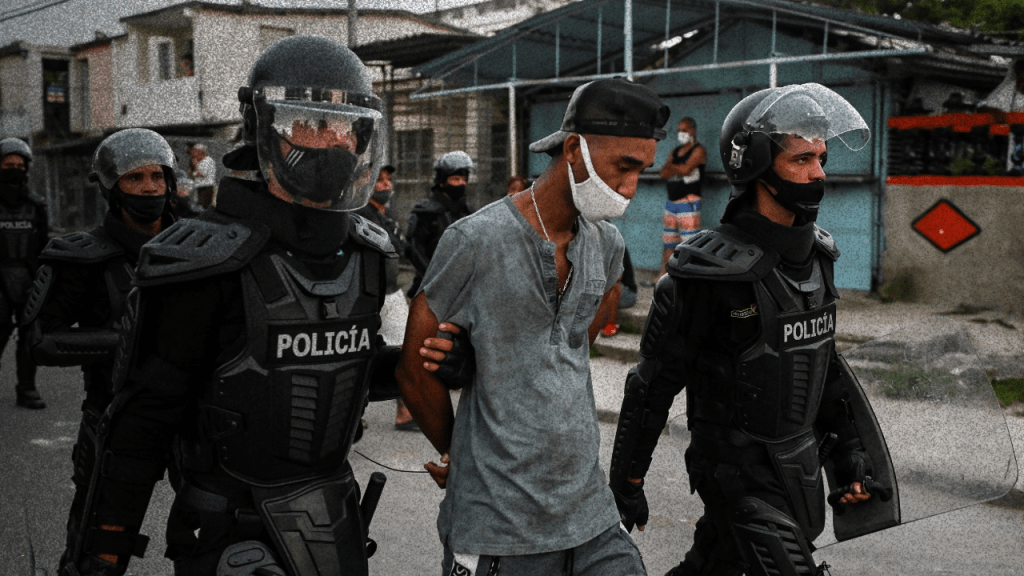
Cuba incarceration rate reflects embargo, regime-change funding, and 2021 crackdowns, not a self-contained verdict on socialism.
When people cite Cuba’s incarceration rate as a self-contained indictment of socialism, what they’re actually doing is presenting a number stripped of every condition that produced it.
The number itself is real. According to the Institute for Crime & Justice Policy Research’s World Prison Brief — the standard global reference, based at Birkbeck, University of London — Cuba holds 794 people per 100,000 inhabitants, placing it second in the world behind El Salvador.
The Prison Policy Initiative’s States of Incarceration: The Global Context 2024 notes the figure likely reflects both Cuba’s post-2021 crackdown and an expanded penal code, and suggests the actual current rate may be even higher.
The figure is accurate. What it means is a different question entirely.
This is a pattern worth naming. The same method — a number presented as self-evident indictment, stripped of every structural condition that produced it — shapes how the U.S.–Mexico border is narrated. As we argue in our structural analysis of the border crisis, the border is not malfunctioning. It is functioning exactly as designed, by the same forces that designed Cuba’s conditions.
A State Built Under Siege
Cuba’s legal and security apparatus did not develop under normal peacetime conditions.
From 1959 onward, the revolutionary government operated under permanent counterinsurgency pressure from the most powerful country on earth, located 90 miles away. The 1961 Bay of Pigs invasion made explicit what had already been implicit in U.S. policy: that the survival of the new state would be contested by force.
In 1962, the United States imposed a comprehensive embargo. That embargo is still in place today.
Every year since 1992, the UN General Assembly has voted on a resolution calling for its end — and every year the margin has been near-unanimous. In October 2024, as Democracy Now! reported, 187 countries voted in favor of lifting the sanctions. Only two — the United States and Israel — voted against.
UN News reported Cuba’s foreign minister called the blockade “a flagrant, massive and systematic violation of the human rights of our people.” The UN press coverage quotes Uganda’s delegate, speaking for the Non-Aligned Movement, noting Cuba lost over $5 billion in a single year simply from being denied access to international markets and development aid.
This is the backdrop against which Cuban law developed. Not a state in peaceful equilibrium making ideological choices — a state managing permanent existential pressure. What counts as a crime reflects that history.
The Special Period: When Survival Became Criminal
In 1991, the Soviet Union collapsed. For Cuba, the consequences were immediate and catastrophic.
NACLA’s analysis of the Cuban economy documents that 80 percent of Cuba’s total trade had been conducted with socialist bloc countries. Overnight, those relationships ended. Cuba lost its primary supplier of food, machinery, and oil. GDP shrank by roughly 35 percent.
As Jacobin’s coverage of the post-Soviet period notes, the Cuban government declared a “Special Period in a Time of Peace” — managing a crisis made worse by the fact that the U.S. responded to Soviet collapse not by easing pressure on Cuba, but by tightening the embargo further through the Torricelli Act (1992) and Helms-Burton Act (1996).
Scarcity exploded. Informal markets proliferated. Cubans engaged in currency trading, unlicensed commerce, and gray-market activity simply to eat.
The state responded by criminalizing many of these activities. From a materialist standpoint, the logic is legible: uncontrolled internal capital accumulation threatened to rebuild class stratification within a fragile socialist economy already under blockade. But the effect was to push incarceration rates upward — not primarily because of violent crime, but because economic survival had become entangled with state security concerns.
NACLA’s deeper analysis of the reform era — drawing on Cuban University of Havana economists — describes how market concessions of the 1990s produced “the reappearance of class and racial differences based on access to employment in tourism,” worsening inequality at precisely the moment the state was trying to contain it through law.
Opposition as a Security Category
Through the 2000s, U.S. policy toward Cuba became more openly focused on cultivating internal opposition.
This is not speculation. The National Endowment for Democracy (NED) openly documents its Cuba programs on its own website, describing efforts to “support a wide variety of independent social actors inside of Cuba” as part of a long-term strategy to bring about “the breakdown of authoritarian rule.”
People’s Dispatch, drawing on research by journalist Tracey Eaton, reported that in a single year at least 54 organizations received State Department, NED, and USAID Cuba-focused funding. Many of these “democracy-building” strategies, Eaton found, are classified as “trade secrets” and exempt from Freedom of Information Act disclosure.
As Roger D. Harris documents in Antiwar.com: Cuba consistently receives among the highest NED spending in Latin America — $6.6 million across 46 active projects — with programs explicitly aimed at producing government change, not merely civic development.
From the perspective of the Cuban state, this was not abstract civil society work. It was a foreign-funded political operation inside a small country with six decades of experience watching exactly how these operations unfold. Organizing outside state-sanctioned channels, receiving foreign funding, or coordinating with externally-backed networks became security matters — not merely civic ones.
Cuba has watched how these operations conclude. As we documented in our analysis of the quiet mechanics of U.S. intervention in Venezuela, the soft apparatus of NED funding and civil society infiltration is not an alternative to military force — it is the architecture that precedes and enables it.
This is the legal framework from which many cases labeled “political prisoners” by Western organizations originate.
2021: When All of It Converged
Any accounting of Cuba’s current incarceration rate has to reckon directly with July 2021, because that moment is embedded in the statistics.
After years of pandemic shortages, rolling blackouts, and sanctions tightened under both Trump and Biden, thousands of Cubans took to the streets. NACLA’s real-time coverage documented both the genuine economic desperation driving the protests and the social media amplification — including misinformation — that shaped how events were understood inside and outside Cuba.
Human Rights Watch reported more than 1,500 people detained, with courts eventually convicting over 380 protesters — some receiving sentences of up to 25 years on charges including sedition. Amnesty International named six as prisoners of conscience and described Cuba developing “a sophisticated machinery of repression” against peaceful assembly.
Jacobin’s reporting on the November 2021 follow-up protests — based on interviews with Cubans on the island — complicates the simple narrative: many who had protested in July did not join the November 15 demonstrations, which had been organized with open U.S. government backing, weighing their genuine economic grievances against the chaos and external manipulation that had come to surround the protest movement. Mass mobilization never materialized.
None of this makes 25-year sentences just. But none of it can be understood in isolation from the structure that produced the moment.
Two Carceral Systems, Two Functions
When comparing incarceration rates internationally, the analytical question is not just how many — but what is the prison for?
Loïc Wacquant, the French sociologist whose work on U.S. penology has become foundational, argues in his essay “From Slavery to Mass Incarceration” — published in New Left Review and republished by Black Agenda Report — that U.S. mass incarceration functions as a fourth “peculiar institution,” following slavery, Jim Crow, and the ghetto.
Writing in Boston Review, Wacquant argues the driver is not crime rates but the management of a racialized surplus population: “Not crime, but the need to shore up an eroding caste cleavage, along with buttressing the emergent regime of desocialized wage labour to which most blacks are fated… is the main impetus behind the stupendous expansion of America’s penal state.”
The United States holds 531 per 100,000. It has a private prison industry whose revenue is tied directly to incarceration volume. Its carceral system manages race, poverty, and labor market surplus — by Wacquant’s analysis, it performs the same social function slavery once did: controlling a population the system has rendered superfluous and threatening.
Cuba holds 794 per 100,000. It has no private prison sector. Its incarceration does not generate profit. Its prisons are not managing a racialized surplus labor force discarded by deindustrialization.
Both numbers are high. What they are doing is structurally different.
The Security State Was Produced
Cuba did not become a security state because socialism inherently produces security states.
Cuba became a security state because it has been subjected to over six decades of economic warfare, covert operations, regime-change funding, and diplomatic isolation — all directed by the most powerful country in the world, sitting 90 miles away.
People’s Dispatch’s analysis of U.S. interference infrastructure in Cuba documents the closed loop this creates: U.S. funding cultivates internal opposition networks; the Cuban state securitizes politics in response; Western media frames that securitization as evidence of inherent authoritarianism, which is then used to justify further funding and sanctions.
The architecture produces the conditions it claims to merely observe.
This closed loop is not unique to Cuba. As we documented in our analysis of U.S. intervention in Venezuela, the stated rationale — democracy, rule of law — consistently diverges from the structural function: disciplining sovereign states back into the U.S.-led order, regardless of what conditions that discipline requires.
End the blockade. End the regime-change apparatus. Count the prisoners again.
That is not a defense of a sentence. It is a demand for honest analysis.
Sources
- ICPR — Prison Populations Continue to Rise, 11.5 Million Held Worldwide (2024)
- Prison Policy Initiative — States of Incarceration: The Global Context 2024
- Democracy Now! — UN General Assembly Votes to Condemn US Embargo on Cuba for 32nd Consecutive Year
- UN News — General Assembly Renews Long-Standing Call for End to US Embargo Against Cuba
- UN Meetings Coverage — Speakers Decry Decades-Old US Blockade on Cuba
- NACLA — Sea Changes: The New Cuban Economy
- NACLA — Rethinking Cuban Socialism in the New Times of Crisis
- Jacobin — How Cuba’s Communists Survived the Fall of the Soviet Union
- NACLA — J-11 in Cuba
- Jacobin — Cubans Don’t Want Regime Change
- Human Rights Watch — Cuba: Crackdown on Protests Creates Rights Crisis
- Amnesty International — Cuba: Three Years After the Protests of 11–12 July 2021
- NED — Case Study: NED Programs Focus on Long-Term Effort to Open Up Cuba
- People’s Dispatch — The US Has an Unhealthy Obsession with Cuba
- People’s Dispatch — How US Interference in Cuba Creates a False Picture of Its Society
- Antiwar.com (Roger D. Harris) — US Reinstates Funding to Propaganda Outlet NED
- Loïc Wacquant / New Left Review — From Slavery to Mass Incarceration
- Black Agenda Report — From Slavery to Mass Incarceration
- Loïc Wacquant / Boston Review — Deadly Symbiosis: When Ghetto and Prison Meet and Mesh

 Spark Solidarity