
Every May 1st, workers around the world rise up in marches, strikes, and protests—not to celebrate, but to confront the forces that exploit, erase, and repress them.
On May 1st, across the globe, workers march, chant, rally, and sometimes riot. But in much of the West, especially in the colonial United States and so-called “Canada,” it passes with barely a whisper, overshadowed by commercialized “Labor Day” weekends or ignored entirely.
This is not a coincidence. May Day, or International Workers’ Day, is not a celebration. It is a threat.
Born in blood, shaped by struggle, and sharpened by repression, May Day has always been more than a day off, it is a rupture.
For the working class, radical, subversive, and even the more pragmatic socialist movements resisting capitalism, nationalism, colonialism, fascism, and imperialism, May Day is a mirror and a battlefield.
What it meant, what it means now, and what it could become is a map of how power responds to the possibility of solidarity.
Born in Flames: The Haymarket Origins
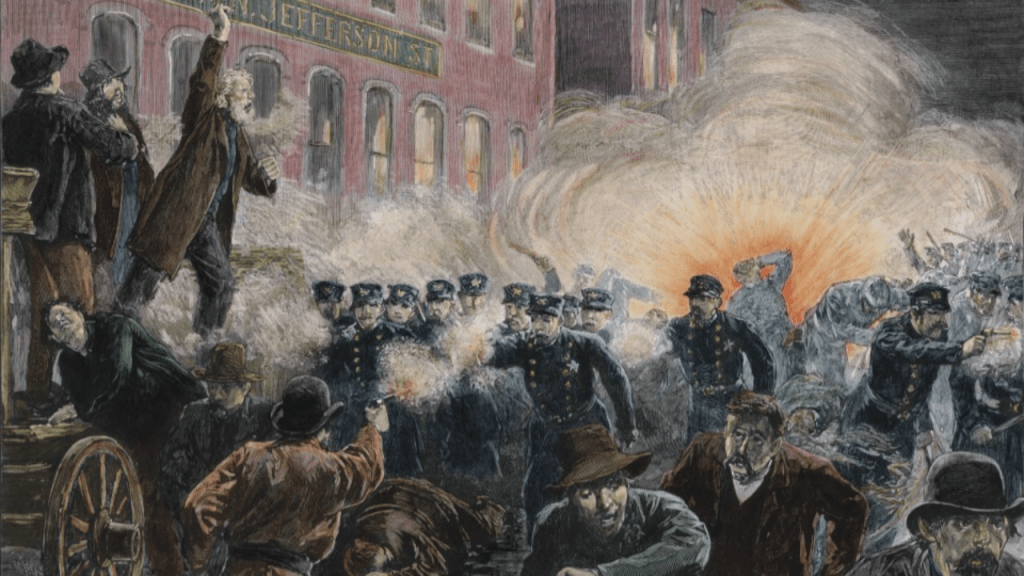
May Day emerged in North America from one of the most brutal crackdowns on the American labor movement.
In 1886, following a call by U.S. labor unions for an eight-hour workday to begin on May 1, hundreds of thousands of workers walked off the job. In Chicago, police killed several striking workers at the McCormick plant.
The next day, a protest rally at Haymarket Square was bombed. In the aftermath, eight anarchists were arrested—most had nothing to do with the bomb. Four were executed. The message from the state was clear: challenge capital, and you will hang.
The Haymarket affair reverberated globally. In 1889, the Second International declared May 1 a day of international working-class solidarity.
From London to Havana to Kolkata, it became a flashpoint. “One pound of dynamite is better than a bushel of ballots,” a radical flyer from 1886 declared.
That sentiment terrified capital and the state, which is why the U.S. eventually invented its own version of “Labor Day” in September, divorced from history, from class war, and from memory.
Global May Days: A World of Struggles
May Day was never just American—nor did the tradition of honoring labor begin in the United States. Long before Haymarket, workers in Europe and Australia held their own labor commemorations and stoppages.
But by the 20th and 21st centuries, May 1st had crystallized into a global calendar date of defiance, a symbol that regimes have tried to co-opt, sanitize, or crush.
In Latin America, May Day became a rallying point for class war. In 1909, police opened fire on striking workers in Buenos Aires, killing dozens.
In Cuba, massive state-orchestrated May Day rallies under Fidel Castro declared defiance against U.S. imperialism.
Meanwhile, in Colombia, labor organizers were assassinated with impunity, more than 80% of all unionist murders globally occurred there for a time. Yet each year, people still marched.
In Europe, May Day has long been a battleground between state spectacle and grassroots radicalism. In France, unions like the CGT organize massive protests, often joined by autonomous anarchist black blocs who confront police repression and inject a much needed militant energy into the day’s actions.
In Germany, Berlin’s Kreuzberg neighborhood becomes a temporary autonomous zone of protest.
In Asia, the contradictions are sharper. In Turkey, the state bans May Day protests in Taksim Square, site of a 1977 massacre, and arrests dozens every year.
Meanwhile, South Korean and Filipino workers rally defiantly, often under red flags and revolutionary slogans, demanding wages, dignity, and sovereignty.
Africa, too, reflects the Janus face of May Day. In South Africa, COSATU holds official events, but tension between labor and state is palpable. In Morocco and Zimbabwe, workers face violent repression.
In Tunisia, the post-Arab Spring energy pulsed through May Day rallies, only to be met with new waves of authoritarian backlash.
In North America, particularly among immigrant and undocumented workers, May Day has found new life.
In 2006, the massive “Day Without Immigrants” mobilized millions in the U.S. to shut down workplaces, schools, and streets, restoring May Day’s disruptive legacy.
For Indigenous peoples and racialized workers within so-called “Canada,” May Day offers a platform for decolonial resistance and cross-border solidarity.
The Media War Over Meaning
May Day’s radical history has been suppressed not just by governments, but by media. After Haymarket, newspapers launched a moral panic over “bomb-throwing anarchists.”
For decades, the image of May Day was filtered through a lens of violence and foreignness.
In modern times, mainstream media continue this erasure. When Occupy-era protests revived May Day demonstrations in 2012, major media outlets like declared the actions a “dud,” ignoring thousands in the streets.
Local news in Seattle or New York focused on “property damage” rather than labor demands. In many countries, the day is reduced to human-interest stories about festivals and weather.
Meanwhile, independent and underground media have played a crucial role in preserving May Day’s radical core. From anarchist zines to socialist newsletters, and now through podcasts, livestreams, and radical digital media like this, organizers continue to tell the truth about what May Day is, and why it matters.
Gig Workers, Green Labor, and Digital Uprisings
Today, May Day is no longer just about unionized factory workers. It is about warehouse pickers, delivery drivers, data-entry gig workers, migrant laborers, nurses, and precarious artists.
It is about striking Amazon workers. It is about Indigenous land defenders. It is about Filipino nurses and Haitian delivery drivers and Palestinian construction workers. It is about sex workers demanding dignity and protection.
It is also about the climate. May Day has increasingly become a convergence point for labor and environmental movements.
The call for a “just transition” links fossil fuel divestment to good jobs, while climate strikes learn tactics from past May Days.
Tech workers and gig workers now stage “May Day caravans,” organize on encrypted platforms, and file class-action lawsuits against Uber, Amazon, and Google.
The advanced world of surveillance capitalism may make organizing harder, but also more urgent.
May Day is no longer just a protest.
It’s an archive. It’s a stage. It’s a network.
The Future of May Day: Collapse or Revolution
The 21st century is defined by crisis: climate catastrophe, digital precarity, war, authoritarian resurgence, and pandemic exhaustion.
In this chaos, May Day can either wither into a historical footnote, or ignite something new.
If labor movements remain siloed, co-opted by liberalism, or reduced to branding exercises, May Day will be meaningless.
But if radical movements continue to link climate justice, migrant rights, decolonization, digital autonomy, and anti-imperialism, May Day becomes not just a day of memory, but a declaration of war on a system that cannot be reformed.
Transnational coordination is already underway. Arab, African, and Global South trade unions are building unified alliances. Indigenous land defenders are joining forces with climate and housing coalitions, forging a shared front against exploitation, displacement, and imperialism.
Workers are not waiting for permission. The question is whether the rest of us will show up.
No One Gives You May Day—You Take It
May Day has always belonged to those who refuse to be governed quietly. Its history is not one of reform, but rupture. Its legacy is not respectability, but rebellion.
To march on May 1st is to step into a history of martyrs and militants. To strike is to say no to the logic of capital. To remember is to refuse erasure.
May Day is not a holiday. It is a weapon. Use it.

 Spark Solidarity