
During Canada’s federal debates, the CBC’s refusal to confront Indigenous genocide denial revealed a deeper institutional complicity masked as journalistic neutrality.
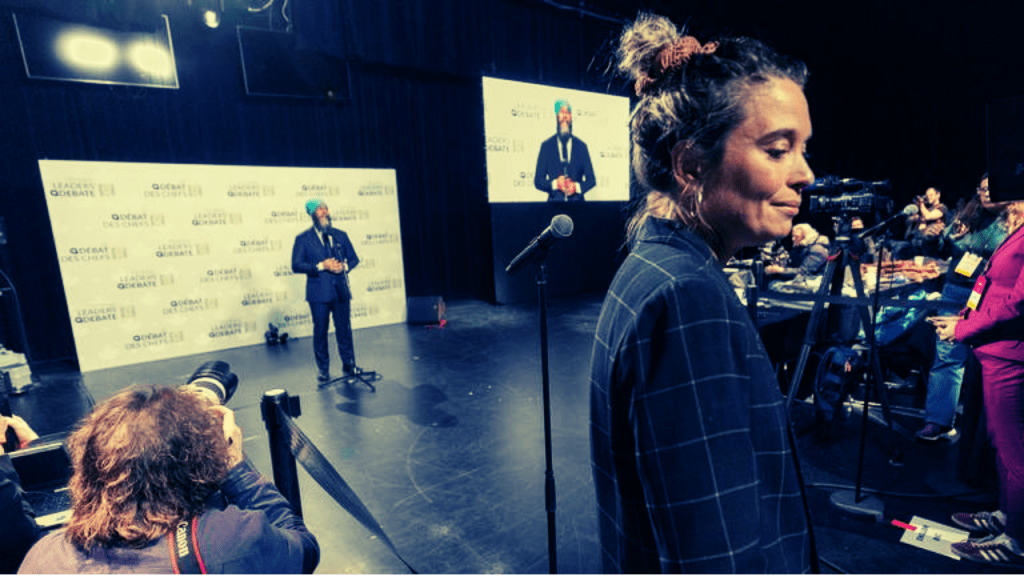
During the recent Canadian federal leaders’ debates, something grotesque happened in plain sight: the denial of Indigenous genocide was broadcast to a national audience—and the CBC said nothing.
When a Rebel News reporter claimed no bodies had ever been found at residential school sites, parroting long-debunked denialist rhetoric, the national broadcaster chose to remain silent. No fact-checks. No clarification. No challenge. Just a quiet nod to “balance” and “objectivity.” And in doing so, the CBC revealed something deeper than a momentary lapse. It exposed the rot at the core of Canadian media: a cowardice disguised as neutrality, a moral abdication dressed up as professionalism.
This isn’t about any one journalist. It’s not about whether Rosie Barton or David Cochrane did enough (though their silence spoke volumes). It’s about the systemic refusal to name what is happening. It’s about a public broadcaster, funded by all of us, consistently choosing to ignore violent disinformation—so long as it comes wearing a suit and speaking the language of “debate.”
The Myth of Neutrality
The CBC likes to imagine itself as a neutral arbiter of truth, a bastion of balance in an increasingly polarized world. But neutrality in the face of fascism is not objectivity—it’s complicity. When the national broadcaster fails to correct clear disinformation, when it refuses to confront those who exploit legal and rhetorical loopholes to push racist talking points, it becomes a partner in that project.
This isn’t a bug. It’s a feature. It’s the white settler consensus being distilled, sanitized, and broadcast through the lens of journalistic neutrality. It’s how institutions in Canada manufacture consent—not through brute force, but through polite silence, the deflection of responsibility, and the flattening of moral stakes into “just another opinion.”
Platforming Genocide Denial
The moment during the French debate was as stark as it was predictable. A Rebel News reporter echoed one of the far right’s most insidious claims: that the discoveries of unmarked graves at former residential schools were never substantiated.
This rhetoric has circulated since the early days of the Truth and Reconciliation Commission. It has been thoroughly debunked by ground-penetrating radar, corroborated by survivor testimonies, and verified by thousands of documented deaths.
But instead of immediately pushing back, CBC sat silent. No real-time correction. No context. No acknowledgment of the harm. And so the lie was allowed to hang in the air, unchallenged, normalized, domesticated. It became, in the eyes of the audience, just another side of the debate.
This is how settler colonialism sustains itself—not only through past violence, but through present erasure.
Developers, Denial, and the Stakes Beneath Our Feet
This denialism is not just about ideology. It’s about the land. It’s about profit. As urban development pushes into formerly untouched areas—former church lands, federal property, places where unmarked graves may still lie—denial becomes a useful tool.
If the public can be convinced there’s “no proof,” then the inevitable discovery of more bodies can be brushed aside. Developers and their media allies are pushing a narrative that creates plausible deniability, even as they pave over the past.
In places like Quebec, this issue will become even more pressing. As more land is disturbed, more truths will emerge. And denialists—whether in far-right media or mainstream institutions—will be ready to spin it.
It’s no accident that outlets like the National Post and figures like Sue-Ann Levy are backing this rhetoric. It serves political and economic interests. And when the CBC allows it to go unchecked, it isn’t just failing in its duty—it’s helping to cover it up.
CBC’s Role in the Status Quo
For all its branding as Canada’s moral compass, the CBC has repeatedly proven itself to be a stabilizing arm of the state. It maintains the fiction of a “balanced” public sphere, while quietly pushing politics to the right. It slashes Indigenous coverage budgets, avoids uncomfortable truths, and sanitizes national conversations.
During the debates, no one mentioned the RCMP’s violent suppression of Indigenous land defenders. There was no acknowledgment of the systemic roots of colonial policing, of pipelines forced through sovereign territory, of the criminalization of Indigenous resistance. Instead, the CBC aired a “balanced” discussion where colonial violence was not even named.
This is not balance. It’s erasure.
The CBC’s silence isn’t just a failure to inform—it’s a failure to act as a moral institution. And that silence, again and again, protects the illusion of civility while violence continues unchecked beneath the surface.
Dangerous Climate, Empty Words
The CBC itself acknowledges the rise in political extremism, the creeping normalization of fascist rhetoric, and the spread of hateful ideologies. But what does it do about it? Slot it into a quick segment between weather and sports. Frame it as part of the “diverse views” of a healthy democracy. Refuse to pick a side—even when one side is denying genocide.
This is the rot. The moral cowardice. The institutional decay that sets the stage for far-right politics to thrive under the guise of “legitimate discourse.” And it’s what lets liberal centrists pretend they’re above it all while helping to create the conditions for it to spread.
This isn’t just a CBC problem. It’s a Canadian problem. A pathology of politeness, a compulsion to remain “civil” in the face of violent extremism, a fear of discomfort that trumps the need for truth.
Silence as Complicity
In moments of crisis, public broadcasters are supposed to clarify, contextualize, and confront. The CBC did none of these things. It remained silent in the face of active disinformation. And that silence wasn’t neutrality—it was participation.
To treat Indigenous genocide denial as just another opinion is to help erase the past, obscure the present, and undermine the future. It is to perpetuate the colonial foundations upon which this country was built. And it is to side, again and again, with power over justice.
The CBC can’t keep pretending it’s a victim of political polarization. It is a co-author of the moment we’re in. And if we don’t name that plainly, we are helping write the next chapter.

 Spark Solidarity