
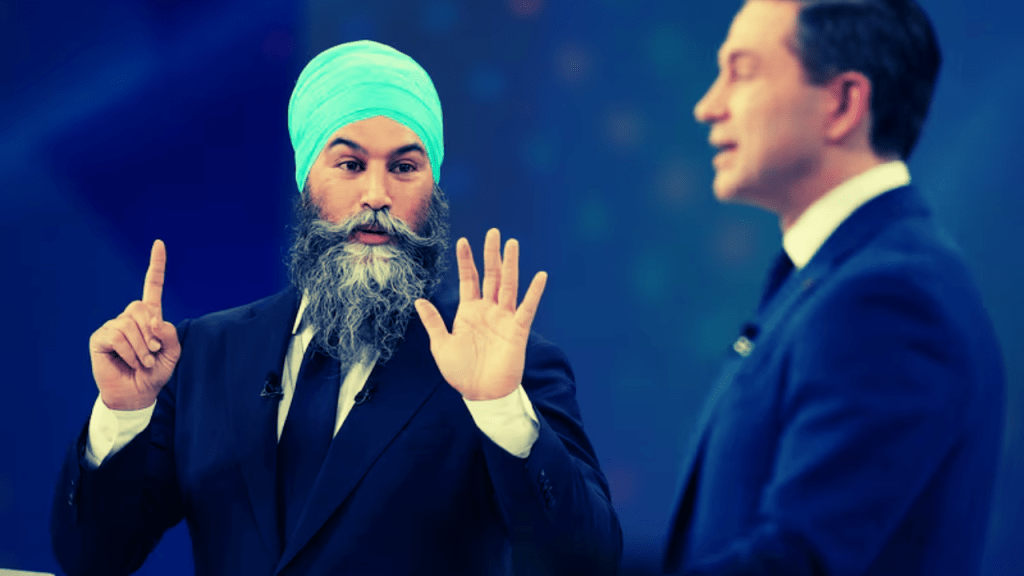
Jagmeet Singh came swinging in this debate—but it felt more like a desperate attempt to prove the NDP still matters. In a system built to sideline alternatives, Singh’s fire hit hard but flared out fast. This wasn’t strategy—it was survival.
In this year’s Canada federal leaders’ debates, Jagmeet Singh didn’t show up as a third-party nice guy with a moral message, he showed up as a man on the edge. Frustrated, cornered, and all too aware of his party’s shrinking relevance, Singh entered the stage not to win votes but to remind voters he and the NDP still exist. It wasn’t an audition for power. It was an act of survival.
Since the pandemic, the NDP has drifted to the sidelines, acting more like Parliament’s conscience than a competitor for government. Singh’s support of the Liberals via confidence agreements has earned him little more than a reputation as Trudeau’s plus-one at the legislative ball. The real contest, the media tells us, is between the technocrat and the demagogue. Singh’s job, if he even has one, is to cheer from the margins.
But in this debate, Singh refused to stay quiet. His tone was different—sharper, more confrontational. Every interruption, every jab, carried a sense of urgency. He wasn’t playing referee. He was trying to jam a wrench into the two-speed bike pedaled by the Liberals and Conservatives for the past decade.
His rhetorical targets were precise. Mark Carney, the moonwalking technocrat easing out of Bay Street’s shadow into Trudeau’s throne. Pierre Poilievre, the self-styled man of the people, yelling into his phone about “gatekeepers” while pledging deregulation and austerity. Singh called them out, directly and clearly—something many on the left have begged him to do for years.
For a moment, it worked. Singh landed shots. He talked housing, mental health, price gouging—issues that touch millions. But as with a fighter down on points, it was less a strategy to win than a flailing attempt to stay standing. He swung hard because he had to, not because it would change the outcome.
And that’s the tragedy: the system is designed to absorb or ignore precisely this kind of performance. The debate format, media coverage, and Canada’s first-past-the-post electoral system all conspire to shut out third parties. Singh, for all his sincerity, sounded like a man yelling into a soundproof room. You could feel his fire, but the room wasn’t built to let it spread.
The broader dilemma is cruel. If Singh pulls his punches, he fades into irrelevance. If he swings hard, as he did here, he risks being dismissed as performative—desperate rather than determined. And yet, what choice does he have? For years, Singh played the careful insider, hoping incremental influence would yield results. It didn’t. Now, with his party staring down seat losses to the very Liberals he propped up, the gloves are off—but it may be too late.
Singh’s pivot to a more combative tone is admirable. But it should have happened years ago, when the NDP had real leverage. Now, it reads as reactive. The electorate has been conditioned to see Singh’s party not as a real alternative, but as a conscience or coalition partner at best. A checkmark beside someone else’s agenda.
The tragedy is structural. The NDP is still the only national party pretending to challenge the neoliberal status quo. But Canada’s political ecosystem, media, elections, institutions—is built to crush that challenge. The more Singh tries to assert the NDP’s relevance, the more the system resists, until even his boldest moments feel like echoes in a chamber built to silence.
He came to fight. He brought fire. But the match was fixed long before the bell rang.

 Spark Solidarity