
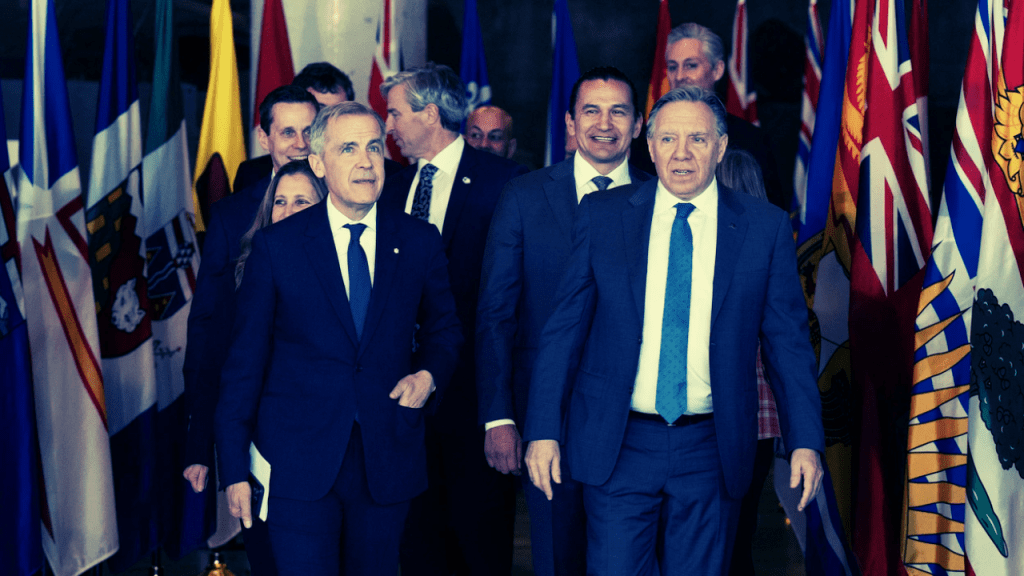
Mark Carney’s push to unify Canada’s economy may sound like smart policy, but it’s a move to centralize power and serve capital at the expense of workers.
Mark Carney’s proposal to transform Canada into “one economy, not 13” is being sold as a common-sense plan to reduce inefficiencies and promote national productivity. But beneath the surface of this technocratic language lies a deeper political project—one aimed not at helping workers or small businesses, but at consolidating power at the federal level and removing local barriers to corporate expansion.
Carney points to Canada’s so-called economic fragmentation—interprovincial trade barriers, differing licensing standards, and conflicting regulations—as a drag on growth. In theory, harmonizing these differences could improve the flow of goods, services, and labor across the country. But in practice, what this plan does is eliminate one of the few remaining checks on corporate power: provincial autonomy.
Provinces currently maintain their own labor laws, environmental protections, tax codes, and industrial regulations. While far from perfect, these frameworks offer at least a minimal degree of democratic responsiveness to local economic conditions.
Under Carney’s vision, that power would shift toward Ottawa, where corporate lobbyists already have outsized influence. This isn’t about national unity—it’s about making Canada more navigable for capital by sidelining local governments and standardizing operations, often at the lowest possible bar.
The word Mark Carney keeps using is “efficiency,” but the real question is: efficiency for whom? If removing interprovincial barriers resulted in higher wages, better working conditions, or stronger regional economies, we’d be having a different conversation. But that’s not the goal here. The goal is to smooth the path for large firms to expand without needing to adapt to local rules—rules that are often dismissed as “red tape” but in reality serve as protections against exploitation.
Carney’s background speaks volumes. As the former governor of both the Bank of Canada and the Bank of England, he is a well-known figure in global finance circles. His priorities reflect that world. When he talks about productivity and modernizing the Canadian economy, he’s not talking about empowering workers or strengthening communities. He’s talking about creating a seamless market environment for investors and multinational corporations.
Take Ontario as a case study. Under Premier Doug Ford, the province has aggressively slashed regulations, undermined environmental protections, and gutted labor standards in the name of economic efficiency. It’s no coincidence that Carney’s proposed national model mirrors these same priorities.
If implemented, it would extend Ontario’s approach across the entire country, turning provinces into passive administrators of Ottawa’s economic agenda.
Quebec may offer some resistance, thanks to its distinct legal system and strong tradition of provincial autonomy. But even that could be undermined by federal maneuvering or backdoor agreements that strip away local control under the guise of national integration.
Carney wants to frame this shift as pragmatic governance. But in reality, it’s a centralization of economic decision-making in service of capital, not people. It’s a race to the bottom—where efficiency means eroding standards, and unity means silencing dissent. If we follow the money, it becomes clear who this plan really serves.








 Spark Solidarity