
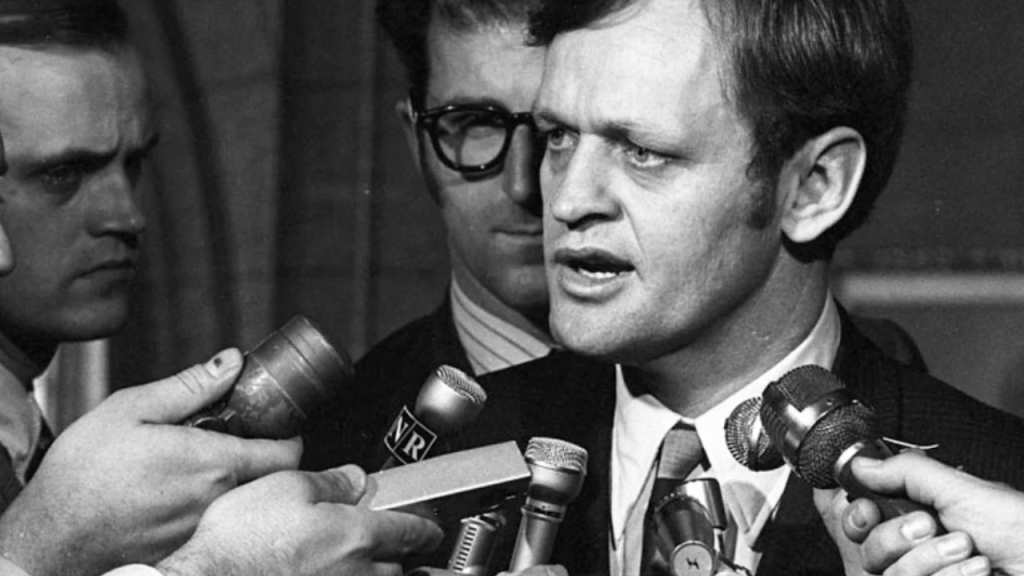
At the recent Liberal leadership convention, Jean Chrétien praised his party’s legacy—but his own role in trying to erase Indigenous rights tells a very different story.
At Sunday’s Liberal Party leadership convention, former Canadian Prime Minister Jean Chrétien, addressed a room full of young delegates with nostalgia. He spoke of attending his first convention in 1958, when Lester B. Pearson became party leader, and praised the party’s accomplishments over the past 68 years.
The tone was triumphant: the Liberals, he said, had given Canada its pension plan, Medicare, bilingualism, and even the Charter of Rights and Freedoms. Most notably, he credited the Liberal Party with enshrining Indigenous rights in the Constitution.
But behind this glowing portrayal lies a deeply uncomfortable truth—one that Chrétien himself played a key role in shaping.
In 1969, as Minister of Indian Affairs under Pierre Trudeau, Jean Chrétien co-authored the now-infamous White Paper. Far from a milestone in Indigenous empowerment, the White Paper was a proposal to abolish the Indian Act and eliminate the legal category of “Indian” status altogether. It aimed to fold Indigenous people into the Canadian mainstream, effectively erasing their distinct legal and political status—and with it, their rights to land, self-governance, and treaty recognition.
The backlash was immediate and fierce. Indigenous leaders denounced the White Paper as a blatant attempt at cultural erasure. Harold Cardinal, then-president of the Indian Association of Alberta, wrote The Unjust Society in response, calling the proposal “a thinly veiled program of assimilation.” The White Paper galvanized Indigenous resistance and marked a turning point in the fight for Indigenous sovereignty.
Chrétien’s attempt to portray the inclusion of Section 35—the constitutional clause recognizing and affirming Indigenous rights—as a Liberal victory conveniently ignores his own attempts to eliminate those very rights just a decade earlier. Section 35 may be on paper, but Indigenous communities have had to fight every step of the way to define and defend what it actually means. Even today, legal battles over land, governance, and consultation continue, often with the federal government as the opposing party.
The Liberal Party’s track record on Indigenous issues is filled with contradictions. While official rhetoric speaks of reconciliation, self-determination, and nation-to-nation relationships, the material reality tells a different story: boil water advisories that stretch for decades, land defenders arrested on their own territories, and a justice system that routinely fails Indigenous people.
So when Chrétien or any Liberal elder takes a victory lap for Indigenous rights, it’s worth asking: who are they speaking for? Because for many Indigenous people, the legacy of the White Paper still looms large, not just as a historical footnote but as a reminder of how quickly rights can be threatened in the name of “progress.”
It’s not enough to celebrate symbolic victories while continuing colonial practices behind the scenes. Recognition without redistribution is just another form of whitewashing—and no amount of nostalgia can hide that truth.




 Spark Solidarity