
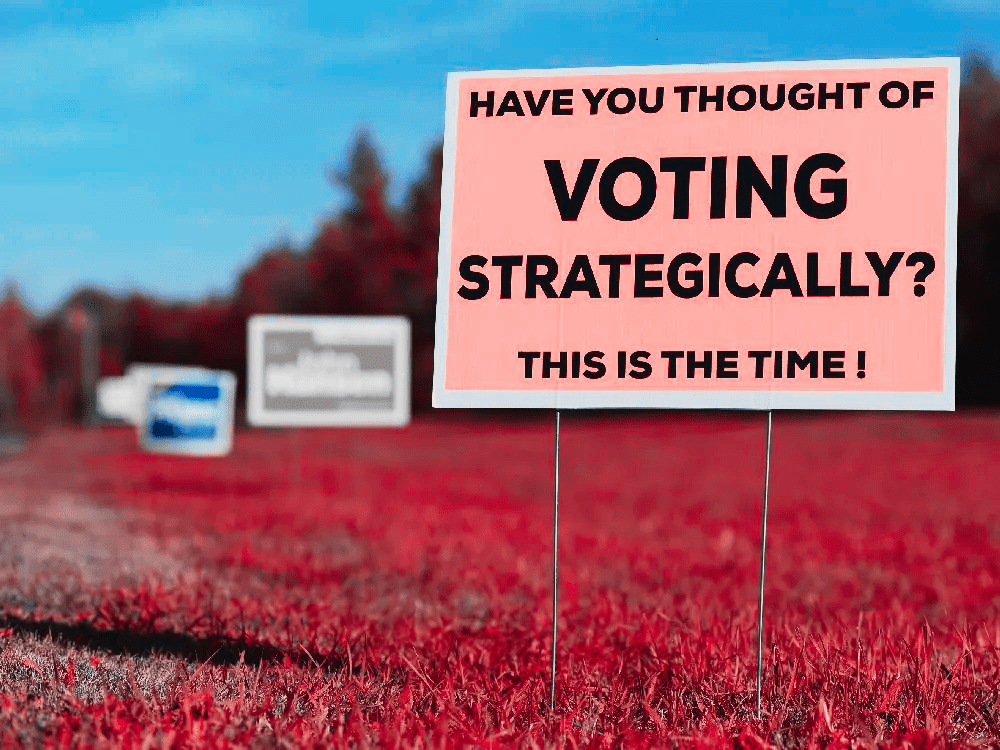
Strategic voting in Ontario remains an empty gesture unless opposition parties actively coordinate to break the cycle of voter frustration and vote splitting.
Strategic voting is often hailed as the solution to Ontario’s electoral woes, but in reality, it serves as little more than a comforting illusion without meaningful action from opposition parties. Under the province’s first-past-the-post system, strategic voting attempts to counter vote splitting, where multiple opposition candidates inadvertently help incumbents like Doug Ford win seats, even if a majority of voters oppose them. Unfortunately, strategic voting places an unrealistic burden on voters rather than on the political parties that should shoulder the responsibility for coordinating their efforts.
The root issue lies with Ontario’s fragmented opposition parties—primarily the NDP, Liberals, and Greens—which continue to stubbornly compete in nearly every riding. This competition dilutes anti-incumbent votes, effectively handing seats to Ford and the Progressive Conservatives. It’s an infuriating cycle in which opposition leaders repeatedly fail to learn from past mistakes, notably evident in the 2022 election, where disunity paved the way for Ford’s decisive victory.
Advocates of strategic voting overlook a critical reality: it only works when parties themselves actively coordinate. Without a unified strategy, voters attempting to choose the “lesser evil” find their efforts scattered and ultimately ineffective. Every candidate placed in ridings they have no genuine chance of winning fragments the opposition further. Rather than voters performing mental gymnastics to guess the most viable candidate, opposition parties should agree beforehand to withdraw candidates from unwinnable ridings, consolidating their support behind a single strong challenger.
Opposition parties have consistently refused meaningful collaboration, prioritizing individual party brands over collective success. Yet, history shows clearly that failing to unite dooms the opposition repeatedly. Strategic voting thus becomes a mere slogan rather than a viable electoral strategy, allowing parties to dodge accountability by shifting blame to voters.
The real solution involves more significant systemic change. Opposition parties should form a temporary coalition focused explicitly on electoral reform. Such a coalition would run unified candidates against Ford’s PCs, winning a mandate to change the first-past-the-post system. After implementing electoral reform, the parties could return to operating independently under a fairer electoral framework, eliminating the need for perpetual strategic voting.
This approach would transform strategic voting from a symbolic gesture into meaningful political change. Without this shift, voters remain stuck in a hopeless cycle, repeatedly urged to vote strategically without the support of parties willing to strategically organize themselves.
Ultimately, strategic voting in Ontario is powerless unless matched by a parallel strategy from opposition parties. Voters alone cannot shoulder the responsibility of overcoming systemic electoral flaws. It’s past time for opposition leaders to stop playing self-defeating partisan games and commit to genuine, cooperative action. If they do, Ontario could finally break free from its electoral dysfunction, restoring genuine representation and accountability. Until then, strategic voting will remain nothing more than well-intentioned but futile wishful thinking, perpetuating the cycle of frustration and disillusionment among voters.







 Spark Solidarity