
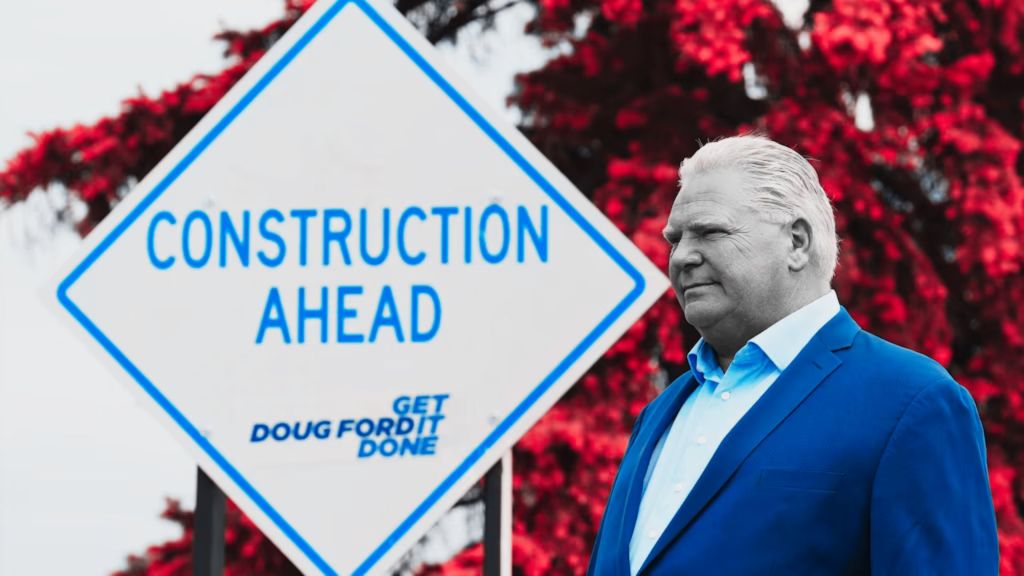
Doug Ford wins the 2025 Ontario election, securing another term despite widespread scandals, corruption allegations, and mounting public frustration.
Doug Ford’s victory in the 2025 Ontario election isn’t some shocking turn or even a particularly interesting development. It’s the inevitable result of a political system that’s been so thoroughly hollowed out, so drained of meaningful conflict or ideological coherence, that a man like Ford — incurious, corrupt, and openly contemptuous of the population — can not only survive, but thrive. His win is less a reflection of public support and more the end product of a process that’s designed to exclude meaningful alternatives while ensuring that the tools of state power remain in the hands of people who see government as a clearinghouse for private enrichment.
Ford’s re-election was framed, predictably, around the looming specter of U.S. tariffs — a convenient external threat that let him posture as Ontario’s last line of defense, even though the economic vulnerability he rails against was engineered by the same class of politicians and corporate interests he’s been serving his entire career. It’s not just that Ford’s promise of dollar-for-dollar tariffs and the cancellation of high-profile U.S. contracts like Starlink are impractical; it’s that they’re not meant to be practical. They’re theater, a pantomime of economic sovereignty performed for a public that’s been deliberately misled about how trade, economic development, and global capital actually function.
The reality is that Ontario’s economic precarity — its exposure to the whims of American policy — is a direct result of the same pro-corporate policies Ford’s government has championed. It’s the logical consequence of decades of deregulation, privatization, and reliance on low-wage, export-dependent industries to prop up the province’s GDP. Ford isn’t protecting Ontario’s economy from external threats. He’s a symptom of the same internal rot that made those threats so dangerous in the first place.
And yet, none of this seemed to matter electorally. Scandals that, in a functioning political culture, would have ended a career — the Greenbelt land grab, the rampant abuse of ministerial zoning orders, the naked handouts to developer cronies — barely registered. Ford’s voters didn’t care because the system they live under has taught them not to. The logic of Ontario politics — and really, of politics across the so-called democratic world — is that everyone is corrupt, nothing can change, and the best you can hope for is a leader who steals on behalf of the right people.
Ford embodies this logic perfectly. He’s not an outlier; he’s the logical conclusion of a system where the electoral process is little more than a recurring contract negotiation between different sectors of capital — real estate, resource extraction, finance — with voters occasionally consulted as a formality. His scandals don’t hurt him because they aren’t a deviation from the norm. They are the norm. In a province where political legitimacy is derived from the management of real estate bubbles, highway expansions, and sweetheart deals for donors, Ford isn’t a scandal-plagued politician. He’s the system working exactly as intended.
To understand why this grotesque figure continues to win, you have to go beyond Ford himself and into the particular dysfunction of Ontario’s political culture — a culture that’s been shaped, in part, by the Ford family’s long-running political project, which is essentially the weaponization of suburban grievance into a permanent electoral base.
The Ford family — documented with disturbing clarity in Crazy Town — didn’t invent suburban resentment politics, but they perfected it for Ontario. They figured out that if you present yourself as the enemy of “downtown elites,” “environmental radicals,” and anyone else who might impede endless sprawl and the personal enrichment it allows, you can lock down the exact demographic that reliably turns out to vote: property owners, small landlords, and people whose primary political identity is hating anyone who wants to build a bus lane.
Doug Ford Sr.’s influence, as detailed in Crazy Town, explains a lot about Doug’s personal style — the authoritarian parenting, the paranoid obsession with loyalty, the belief that power is something you seize and defend at all costs. When Ford Sr. forced his kids to take lie detector tests over some missing money, it wasn’t just psychotic behavior. It was a dress rehearsal for how the Ford family would one day run Ontario — through suspicion, coercion, and the belief that loyalty is the only currency that matters.
This isn’t just Ford family pathology, though. It’s a microcosm of how power works in Ontario’s political economy. Government isn’t an instrument for collective action or public welfare; it’s a protection racket for capital, where the goal is to secure loyalty from the right developers, the right lobbyists, the right trade associations — all while keeping the broader population too exhausted and disillusioned to fight back. Ford, with his mix of crude charisma and shameless venality, is perfectly suited for this role because he doesn’t pretend to be anything else. His honesty — the honesty of an open thief — is perversely comforting to voters who no longer believe in anything except the inevitability of theft.
The electoral process itself ensures that no meaningful challenge can emerge. Ontario’s failed first-past-the-post system, combined with a media ecosystem that treats politics as a personality contest rather than a site of material struggle, guarantees that parties offering any actual structural critique are marginalized before they even begin. The Liberals, despite their staggering failures, remain the designated “alternative” — a party fully committed to the same economic model, differing from Ford only in tone and branding. The NDP, long since stripped of anything resembling socialism, exists primarily to absorb discontent and funnel it back into procedural irrelevance.
In this context, Ford’s win isn’t a democratic mandate. It’s a confirmation that the system works exactly as intended — as a mechanism to preserve capital’s control over land, labor, and resources, while offering voters a rotating cast of characters to blame for their steadily worsening lives. Ford’s populism — which frames itself as a defense of “ordinary Ontarians” — is just the latest branding exercise in a system that has always relied on constructing an internal enemy to justify its looting.
The tragedy is that much of Ford’s base isn’t wrong about being screwed over. They are being screwed — just not by the people Ford tells them to hate. They’re not losing their future to bike lanes or climate activists. They’re losing it to the exact process Ford facilitates: the enclosure of land, the transformation of housing into an asset class, the destruction of labor protections, and the relentless commodification of every public good.
Doug Ford’s Ontario is what you get when capitalism has fully captured the state and the only real question left is which faction of the ruling class gets to divvy up the spoils. It’s a politics of managed decline, where elections are periodic opportunities to decide whose friends get rich off the carcass of what used to be a functioning society. Ford isn’t a deviation from Ontario’s political norms — he is the living embodiment of them.
And until the population is able to imagine something beyond this rigged game — until they see elections not as a desperate gamble for personal survival, but as a site of collective struggle for actual power — Ford, or someone just like him, will keep winning. Not because they deserve to, but because the system is built to make sure they do.




 Spark Solidarity