
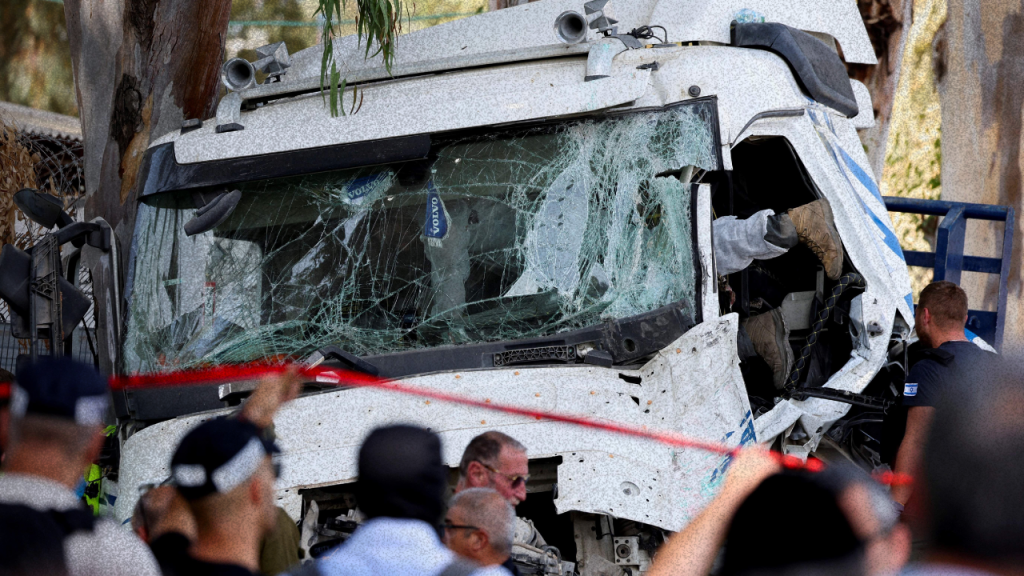
Tel Aviv bus stop attack at Glilot Junction killed one and wounded 35 on October 27, 2024, when a truck drove into a crowd of elderly civilians.
On October 27, 2024, a truck rammed into a crowd at a bus stop near the Glilot military complex in Ramat HaSharon, north of Tel Aviv. The attack killed one person and wounded at least 35 others, six of them seriously. Several victims were trapped under the vehicle when emergency responders arrived.
Magen David Adom dispatched ambulances, paramedics, and first-responder units to the scene. Victims were transported to Ichilov and Beilinson hospitals in the Tel Aviv area. One victim, later identified as Bezalel Carmi, 72, from Rishon Lezion, died of his injuries at Ichilov Medical Center. The Glilot area is home to Mossad headquarters and several IDF intelligence units, including signals intelligence Unit 8200.
Who the Victims Actually Were
Initial coverage emphasized the proximity of the attack to military installations and suggested the victims were primarily soldiers. On-the-ground reporting told a different story. According to multiple Israeli sources, a significant portion of those wounded were elderly civilians who had disembarked from an intercity tourist coach at the stop, preparing for a visit to a nearby museum. The stop serves general commuter traffic in addition to military personnel, and the crowd present at the time of the attack was predominantly civilian.
This distinction matters. The framing of the attack as directed at military targets — amplified by the site’s proximity to Mossad headquarters — shaped early international coverage in ways that did not reflect the composition of the actual victims. The person killed, Bezalel Carmi, was a 72-year-old civilian with no reported military connection.
The Attacker and How He Was Stopped
Israeli police identified the truck driver as Rami Nasrallah Nator, an Arab-Israeli man from Qalansawe in central Israel. His employer told Israeli public broadcaster Kan that Nasrallah had deviated from his assigned delivery route to reach the location of the attack. Nasrallah exited the truck after the ramming, reportedly carrying a knife. He was shot dead by armed bystanders and soldiers present at the scene.
Forensic investigators retrieved footage from cameras capturing the incident. Police analysis of the footage showed the truck being deliberately directed at the crowd with no attempt to brake — no skid marks were found on the road — and that the vehicle accelerated toward the stop. An initial autopsy found no indication of a medical episode. Based on this evidence, Israeli police classified the incident as a nationalist terror attack. A police officer who attempted to intervene was attacked with a rod in the truck’s cabin before falling from the vehicle and firing a warning shot.
Hamas Praised the Attack, Did Not Claim It
Hamas released a statement praising the attack as a “heroic ramming operation” carried out near “Mossad headquarters,” framing it as a response to Israeli military operations in Gaza, the West Bank, and Jerusalem. Islamic Jihad issued similar language. Neither organization claimed operational responsibility for the attack or identified Nasrallah as a member or operative. The attack occurred nine days after Israeli forces killed Yahya Sinwar in Gaza, and on the Hebrew calendar anniversary of the October 7, 2023 assault.
The attack unfolded against a backdrop of rapid regional escalation. Just weeks earlier, Israeli airstrikes on Beirut killed Hezbollah leader Hassan Nasrallah, marking a major intensification of Israel’s military campaign beyond Gaza. Israeli coalition politicians moved quickly to call for legislation stripping relatives of attackers of citizenship — a response pattern that illustrates how individual incidents become immediately absorbed into broader political agendas regardless of their specific circumstances.
Vehicle Ramming Attacks as Conflict Tactic
Vehicle ramming has become a recurring tactic in the Israeli-Palestinian conflict over the past decade. The method requires no specialized weapons or external network support, making it extremely difficult to interdict through conventional intelligence methods. A truck or car operated by a single individual with no prior communication with a militant organization produces no detectable planning signature. Bus stops, markets, and pedestrian areas cannot be uniformly secured.
The Glilot attack follows a logic of asymmetric conflict in which the gap in military capacity between parties drives violence toward accessible soft targets. Whether classified as terrorism, resistance, or political violence depends entirely on the political framework applied — a debate the incident immediately generated across global media. What is not in dispute is the outcome: one civilian killed, dozens more injured, and a public space converted, for a moment, into a site of war that neither side in the conflict has shown the capacity or intention to end.
Sources
- One killed, dozens wounded after truck hits bus stop in Israel’s Tel Aviv — Al Jazeera (2024-10-27)
- Police suspect ramming attack in Glilot was terrorist attack, motivated by nationalism — Jerusalem Post (2024-10-29)
- One dead, 32 wounded in suspected terror truck-ramming at bus stop north of Tel Aviv — Times of Israel (2024-10-27)




 Spark Solidarity