
Yahya Sinwar’s life and death trace the evolution of Hamas as a political and militant organization, embedded within the larger context of the Israeli-Hamas conflict.
The Journey of Yahya Sinwar, from his early life in the Gaza Strip to his final moments in October of 2024, runs parallel to the struggles of the Palestinian people under Israeli occupation. His death, this highly symbolic event, marks the end, but also the beginning of a significant chapter in Hamas’s leadership and history.
Born in the Khan Yunis refugee camp in the southern Gaza Strip, Yahya Sinwar experienced firsthand the harsh realities of life under Israeli occupation. Gaza had long been a site of displacement, where Palestinians lived in overcrowded camps, cut off from economic opportunities and subject to consistent violence from Israeli forces. Sinwar’s upbringing in this environment shaped his early political beliefs. And so Hamas, the organization Sinwar would later lead, emerged in the late 1980s during the First Intifada, an uprising of Palestinians against Israeli rule.
The conditions in Gaza, including a lack of political representation and frequent military clashes, led to the birth of Hamas as a movement that combined political advocacy with armed resistance. Sinwar, like many young Palestinians, was drawn to the organization’s call for resistance against the occupation. Sinwar quickly rose through its ranks, becoming involved in efforts to target alleged Israeli collaborators. This is what led to his arrest by Israeli authorities in 1989. Sentenced to multiple life terms in prison for his activities, Sinwar became a significant figure in the Palestinian prisoner movement.
While Sinwar was imprisoned, his influence grew. He was not only a leader within the prison but also an intellectual force, teaching himself Hebrew and translating key Israeli texts into Arabic. It’s been noted that this ability to understand the language and culture of the Israeli state made Sinwar a formidable figure upon his release. He studied the memoirs of Israeli military and security officials, gaining insight into their strategies and operations. His leadership within the prison, where he played a key role in organizing resistance among the prisoners, marked him as a rising figure in Hamas.
Sinwar’s Leadership: Hamas, Gaza Blockade, and Calls for Peace
In 2011, after more than two decades in prison, Yahya Sinwar was released as part of a high-profile prisoner exchange between Hamas and Israel. This deal involved the release of over 1,000 Palestinian prisoners in exchange for the Israeli soldier Gilad Shalit. Sinwar’s status within Hamas was significantly elevated by his release. Upon returning to Gaza, he quickly rose to leadership, becoming the head of Hamas in Gaza within a few years, marking his ascent during a critical moment for the organization.
Under Sinwar’s leadership, Hamas underwent strategic changes. In 2017, Hamas revised its charter, officially accepting a two-state solution based on the 1967 borders, which included Gaza, the West Bank, and East Jerusalem. This shift was seen as an attempt to align Hamas’s goals with the international framework for ending the siege on Gaza. However, despite this major political shift, Israel and its allies showed little interest in engaging with Hamas. The blockade on Gaza remained in place, and diplomatic isolation persisted, leaving both Hamas and the broader Palestinian population increasingly marginalized.
Sinwar’s leadership was defined by a delicate balance between military resistance and political pragmatism. While Hamas softened its political stance with the two-state solution, Sinwar’s attempts at political negotiation were met with continued military action from Israel. Multiple rounds of fighting between Hamas and Israel continued, with no substantial diplomatic breakthroughs. The ongoing blockade, isolation and outright siege on Gaza only deepened the tensions between both sides, solidifying a cycle of resistance and retaliation.
One of the defining moments of Sinwar’s leadership occurred during the 2018 Great March of Return protests. Thousands of Palestinians gathered at the Gaza border, demanding their right to return to their ancestral lands. The protests were met with force from the Israeli military, leading to hundreds of casualties. During this period, Sinwar gave a key interview to an Italian journalist, later translated by Haaretz.
In the interview, Sinwar emphasized that Hamas was not just a militia but a national liberation movement focused on defending the Palestinian people and their right to freedom and independence. Expressing his frustration with the ongoing conflict, he stated, “Whoever knows what war is, doesn’t like war,” adding that he no longer wanted war but instead sought an end to the siege on Gaza. He poignantly remarked on the impact of the siege on Gaza’s youth, noting, “You walk to the beach at sunset, and you see all these teenagers on the shore chatting and wondering what the world looks like across the sea. It’s breaking. And it should break everybody. I want them free.”
Despite Sinwar’s calls for peace, particularly for the younger generation to have a chance at a normal life, the political and military landscape in Palestine remained unchanged. Hamas’s 2017 charter update embraced a two-state solution, a position that aligned with the goals of the United Nations, the United States, and other Western powers. However, there was no engagement from Israel or its allies. The siege on Gaza persisted, and the diplomatic isolation of Hamas continued. Even as the group attempted to moderate its demands, the situation remained stagnant.
And Then Came October 7th, 2023
It was on that day, as The Times of Israel reported, that the Hamas-led attack on Israel, resulted in 1,175 deaths, including 796 civilians, among whom were 725 Israelis and 71 foreign nationals, as well as 379 Israeli security personnel. This attack marked a major escalation in the conflict, intensifying tensions between Hamas and Israel to new heights.
In response, Israel initiated a year-long campaign against Gaza, with the Palestinian civilian population bearing the brunt of the retaliation. The death toll in Gaza soared, reaching figures far greater than those suffered by Israel during the initial attack.
A recent report from The Lancet has highlighted the far-reaching consequences of the conflict, noting that indirect deaths in Gaza—due to the breakdown of infrastructure, a lack of medical care, malnutrition, and other factors—are significantly higher than the immediate casualties of the violence. The journal estimated that by June 2024, the total death toll in Gaza may have reached up to 186,000 people.
This estimate included both direct and indirect deaths, illustrating the devastating long-term impact of the conflict on Gaza’s population. As of August 2024, The Palestinian Health Ministry has reported 40,005 deaths, but public health experts have warned that these figures are likely a severe undercount, given the challenges of tracking casualties in a war zone.
Following the October 7th attacks, a year-long manhunt for Sinwar commenced. According to The Times of Israel, Sinwar went into hiding shortly after the attack, evading capture for over a year, and Although he had not been seen publicly, Sinwar’s role in orchestrating Hamas’s military activities during the attack ensured that he remained a central figure in the conflict. His leadership of Hamas—defined by a combination of political pragmatism and military resistance—shaped the organization’s trajectory during this crucial period of its history.
Sinwar’s legacy, as documented by Al Jazeera, reflects the complexities of leading a movement caught between the desire for peace and the realities of resisting occupation. His efforts to balance military resistance with political engagement were continuously thwarted by external pressures, leaving him at the center of a long and intractable struggle.
Yahya Sinwar: A Final Stand and the Rise of a Palestinian Symbol
On Wednesday in Rafah, in the southern Gaza Strip, Israeli Defense Forces (IDF) finally located Yahya Sinwar. The Times of Israel detailed the encounter, noting that the Israeli forces were on a routine patrol when they engaged several Hamas militants. Unbeknownst to them, Sinwar was among those they engaged. After the initial skirmish, Sinwar retreated to a damaged building, where he took refuge on the second floor. According to Haaretz, Israeli forces deployed a tank, which fired a shell at the building. The explosion severely injured Sinwar, causing him to lose his arm.
As reported, in a desperate attempt to continue fighting, Sinwar threw two grenades at the soldiers as they entered the building. The grenades rolled down the staircase, forcing the soldiers to flee. The IDF soldiers then deployed a drone to scan the building, capturing footage of Sinwar’s final moments. Sinwar, severely wounded, was seen sitting alone in the wreckage, wearing a keffiyeh. In a final act of defiance, he threw a piece of wood at the drone. The tank fired again, and the building collapsed, killing Sinwar.
Following his death, Israeli forces later confirmed his identity through dental records, fingerprints, and DNA analysis. Photos allegedly showing Sinwar’s body have since circulated online. The images depicted a man, lying under rubble in a keffiyeh and military attire with a head and arm wound.
The footage released by Israeli authorities of Sinwar’s final moments, will play a significant role in shaping his legacy. Israel intended to highlight the successful “elimination” of a key figure in Hamas, but the footage will certainly contribute to Sinwar’s growing status as a symbol of Palestinian resistance.
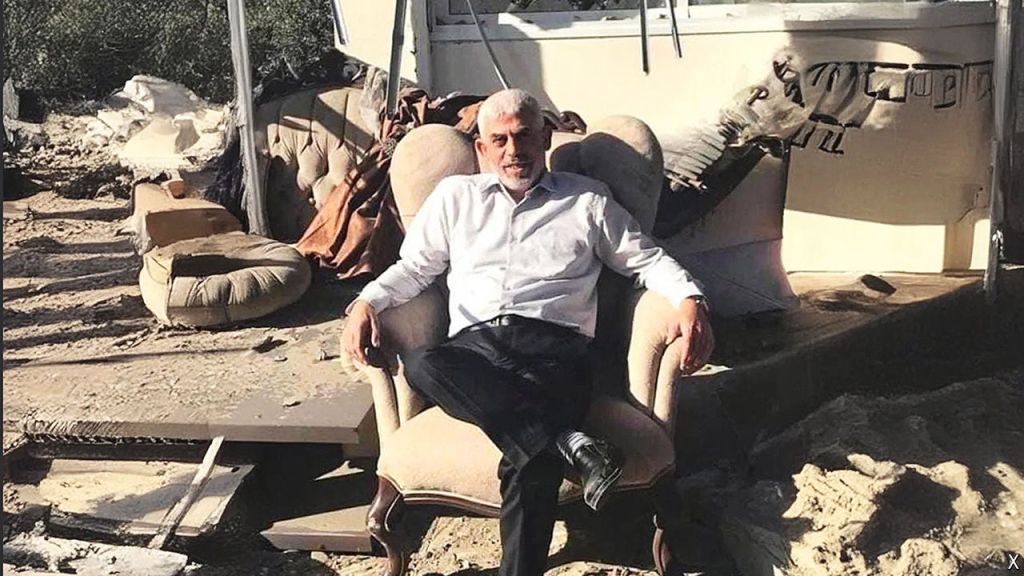
In 2021, an image of Sinwar sitting calmly in an armchair amidst the rubble of his home, which had been bombed by the IDF, gained widespread attention and became a powerful symbol of defiance across Gaza. Many Palestinians adopted the “Sinwar Pose,” mimicking his stance as a statement of resilience in the face of destruction. The image captured the essence of Sinwar’s leadership—unwavering resistance even in moments of personal vulnerability.
On Wednesday, in his last moments, Sinwar once again appeared calm and defiant, continuing to resist even as his fate was sealed. This image of Sinwar will surely resonate with Palestinians across the world, and will reinforce his role as a symbol of resistance for the cause of liberation.
Sinwar’s death, rather than diminishing his influence, will elevate him to the status of a legend. His final act, throwing a piece of wood at the drone, became a symbol of resistance in the face of overwhelming force. As one observer put it, “Sinwar didn’t know he would be filmed nor his heroic story recorded by his enemy. He was fighting on his own with God as his only audience.” This framing of his death as a solitary act of defiance only deepens the narrative of Sinwar as a martyr for the Palestinian cause.
Sinwar’s legacy is not just that of a military leader but also of a political figure who navigated the complexities of Gaza’s isolation and the broader Israeli-Palestinian conflict. His leadership of Hamas during a period of increasing isolation for Gaza reflected both the challenges faced by the Palestinian people and their ongoing resilience. Hamas’s acceptance of a two-state solution in 2017 showed that the organization was willing to engage with political realities, even if those efforts were ultimately rejected by Israel and its allies.
In the end, Sinwar’s death does not signify the end of Hamas or the Palestinian resistance. As many others have concluded, leaders like Sinwar often become symbols in death, with their legacies becoming even more powerful than their actions in life.
For many Palestinians, Sinwar represents the ongoing struggle for self-determination, a fight that has spanned decades and continues to this day. His life, marked by resistance, imprisonment, and leadership, reflects the broader Palestinian experience under Israel’s apartheid and occupation. His death, captured and broadcast by his enemy, turned him into a symbol of unwavering defiance, further aggrandizing his role as a symbol of unwavering commitment to the cause of Palestinian resistance.




 Spark Solidarity