
DNC protests reveal split between activists who prioritize safety and those who believe in confronting the reality of an ongoing genocide.
The recent protests at the Democratic National Convention (DNC) in Chicago last week exposed a significant divide within ‘progressive’ activist movements, underscoring a deep tension between those who prioritize “safety” and those who believe in confronting the harsh reality of what they see as an ongoing genocide.
The protests began with a major breach of an outer security fence near the United Center on Monday afternoon, as delegates were arriving for the start of the convention. Police responded quickly to contain the situation, arresting nearly a dozen people.
This incident set the stage for a broader ideological conflict that unfolded throughout the week: Is there a problem with protest movements always playing it safe? Should activists stick to peaceful demonstrations, or should they adopt more radical, aggressive tactics to challenge systemic injustices directly?
This debate isn’t just about tactics—it’s about addressing the core contradiction faced by Western supporters of Palestinian liberation: How to oppose an ongoing genocide that is openly supported by our own government.
Misplaced Focus on Safety Amidst Genocide
On one side of this issue are those who advocate for structured, peaceful protests, believing that non-confrontational approaches are the best way to gain public support and protect vulnerable protesters. Many argue that avoiding direct conflict and maintaining safety prevents public backlash and helps preserve the movement’s credibility.
During the DNC protests, various factions within the Coalition to March on the DNC, including marshals and organizers, raised safety concerns about various escalating tactics of more radical demonstrators. These concerns were echoed not only by the march leaders but also by the Chicago Police.
At the CPD press conference on the final day of the convention, Chicago police superintendent Larry Snelling thanked the marshals from the Coalition for Justice in Palestine rally on Wednesday, stating they were “working in collaboration” with officers ‘to defuse situations.’
Snelling praised the efforts of safety marshals for their role in maintaining order and preventing violence during recent protests. He stated, “I can’t say enough about the organizers who had their marshals moving along. And when somebody was getting out of control, they would step in and help and calm that down.”
After the initial march on the DNC, organizers, marshals, and the Chicago police claimed that by escalating confrontations, some protesters put all demonstrators at risk, including vulnerable groups expecting a peaceful protest. However, these claims assume that all interventions by police or marshals were justified, ignoring that it was often the police response that escalated tensions in the first place.
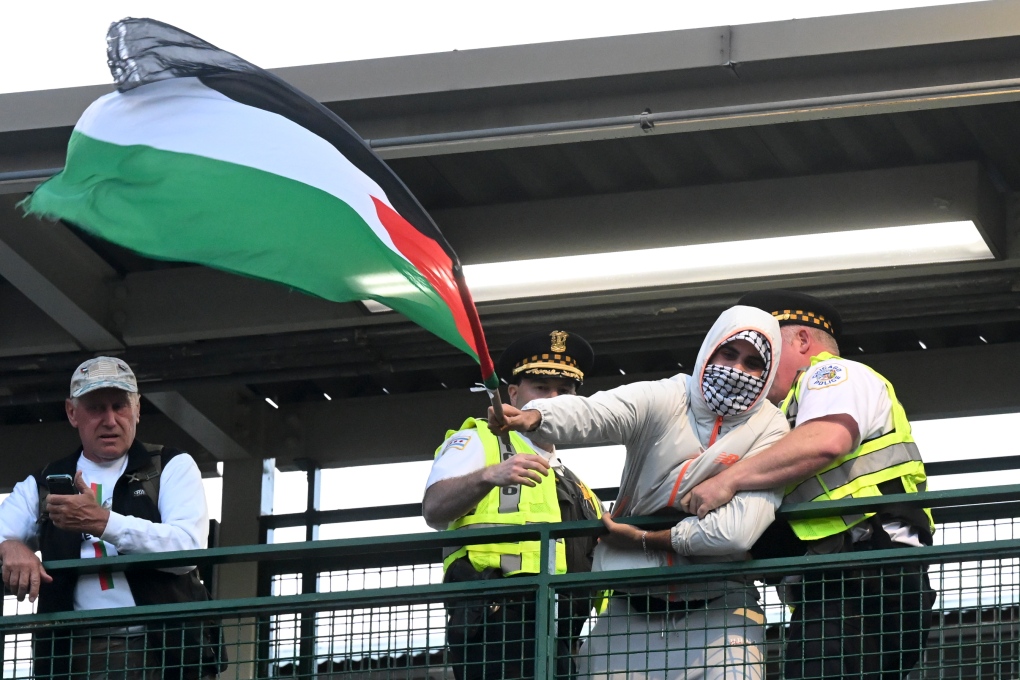
One incident that clearly illustrated these tensions occurred when a protester waving a Palestinian flag on a downtown subway platform was captured on video being forcibly removed by Chicago PD. Protest marshals swiftly intervened, claiming they wanted to avoid the individual’s arrest.
This action has sparked significant criticism, with many seeing it as collaborating with police to suppress dissent while prioritizing order over the right to protest. By intervening, marshals are seen as legitimizing police authority and aligning with state control, rather than defending the right to free expression.
Focusing on maintaining a non-confrontational image undermines liberation movements by stifling more visible and impactful forms of resistance, whether it be by waving a Palestinian flag, or far more radical actions.
The approach of the protest marshals at the DNC serves to reinforce the power dynamics that liberation movements should be aiming to challenge, which limits the effectiveness and authenticity of such actions.
The justification that protest marshals prevent arrests is also questionable, as it suggests that police would have just cause to arrest protesters for asserting their constitutional rights. Whether or not an arrest is lawful shouldn’t deter acts of protest. By intervening, the marshals’ actions help reinforce these unlawful police actions instead of defending against them.
For many so-called ‘progressive’ protest movements, the emphasis on safety—whether intentional or not—can reinforce the status quo and fail to address the primary issue: an ongoing genocide supported by American interests. In this context, the notion of safety in peaceful protests is an illusion that doesn’t address the suffering caused by American-supported colonial occupation.
This contrast highlights a significant disconnect within the struggle for Palestinian liberation: a superficial focus on the protest movement itself versus the pressing and real issues at stake.
Despite the efforts of protest marshals, organizers, and police, the security breach and subsequent clashes with police highlighted that protest action in the current context carries inherent risks. However, it must be understood that these risks are directly connected with the presence of armed police and security forces, not radical demonstrators.
Misunderstanding the Nature of Danger: The Role of the State
The state’s response to the DNC protests—with armed police, arrests, and heavy security—reveals the power dynamics at play. These measures are not about protecting public safety; they are about protecting the interests of those in power.
In a society where state and police violence are used to maintain control, traditional ideas of “safety” are not only misleading but also an illusion. True safety cannot be achieved by avoiding confrontation, as the presence of armed police itself represents a violent threat.
Real safety comes from changing the conditions that make protests dangerous in the first place. Similarly, real change cannot be achieved through symbolic gestures or peaceful coexistence with these oppressive systems. Thus, confrontational actions are necessary to ensure long-term safety.
Criticism that these actions endanger the movement fails to understand that any challenge to the status quo, peaceful or otherwise, will be met with state repression and police violence. True safety is not achieved by compliance with oppressive systems but by the elimination of those oppressive systems entirely.
Diversity of Tactics Exists Within a Context
A diversity of tactics within liberation movements is essential, but it should be grounded in a shared commitment to addressing the primary issue. This doesn’t mean all methods should be accepted, but rather only those that are effective and not counterproductive in addressing the core issue.
Actions aimed at challenging the ongoing genocide of Palestinians must be evaluated based on their impact and context. Diversity of tactics means supporting methods that effectively confront the primary issue, not just those that align with acceptable political norms. The focus should be on tactics that directly challenge and hold accountable those complicit in the ongoing genocide.
Avoiding inevitable conflicts or criticizing more forceful approaches weakens the movement and distracts from its true purpose. In the current context of ongoing genocide, where we as Westerners are directly complicit, the most effective action for those unwilling to take radical steps themselves is to support those who are willing to engage in more direct actions.
Solidarity means recognizing the need for a true diversity of tactics—those that are effective in addressing this ongoing genocide.
Primary vs. Secondary Contradictions
In revolutionary theory, contradictions are essential for understanding the motivations behind actions. The primary contradiction here is the ongoing ethnic cleansing and genocide that Israel is committing against Palestinians.
This primary contradiction is the main injustice that protesters should be fighting against. Focusing on secondary contradictions—like disagreements over tactics, concerns about the movement’s public image, or safety—distracts from the urgent need to address the primary issue.
Prioritizing these secondary concerns only helps to maintain the systems of violence and oppression that we are trying to oppose.
Confronting the Primary Contradiction Directly
During the march on the DNC, some protesters chose to leave the planned route to confront police forces and approach the Israeli Consulate. Actions like these highlight the complicity of establishment powers in the ongoing genocide in Gaza. While some argue that these confrontational tactics endanger peaceful protesters, these criticisms overlook the fact that real danger lies in allowing genocide to go on unchecked, not in confronting it.
Many who claim to support radical political action end up constrained by the very political framework they aim to oppose. Actions like disrupting speeches or political appearances, such as those seen on Kamala Harris’s campaign trail and at the DNC, often prove ineffective in addressing an ongoing genocide.
By letting political actions be defined and limited by existing structures, activists risk reinforcing the very power dynamics they seek to dismantle. This leads to the continuation of ineffective political figures who use progressive language for symbolic protest while maintaining the power structures they claim to oppose.
In the context of ongoing genocide, symbolic actions are insufficient and fail to bring about meaningful change. Instead, they create a superficial appearance of progress while the underlying atrocities continue. True radical action must go beyond symbolic gestures and directly challenge the systems that enable violence and oppression.
Confronting the Reality of Our Complicity in Genocide
The protests at the Democratic National Convention (DNC) highlighted the urgent need to address the primary issue: the ongoing genocide and systemic oppression against Palestinians, carried out by Israel with support from powerful allies like the United States.
This genocide is evident from the high civilian death toll in Gaza, with some estimates suggesting as many as 186,000 people, or about 8% of Gaza’s pre-October 7th population, have been killed. The widespread destruction in Gaza, along with statements from Israeli officials indicating an intent to kill and displace Palestinian civilians, underscores the crisis’s severity. Severe restrictions on food, water, fuel, and other essentials further indicate genocidal practices.
The United States plays a significant role in these atrocities as Israel’s largest financial backer, having provided around $310 billion in economic and military aid since Israel’s founding. This includes $3.8 billion annually in military aid through 2028, supporting Israel’s military capabilities by granting access to advanced U.S. military platforms and technologies.
A significant portion of this military aid is spent on U.S.-made weapons and defense equipment, with 74% of the Foreign Military Financing (FMF) funds provided to Israel required to be spent on U.S. defense equipment, services, and training. Under the current 10-year Memorandum of Understanding (MOU) signed in 2016, Israel receives $3.3 billion each year from 2019 to 2028.
This ensures that much of the aid circulates back into the U.S. defense industry, benefiting both Israeli military capabilities and U.S. defense manufacturers. Since the 1970s, Israel has been a top recipient of U.S. foreign aid, with most of it now allocated to military assistance.
This arrangement benefits U.S. defense industries, as Israel purchases high-tech products, such as surveillance drones, from smaller U.S. manufacturers. Since the most recent campaign of collective punishment against Palestinian civilians starting in October 2023, the U.S. has provided at least $12.5 billion in additional military aid.
Beyond financial support, the U.S. has consistently backed Israel diplomatically, supporting it in international forums and conflicts and maintaining a strategic partnership based on shared interests.
The protests at the DNC aimed to expose the United States’ role in supporting and enabling the ongoing genocide against Palestinians. By protesting a major event linked to U.S. political power, activists directly challenged American leaders’ complicity in funding and diplomatically shielding Israel’s actions.
The DNC, with its strong ties to U.S. policy, was an appropriate venue for voicing opposition and bringing the crisis’s urgency to public awareness.
To achieve real change, it was necessary to confront these power structures directly. Radical action should go beyond raising awareness; it should demand accountability and expose the connections between U.S. policies and the violence in Gaza. Criticisms of such radical actions, like those at the DNC, ignore that the real danger lies in the genocidal actions being opposed, not in the tactics used by the movement.
Radical actions at the DNC were crucial to revealing the uncomfortable truths of U.S. complicity in genocide and the urgent need to dismantle the systems enabling such atrocities.
True safety and justice can only be achieved by directly addressing the main issue, challenging the powers that perpetuate violence, and confronting the complicity that allows it to continue. Only through such direct action can a just and equitable world be created, where the rights and lives of all people, including Palestinians, are respected and protected.

 Spark Solidarity