
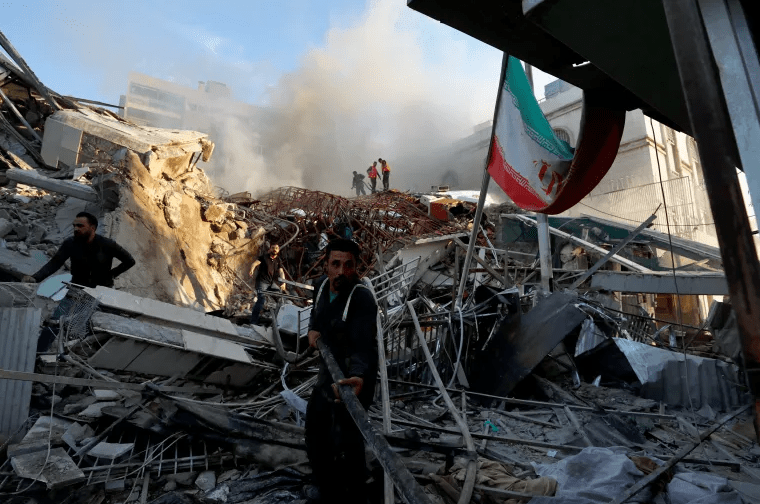
In the recent surge of Middle Eastern tensions, Israel’s aggressive airstrike on the Iranian consulate in Damascus on April 2nd, 2024, stands as a stark reminder of the region’s volatility. This attack, which resulted in the deaths of at least seven Iranian officials, including high-ranking Revolutionary Guard commanders, has been vehemently condemned by Iran as a blatant breach of international law and an act of terrorism. Tehran’s vow to retaliate underscores the gravity of the situation, exposing Israel’s escalation of aggression in its pursuit to undermine Iran’s influence across the region.
Israel’s belligerent actions, coupled with the targeted assassination of an Iranian general, paint a grim picture of its increasingly confrontational approach towards Iran and its regional interests, particularly in Syria. Israel justifies its military strikes as preemptive measures against perceived threats posed by Iran and its support for groups like Hezbollah in Syria. However, the relentless bombings not only exacerbate regional instability but also raise serious moral and legal concerns, as civilian lives become collateral damage in Israel’s pursuit of its security objectives.
Additionally, the escalating tensions in Lebanon are intricately linked to the broader regional dynamics, notably the ongoing war crimes and genocide being perpetrated by Israel in Gaza. Hezbollah’s military capabilities and its proximity to Israel’s border have played a significant role in supporting Gaza against Israeli aggression. The aggressive stance of Israel towards Hezbollah, with backing from Iran, not only raises concerns about further destabilization in Lebanon but also heightens the risk of broader escalation across the Middle East.
This targeted attack on the Iranian consulate epitomizes the complex network of alliances and rivalries in the region, with Israel, a rogue state operating in total self-interest to advance its colonial imperial project, escalating tensions through unilateral military actions. By prioritizing military aggression over diplomatic engagement, Israel not only undermines prospects for peaceful resolution but also imperils regional stability, potentially ensnaring major global powers in a wider conflict.
Global Powers’ Influence Middle East Conflict
The involvement of global powers like the United States and Russia further complicates the situation. The U.S.’s steadfast support for Israel’s aggressive policies and its opposition to Iran heighten tensions, while Russia’s alliance with Syria and Iran adds another layer of complexity. In response to the attack on the Iranian consulate, Russia condemned the action, aligning itself with Syria and Iran, which highlights the intricacies of international relations in the region. This interplay of interests increases the risk of a broader conflict with potentially catastrophic consequences.
The dire situation underscores the urgent need for diplomatic solutions to de-escalate tensions and address the root causes of conflict. Diplomacy, not military aggression, offers the best chance for resolving the complex issues plaguing the region. The international community must prioritize dialogue and cooperation to prevent further escalation and pave the way for a peaceful resolution to the Middle East’s enduring conflicts.
In the wake of recent attacks on Russian territory, the geopolitical landscape becomes even more precarious. Russia’s accusations against Ukraine for these attacks link the conflict in Eastern Europe directly to the escalating tensions in the Middle East, further exacerbating the global crisis. The evidence suggesting connections between groups involved in the Syrian conflict and activities within Russia highlights the interconnected nature of regional conflicts and the potential for them to spiral into broader confrontations with global ramifications.
Western officials have asserted that Russia’s efforts to draw parallels between its security concerns in Eastern Europe and the dynamics in the Middle East serve as a strategic move to justify its actions and deflect international criticism. However, when considering the broader context, including Israel’s recent bold actions against Iran, such comparisons ring true.
The international community must prioritize dialogue, cooperation, and peaceful resolution to prevent the situation from deteriorating further. The interconnected nature of global security challenges necessitates a unified and concerted approach to address the root causes of conflict and promote stability and peace in the region and beyond.




 Spark Solidarity