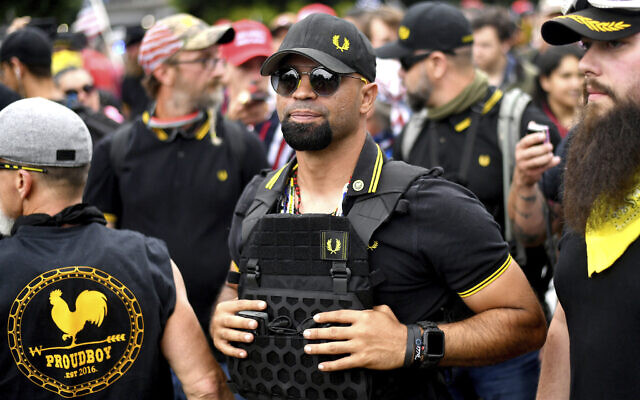
Enrique Tarrio’s attorney argued in the seditious conspiracy trial that his white nationalist client was scapegoated, with the real cause of the violence being the then-US president’s incendiary rhetoric.
The defense attorney representing white nationalist Enrique Tarrio argued on Tuesday that the former US president, Donald Trump, should be held responsible for the deadly January 6 Capitol riot, rather than his client. As reported by the AP, Tarrio’s attorney has claimed that Tarrio is being made a scapegoat by the US Justice Department.
Tarrio, the leader of the Proud Boys, and four of his associates face charges of seditious conspiracy for allegedly plotting an attack on the Capitol to prevent the transfer of presidential power from Trump to President Joe Biden after the 2020 election. Tarrio’s defense lawyer, Nayib Hassan, highlighted during his closing argument that his client was not in Washington, D.C., on January 6, 2021, as he had been banned from the city following his arrest for allegedly defacing a Black Lives Matter banner. Hassan argued that it was Trump who incited the crowd outside the White House to “fight like hell.”
Hassan told jurors in the Washington federal court, “It was Donald Trump’s words. It was his motivation. It was his anger that caused what occurred on January 6th in your beautiful and amazing city. It was not Enrique Tarrio. They want to use Enrique Tarrio as a scapegoat for Donald J. Trump and those in power.” The charge of seditious conspiracy, which is rarely used and can be difficult to prove, carries a maximum prison sentence of up to 20 years.
The defense’s argument is part of a broader strategy accusing prosecutors of using Tarrio as a scapegoat, claiming that charging Trump or his powerful allies would be too challenging. Trump has denied inciting violence on January 6 and maintains that he exercised his First Amendment rights by challenging his electoral loss to Biden. Trump currently faces multiple civil lawsuits related to the riot, as well as investigations led by a special counsel appointed by Attorney General Merrick Garland into his and his allies’ efforts to overturn the election results.
Prosecutor Conor Mulroe argued on Monday that the Proud Boys viewed themselves as Trump’s foot soldiers, prepared for “all-out war” and fighting to keep their preferred leader in power, regardless of the law or court decisions. Jurors could begin deliberations as early as Tuesday after hearing closing arguments and the prosecution’s rebuttal.
Tarrio, a Miami-based Proud Boys leader, currently stands trial alongside fellow members Ethan Nordean, Joseph Biggs, Zachary Rehl, and Dominic Pezzola. Nordean, hailing from Auburn, Washington, acted as a Proud Boys chapter president, while Biggs, from Ormond Beach, Florida, served as a self-proclaimed organizer for the group. Rehl was the Philadelphia chapter president, and Pezzola, a Rochester, New York native, was a Proud Boys member.
Closing arguments for Nordean and Rehl were presented by their attorneys on Monday.
Despite not being present in Washington on the day of the attack, Tarrio is accused of coordinating the assault remotely. Authorities arrested him two days prior to the riot on charges of burning a church’s Black Lives Matter banner during an earlier demonstration in the city. Following his arrest, a judge ordered Tarrio to leave Washington.
Defense lawyers have argued that there is no concrete evidence of a conspiracy or plan for the Proud Boys to attack the Capitol. Tarrio’s attorney asserted that his client had no plan or objective in mind.
Pezzola testified that he had never spoken to any of his co-defendants prior to sharing a courtroom following their arrests. His defense attorney, Steven Metcalf, insisted that Pezzola was unaware of any plan for January 6 or that he participated in a conspiracy with Proud Boys leaders.
Metcalf dismissed the notion of a conspiracy, stating, “It’s not possible. It’s fairy dust. It doesn’t exist.”
Prosecutor Mulroe countered this claim, explaining to the jury that a conspiracy can be an unspoken and implicit “mutual understanding, reached with a wink and a nod.”
The government’s case, which began with jury selection in December, is built upon a wealth of messages exchanged privately between Proud Boys leaders and members via encrypted chats and public social media posts before, during, and after the deadly January 6 attack.
Prosecutor Nadia Moore argued that the Proud Boys did more than merely discuss their objective of keeping Trump in office—they marched to the Capitol and disrupted the certification of the Electoral College vote. Moore emphasized, “These men aren’t here because of what they said. They’re here because of what they did.”
Norm Pattis, an attorney representing Biggs, referred to the Capitol riot as an “aberration” and implored the jury to consider the larger implications of their verdict, which he said would “speak to the future.”
Pattis urged the jury to “Show the world with this verdict that the rule of law is alive and well in the United States.”
While the Justice Department has already secured seditious conspiracy convictions against members of another far-right extremist group, the Oath Keepers, this trial marks the first major case involving leaders of the far-right Proud Boys—a neo-fascist group of self-proclaimed “Western chauvinists” that continues to exert influence in mainstream Republican circles.
As reported by the New York Times, court documents and interviews with former law enforcement officials have revealed that Enrique Tarrio, the enigmatic leader of the right-wing extremist group the Proud Boys, previously acted as an informant for the Federal Bureau of Investigation (FBI). This disclosure casts a shadow of intrigue over the controversial far-right extremist group that Tarrio once led.
 Spark Solidarity