
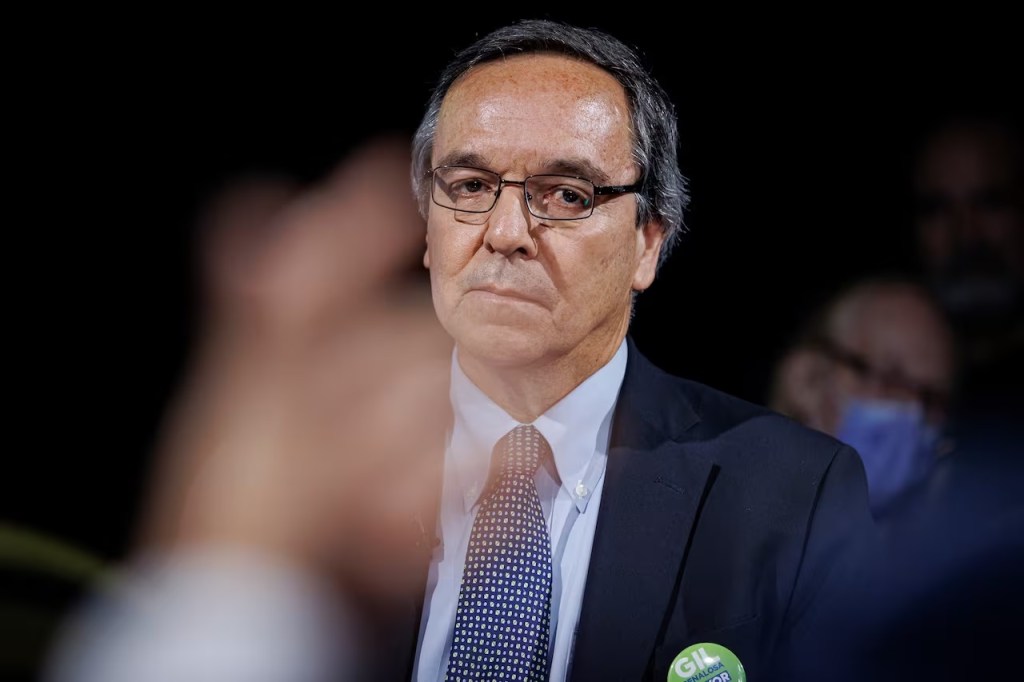
In this article, we present a translated and adapted version of an original piece by Yohir Akermann, published in Cambio, a Colombian news outlet. The original article, titled “Mister Gil,” delves into the background and controversies surrounding Gil Peñalosa, a Colombian-born urban planner and Toronto mayoral candidate.
Akermann’s article sheds light on the complex history and political maneuverings of the Peñalosa family, touching upon their involvement in parks, bicycles, and public transport initiatives both in Colombia and abroad. The following is a recreation of the original text, adapted for an English-speaking audience.
Hailing from Colombia, urban planner Gil Peñalosa, brother of Enrique Peñalosa, has declared his intention to run for the esteemed position of Toronto’s Mayor, one of Canada’s most prominent cities. Despite being a relatively unknown figure in the local political landscape, the consultant and activist has chosen to capitalize on the apparent dearth of contenders for the role.
At first glance, the prospects appear quite promising for the candidate.
According to the World Urban Parks organization’s website, Mr. Gil, as he is referred to in English, describes himself as a passionate advocate for urban development. He claims to have contributed to the management of 350 cities globally, focusing on sustainable mobility, park utilization, and efficient bicycle transportation systems.
Notably, his profile emphasizes his extensive experience in Canada, where he established a parks organization, and in Bogotá, where the site states, “Gil successfully led the design and development of over 200 parks, including Simón Bolívar, at the city’s core.” This assertion appears exaggerated, considering that the park’s design dates back to the late sixties when Gil was likely just a child.
Conversely, his campaign site credits Mr. Gil with the invention and implementation of bike lanes in Bogotá. However, his brother also claims the same accomplishment, so we shall not delve into familial disputes. What can be confirmed is that the Department of Parks, Sports and Recreation, IDRD, attributes the first bike path in Bogotá to Mayor Luis Prieto Ocampo on December 11, 1974, a time when Gil had not yet entered university.
Another aspect that stands out in his campaign biography is his experience and expertise as the director of the IDRD in Bogotá. However, this is where the candidate’s resume begins to show some discrepancies.
Pursuing this matter further, Mr. Gil Peñalosa served as the director of the IDRD from January 27, 1995, to May 20, 1997. At that time, he was still known as Guillermo Peñalosa Londoño, an individual who later faced legal issues, as previously discussed in this column.
Gil stepped down from his IDRD position when his brother, Enrique Peñalosa, announced his candidacy for the upcoming mayoral term. However, Gil’s complications began six months prior to his appointment to the recreation and sports entity.
On June 22, 1994, the IDRD signed lease agreement number 136 with the company Reforestaciones y Parques SA. Under this agreement, the corporation was granted management rights over the games, attractions, parking lots, and other facilities located in the prominent Parque El Salitre in Bogotá.
So far, everything appears normal. The issue arises from the fact that, on the date the agreement was signed, the board of directors of Reforestaciones y Parques SA included, among others, Enrique Peñalosa Camargo—the late father of the former mayor with the same name—and his son, Guillermo Peñalosa Londoño. Notably, Londoño later changed his name to Gil Peñalosa upon relocating to Canada.

The Peñalosas resigned from the board of directors of the company on August 3, 1994, a mere 43 days after signing the contract with the IDRD. The old adage seems fitting here: a family that engages in business together might also skirt the rules together.
However, that is not the only irregularity. A report from the Bogotá Comptroller’s Office revealed that the contract evaluation bypassed the standard bidding process, opting for a direct agreement with a company that lacked the necessary experience, administrative capacity, and technical competence to provide public recreation and cultural services. Notably, the company in question was established only 12 days prior to the signing of the agreement.
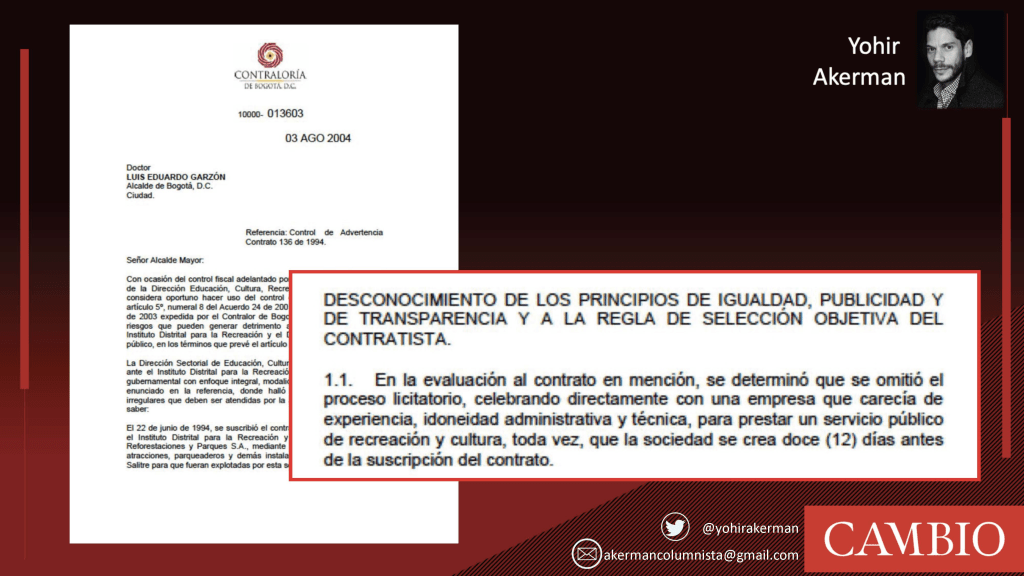
Remarkably, on June 10, 1994, the company Inversiones Lindaraja partnered with three other firms and five individuals to establish Reforestación y Parques SA. A mere 12 days later, they signed the agreement. The Peñalosas’ good fortune is evident: they created a company and quickly secured a lucrative contract, which they themselves awarded. Such are the perks of familiarity with public procurement.
Enrique Peñalosa Londoño was a partner and manager of Inversiones Lindaraja, with his brothers Guillermo and Camilo later joining as partners and Julián serving as manager. On June 22 of that year, a 15-year lease for El Salitre was signed.
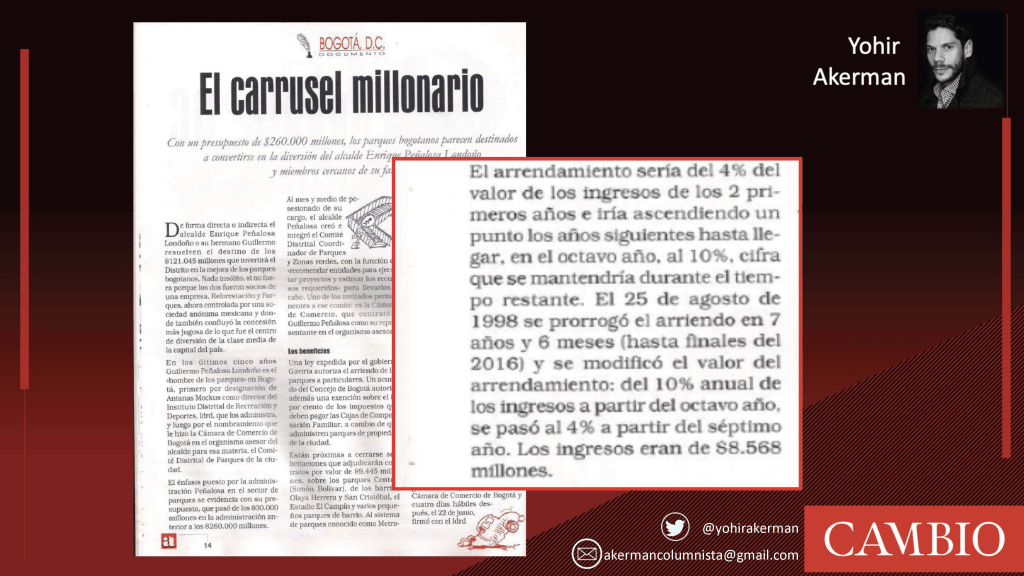
Their luck persisted. As reported by Alternativa magazine in an article titled “The Millionaire Carousel,” the lease specified a 4% fee of the total revenue for the first two years, with a one-point increase in subsequent years until reaching 10% in the eighth year—a rate that would remain unchanged for the remainder of the lease term. On August 25, 1998, the lease was extended for an additional 7 years and 6 months, concluding at the end of 2016.
While this situation did not constitute a legal disability or incompatibility, it raised suspicions regarding the objectivity of the contractor selection process, suggesting a preferential appointment.
In light of these events, an investigation was launched, and the Prosecutor’s Office summoned the current Toronto mayoral candidate several times to determine his criminal responsibility concerning his tenure as the director of the District Institute for Recreation and Sports.
In July 2001, it was revealed that the Prosecutor’s Office’s Unit for Crimes Against Public Administration had issued an arrest warrant against Guillermo Peñalosa Londoño, who was then the director of Proexport in Canada and already known as Gil. This column consulted various sources, records, and Sijín databases, confirming that the case is currently inactive.
What emerges from this narrative is the Peñalosa family’s skill in leveraging discourses on parks, bicycles, and articulated buses for the benefit and expansion of private enterprises, as demonstrated by Mr. Gil’s handling of park-related matters. This family business could undoubtedly continue to thrive in Canada, with an English-speaking twist, should he win the race for Toronto’s mayorship.






 Spark Solidarity