
Toronto G20 protests reveal how undercover policing, mass arrests, and billion-dollar security turned burning cruisers into justification for crackdown.
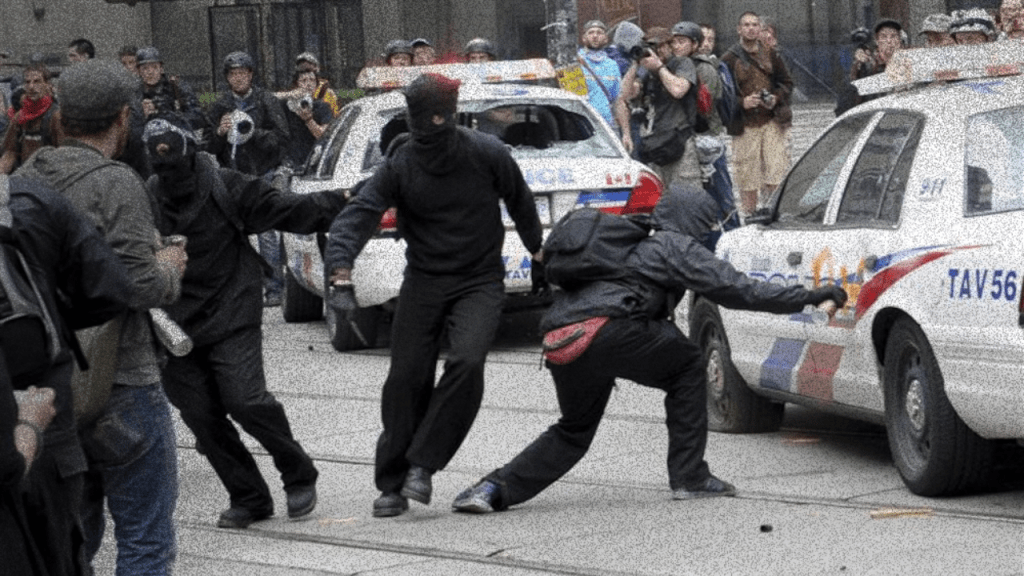
On June 26, 2010, two Toronto Police cruisers were set ablaze on Queen Street. The images traveled globally within hours. By the time the smoke cleared, the dominant narrative had already been written: protest means destruction, security is justified, the state is under threat.
What the images did not show — and what corporate media largely chose not to foreground — was the question of how those cruisers came to be there in the first place.
Officers had withdrawn from the vehicles. Riot police were stationed nearby on Spadina. The cruisers sat unattended for an extended period before being ignited. Police did not immediately intervene on that stretch of Queen Street even as they burned.
None of that was in the image. The image was the argument.
A Billion-Dollar Security Apparatus and the Spectacle It Required
The 2010 G8/G20 summits in Ontario were secured at a cost that CBC reported hit $1.1 billion even before the summits began — including $933 million in security alone, as documented by Canada’s Parliamentary Budget Officer. The final figure reached approximately $1.3 billion combined.
To put that in context: security for the 2009 G20 in London cost $30 million. Security for the Pittsburgh G20 cost $18 million in overtime and extra police.
The World Socialist Web Site’s coverage noted the scale: “Six kilometers of fencing, topped with concertina wire and anchored in concrete encircled the actual meeting area. Snipers were stationed on the city’s high rise rooftops. American Navy Seals surreptitiously patrolled the harbour.”
This was not a security response to a known threat. This was a security performance. And performances require drama.
The burning cruisers provided it.
The mechanism is not unique to state security operations. As we documented in our analysis of the information war that followed El Mencho’s killing in Mexico, spectacle precedes verification by design — the image circulates as argument before the context that would complicate it can catch up.
The Intelligence Architecture: Eighteen Months of Embedded Deception
The policing of the G20 did not begin in June 2010. It began at least eighteen months earlier.
CBC’s reporting on the court disclosures revealed that OPP Officers Bindo Showan and Brenda Carey spent a year and a half embedded inside southern Ontario activist communities. Showan rented an apartment in Guelph, attended weekly meetings of a land defense group, and built personal friendships under the alias “Khalid Mohammed.” Carey moved into a house with activists, operating under the alias “Brenda Dougherty,” telling people she was fleeing an abusive relationship.
They were part of a Joint Intelligence Group that the RCMP’s own post-summit review described as “likely the largest JIG ever assembled in Canada.” At least 12 undercover officers infiltrated groups across the country in the lead-up to the Vancouver Olympics, G8, and G20.
The Globe and Mail’s detailed chronology reveals the depth of this infiltration: Showan attended First Nations fundraisers, anarchist bookfairs, planning meetings for unrelated environmental campaigns — building a web of relationships and intelligence while pretending to share political commitments.
This is the apparatus that produced the “evidence” used to prosecute the summit organizers.
The Target List and the Conviction That Wasn’t What the Public Remembers
After the fires, the prosecutions focused not on the arson but on organizing.
Seventeen activists were charged with conspiracy. Charges against eleven were eventually dropped. Six pleaded guilty to counselling to commit mischief — a reduced charge — in a deal that ended an 18-month legal battle. The “ringleaders” were not the people who set the cruisers on fire. They were organizers, planners, and meeting attendees.
Central to the Crown’s case was a so-called “target list” of potential disruption locations. It became the evidentiary lynchpin of the plea negotiations.
After pleading guilty, Alex Hundert stated publicly: undercover OPP Officer Brenda Carey “played a major role in producing the target list that I had to plead guilty for. Other than myself, there was nobody more involved.” He added that Carey had actively advocated for the list to be distributed as widely as possible and signed off on the final version.
The state’s primary piece of evidence against the organizers was co-produced by the state’s own undercover operative.
Regardless of legal technicalities, what this means politically is clear: the prosecution of summit organizers rested substantially on intelligence shaped by officers who were not merely observing but participating. The line between documenting plans and producing them had dissolved.
The Crackdown: 1,100 Arrests, Most Released Without Charge
While the prosecutions of organizers wound through courts for years, the mass enforcement happened in real time.
As CBC reported, police used kettling tactics — surrounding hundreds of people in confined spaces with no clear exit — in multiple downtown locations. Rain fell as demonstrators, journalists, and bystanders were held for hours. Many were transported to a temporary detention centre, later described in court documents as overcrowded wire-cage conditions without adequate food, water, or legal access.
1,118 people were arrested — the largest mass arrest in Canadian history. Nearly 800 were released without charge.
Ontario’s Ombudsman called what happened “the most massive compromise of civil liberties in Canadian history.”
The G20 crackdown was not an aberration in Canadian policing — it was the national expression of a local pattern. As we documented in our analysis of Montreal’s ongoing confrontation with police violence, the institutional reflex to meet organized dissent with disproportionate force, and to protect the officers responsible, is consistent across jurisdictions and across decades.
Ten years after the G20, a $16.5 million class action settlement was reached between the Toronto Police Services Board and approximately 1,100 class members. Toronto Police acknowledged that “mistakes were made.” Arrest records were expunged. The settlement committed police to specific future reforms on crowd control.
No individual officer faced meaningful discipline. Police Chief Bill Blair’s budget for his portion of the security operation alone was $124.8 million.
The institution was settled. The individuals were protected. The infrastructure was funded for next time.
Montebello: The Pattern Was Already Established
The G20 did not emerge from nowhere. Three years earlier, a smaller incident established what would later become standard operating procedure.
At the 2007 North American Leaders’ Summit in Montebello, Quebec, video footage captured three masked, rock-carrying men embedded among protesters. They were confronted by Dave Coles, then-president of the Communications, Energy and Paperworkers Union, who publicly accused them of being police agents.
CBC reported that after Coles and other demonstrators tried to remove their bandanas, the three men quietly moved to the police line, where officers gently handcuffed them in a brief staged scuffle.
Photographs showed the soles of the trio’s boots bore identical tread markings to those worn by the officers arresting them.
After three days of public pressure, the Sûreté du Québec admitted the men were their undercover officers. The Globe and Mail’s account of the incident noted the absurdity of their “costumes”: massively built men in ball caps and camouflage, one carrying a rock, having wandered into a march of — as Coles put it — “mainly grandparents.”
The World Socialist Web Site’s coverage noted that media dropped the story after a single day. The state confirmed it had embedded provocatively-dressed officers with rocks inside a peaceful protest — and moved on.
Montebello confirmed the capacity. G20 deployed it at scale.
Who Does This Serve? The Political Economy of Summit Security
The original piece asks the right forensic questions. But from a materialist standpoint, there’s a sharper question underneath them: who required this apparatus to exist at this cost?
The summits brought together the heads of the twenty largest economies to manage the aftermath of the 2008 financial crisis — the greatest transfer of public wealth to private financial institutions in modern history. In Toronto, governments were formally debating austerity frameworks that would impose the cost of that crisis on working people, particularly in the Global South.
Outside the security perimeter, demonstrators were protesting global poverty, climate change, and financialized capitalism. Inside the perimeter, leaders were deciding how to distribute the losses.
A billion-dollar security apparatus was the price of ensuring those decisions were made without disruption. The cruisers burned. The cameras caught it. The mass arrests followed. The organizers were prosecuted for counselling. Eleven months later, the austerity programs that the summit endorsed were being implemented across Europe.
This is Canada’s consistent role in the imperial order: not the loudest enforcer, but a reliable infrastructure provider. As documented in analysis of the myth of Canada’s non-involvement in the Iraq War, the pattern of formal distance masking structural entanglement repeats — from Baghdad to Bay Street.
The spectacle of the G20 in Toronto served a purpose. It produced the public image of chaos that justified the crackdown. And the crackdown produced the climate of intimidation that shapes organizing to this day.
“Black Bloc” as Political Technology
In the years since 2010, the label “Black Bloc” has circulated with increasing elasticity in Canadian political discourse.
The original piece correctly identifies this elasticity: “Black Bloc” technically describes a tactic, not an organization. It has no membership, no leadership, no fixed form. Its very formlessness makes it useful — as a label, it can absorb almost any disruption, attach to almost any protest environment, and justify almost any preemptive response.
In 2020, amid demonstrations against anti-Black racism and police violence, social media chatter about “Black Bloc” and “outside agitators” circulated in advance of protests across Canadian cities. The imagery of G20 hung over those warnings, lending them weight they might not otherwise carry.
This is the lasting function of the 2010 spectacle: it produced a threat image that could be deployed at will, indefinitely, against subsequent mobilizations. Not because the threat was necessarily real — but because the image had already been established.
The threat image requires distribution to function. As we examined in our analysis of how Canadian liberal media uses the far right to silence real dissent, the media ecosystem does not merely report disruption — it processes it in ways that delegitimize structural critique and expand the acceptable justification for state response.
What the Record Shows
Taken together, the documented record of 2010 contains:
A $1.1 billion security operation produced no serious advance intelligence that prevented the window-smashing. The “largest JIG ever assembled in Canada” embedded officers who co-produced the evidence used to prosecute the organizers. The actual window-smashers were largely not the people prosecuted. The mass arrests detained over a thousand people, most of whom faced no charges that stuck. A class action settlement acknowledged systematic Charter violations. The primary legal outcome was the imprisonment of activists for attending planning meetings.
The WSWS framed the G20 operation correctly: “This was not the product of a few rogue elements within the police, but a deliberately planned provocation that enjoyed support from all levels of the state apparatus aimed at intimidating activists and working people.”
That framing may be harder to prove in a court of law. But it is the only analysis consistent with all the documented facts: the abandoned cruisers, the undercover operatives who co-authored the prosecution’s evidence, the mass arrests that exceeded any plausible proportionality, and the billion-dollar budget that required a threat to justify it.
The flames were real. The context was manufactured.
 Spark Solidarity