
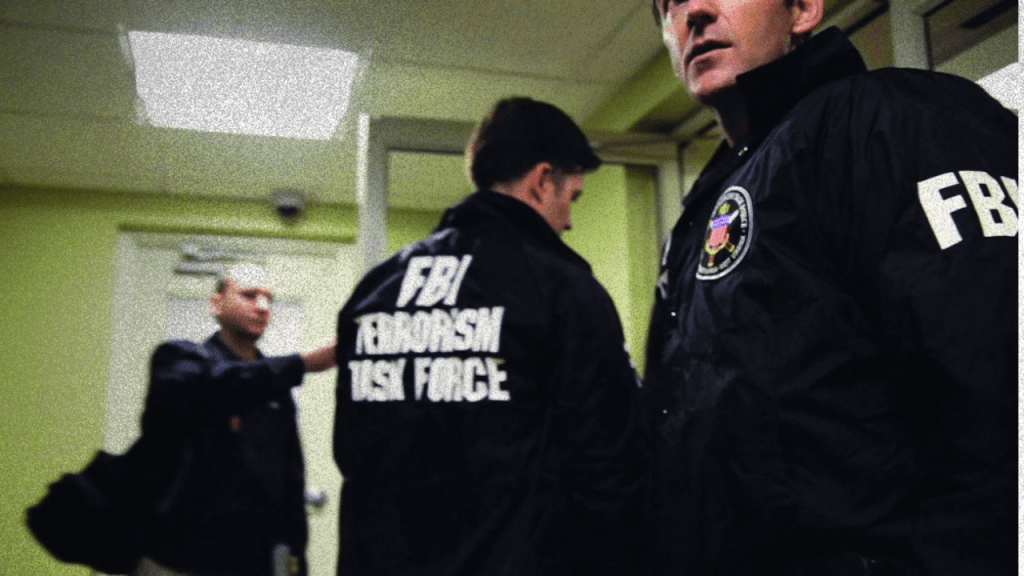
FBI informants create the terror threats they prevent — supplying fake bombs, proposing targets, guiding suspects through crimes the bureau itself designed.
After September 11, 2001, U.S. intelligence agencies shifted from investigating completed attacks to preventing potential ones. This required a new operational model: preemptive intervention. Rather than wait for suspects to acquire weapons or finalize plans, authorities embedded informants in communities, monitored online spaces, and constructed elaborate sting operations designed to reveal intent before capacity existed.
The strategy produced dozens of high-profile arrests. Officials presented each case as a disrupted plot. But the plots themselves were structurally dependent on FBI resources. Informants supplied the explosives — always inert. Undercover agents proposed the targets. Government operatives guided suspects through operational plans the suspects had no independent means to execute. The question the American Civil Liberties Union and defense attorneys began raising was straightforward: if the FBI provides the bomb, selects the target, and writes the plan, has it stopped terrorism or manufactured a prosecutable crime?
Fort Dix: FBI Assets Supplied the Weapons
The 2007 Fort Dix case established the template. Five men were convicted of plotting an attack on a New Jersey military base. The investigation centered on two paid FBI informants who recorded conversations about attacking soldiers. When the suspects attempted to purchase AK-47s and M16s, they were buying from FBI assets. The weapons came from the investigation itself.
Prosecutors argued the recorded conversations proved intent. Defense attorneys noted the informants escalated the discussions and controlled access to firearms. The jury convicted. The precedent held: if a suspect expresses willingness to commit violence, authorities can supply the means to test that willingness and prosecute the result. The Fort Dix template has since been repeated across dozens of cases.
Liberty City: Three Trials, No Weapons, No Plan
The 2006 Liberty City investigation targeted seven men in Miami who allegedly planned attacks on government buildings and the Willis Tower in Chicago. The case collapsed into three separate trials before convictions were secured. A government informant posed as an al-Qaeda operative, offered money, and encouraged the group to swear allegiance to the organization. Prosecutors acknowledged the men had no weapons, no explosives, no plan. Jurors struggled to distinguish between provocative rhetoric and genuine conspiracy. The multiple mistrials exposed how fragile the evidence was when removed from the FBI’s narrative framing.
Portland and Cleveland: FBI Built the Bombs
In 2010, Mohamed Osman Mohamud was arrested in Portland for attempting to detonate a car bomb at a Christmas tree lighting ceremony. The bomb was an inert device assembled by FBI bomb technicians. Undercover agents posing as militants had spent months cultivating the relationship before providing the explosives and the operational plan. Mohamud dialed the cell phone trigger. He was arrested immediately.
The 2012 Cleveland bridge plot followed the same structure. Five men were accused of attempting to destroy a highway bridge using C-4 explosives. The explosives were fake. An FBI informant introduced the bridge target and facilitated the acquisition of the inert materials. The suspects attempted to trigger the device via text message. The FBI controlled every material element of the conspiracy. Both cases produced convictions. In neither case did the suspects possess independent capacity to carry out the attacks they were charged with planning.
Michigan: Entrapment Defense Wins at Trial
The 2020 Gretchen Whitmer kidnapping case exposed the limits of informant-driven prosecutions when defense attorneys successfully centered the entrapment question. Federal authorities alleged members of the Wolverine Watchmen militia planned to abduct Michigan’s governor from her vacation home. Court proceedings revealed an unusually high number of FBI informants and undercover agents embedded in the group. Informants attended militia meetings, organized training exercises, and maintained extensive communication with suspects.
The first trial in April 2022 resulted in two full acquittals and two mistrials. The acquittals marked the first successful entrapment defense in a terrorism case since 9/11. A second trial produced convictions, but the initial jury outcome demonstrated that when the FBI’s operational role becomes the evidentiary focus, juries can reject the government’s framing outright.
The “Predisposition” Standard Enables Targeted Prosecution
U.S. courts permit sting operations if prosecutors demonstrate the suspect was predisposed toward criminal conduct. The legal standard turns on intent rather than capacity. Defense attorneys argue this framework allows authorities to target vulnerable individuals — socially isolated, economically precarious, or mentally unstable — and guide them through crimes they lack independent means to commit. Civil liberties organizations describe the pattern as manufacturing prosecutable conspiracies rather than disrupting organic threats.
Prosecutors reject this characterization. From their perspective, the suspect’s willingness to participate in violence justifies intervention regardless of who supplies the materials. The investigation reveals intent in a controlled environment where no public harm can occur. The debate remains unresolved because it hinges on an interpretive question: does a person willing to press a button on a fake bomb pose the same threat as someone capable of building a real one?
Known Wolf Cases Show the System’s Real Limits
If the preemptive model were functioning as designed, the FBI’s surveillance reach would prevent real attacks. The evidence suggests otherwise. The 2014 Ottawa Parliament Hill shooter Zehaf-Bibeau had been flagged by CSIS — and how CSIS missed both him and Couture-Rouleau despite active monitoring was a question that went unanswered. Whether the Parliament Hill attack represented an intelligence failure or something more systemic was never definitively resolved. Martin Couture-Rouleau, who killed a soldier in Saint-Jean-sur-Richelieu two days before the Ottawa attack, had his passport revoked by authorities who considered him a threat.
Two individuals already on the intelligence radar carried out attacks within forty-eight hours of each other. The system that produces high-profile sting arrests — built around informants, undercover agents, and manufactured conspiracies — consistently fails to detect the lone actors who actually strike. The apparatus is optimized for prosecution, not prevention.
The Security Machine Justifies Its Own Expansion
The structural shift post-9/11 was from reactive investigation to preventive intervention. Rather than prosecute completed attacks, authorities now prosecute expressed intent combined with symbolic participation in FBI-controlled scenarios. This model requires the state to create the conditions under which the crime becomes possible, then prosecute the suspect for acting within those conditions.
The logic is coherent from a national security perspective: lone actors can attempt attacks with minimal planning, making early intervention necessary.
But the practice produces a system where investigative agencies design the plots, supply the weapons, select the targets, and guide suspects through operational steps — then present the resulting arrests as evidence of thwarted terrorism.
The pattern repeats across Fort Dix, Liberty City, Portland, Cleveland, and Michigan because the operational model is identical: informants escalate, undercover agents facilitate, the state supplies inert materials, and prosecutors charge the suspect for participating in a crime that could not have existed without the investigation itself. Whether that constitutes counterterrorism or state-directed crime creation for prosecutorial purposes is a question the legal system has never been forced to definitively answer.
Sources
- Michigan kidnapping trial acquittals and mistrials — ABC News (2022)
- First successful entrapment defense in terrorism case since 9/11 — NPR (2022)
- Fort Dix investigation relied on paid FBI informants — Washington Post (2022)
- Fort Dix suspects arrested buying weapons from FBI asset — Washington Post (2007)
- Portland fake bomb supplied by FBI undercover agents — NBC News
- Portland conviction — U.S. Department of Justice (2013)
- Cleveland suspects bought fake C-4 from FBI informant — CBS News
- Civil liberties critique of manufactured terrorism plots — The Guardian (2011)




 Spark Solidarity