

In a world where power and influence often wear the guise of service and community, the story of Gerry Lougheed Jr. and his family offers a fascinating, if complex, portrait.
Gerry Lougheed Jr. stands as a member of the Order of the Lion of Finland—a prestigious honor awarded for both military and civilian merit—and serves as a Worshipful Master in Freemasonry, a venerable institution with origins in medieval stonemason guilds. Yet, beneath these esteemed titles lies a network of affiliations that reveal the intricate interplay between legacy, civic duty, and elite symbolism.
At a recent Annual Lodge Memorial Service, Lougheed Jr. presented an address under the direction of the Worshipful Master. The ceremony, held at Finlandia Village in the newly inaugurated Voima Hall, saw Finnish Ambassador Charles Murto and Brian Koivu of Algonquin Lodge No. 536 bestow upon him the Order of the Lion of Finland. This moment was not only a recognition of personal achievement but also a testament to the enduring tradition of awarding honors that link civic service with international prestige .
The Freemasonry connection, deeply rooted in centuries-old tradition, is itself a study in contrasts. Freemasonry, which evolved from the medieval craft guilds of stonemasons, today operates as a decentralized fraternity with local lodges and a gradal system of degrees—from Apprentice to Master Mason. Despite its lofty claims of brotherhood and equality, its secretive nature and exclusive membership continue to invite scrutiny from progressive circles, who question the democratic implications of such hierarchical systems.
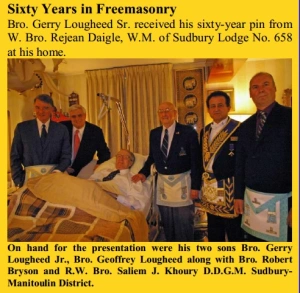
Beyond the closed doors of Masonic lodges, the Lougheed family’s influence extends into the civic realm through Rotary International. Gerry Lougheed Jr. founded the Rotary Club of Sudbury Sunrisers in 1991, echoing the long tradition of his father, Gerry Sr., who was an active Rotarian since the early 1950s and even presided over the Sudbury Rotary Club in 1964.
Rotary International, established in 1905 by Paul Harris, positions itself as a force for humanitarian service and ethical leadership. Yet, one cannot ignore that these organizations, with their global networks and exclusive membership rosters, often reflect a form of power that is at odds with the grassroots values championed by more progressive ideologies .
The legacy of civic engagement does not stop there. Gerry Lougheed Sr. was also involved with the Shriners—an organization known for its philanthropic contributions but rooted in the traditions of Freemasonry—and played a pivotal role in rebuilding St. John Ambulance services in Greater Sudbury.
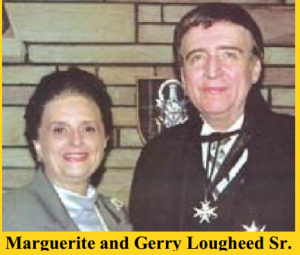
His knighthood in 1990, conferred by the Governor General of Canada, further cemented the family’s elite status. This intertwining of business, civic service, and ceremonial honor is emblematic of a broader system where symbols like the Maltese Cross, associated with the Sovereign Military Order of Malta and the Order of St. John, serve as emblems of both historical valor and contemporary influence ; .
As the Lougheed name continues to be synonymous with community service and elite symbolism, the narrative invites us to question how such legacies are constructed—and whether the veneer of civic virtue can sometimes mask underlying power structures that demand closer, more critical scrutiny.

 Spark Solidarity