
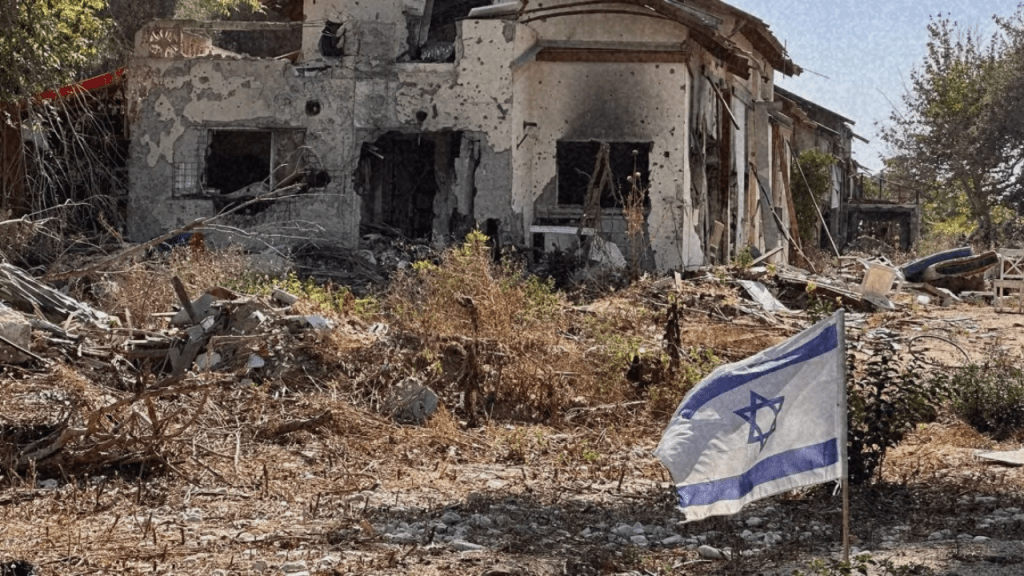
Gaza envelope media asymmetry: the frontier doctrine that built Nir Oz also designed how the world would react to any attack on it.
The frontier doctrine that built Nir Oz was not only a geographical design. It also pre-loaded the story-form that would organize the world’s response to any attack on the border it had created. When a rocket crosses the fence eastward, a name enters the news cycle. When a bomb crosses westward, a number enters a spreadsheet. The asymmetry is not incidental to the doctrine. The asymmetry is what the doctrine was for.
The Grammar of Coverage
The two most photographed children of the war between October 2023 and February 2025 were Ariel and Kfir Bibas, aged four and ten months, taken from Kibbutz Nir Oz along with their mother Shiri. Their images were carried on Israeli campaign posters, printed in the front pages of every major Western newspaper for sixteen months, projected onto public buildings across a dozen countries, and made the subject of official statements by the presidents and prime ministers of every state in the Western hemisphere.
The two most photographed children in Rafah, or in Beit Hanoun, or in Jabalia, do not have names in the same sense. They have file numbers in the UN’s Humanitarian Data Exchange. A subset have been named by their families, by grave markers, by Al Jazeera correspondents who worked to identify them before those correspondents were themselves killed. Most simply appear in a running tally the machinery of coverage refers to only in aggregate.
By the point at which forensic identification of the Bibas family became a global news event — the third week of February 2025 — Save the Children and OCHA had documented the deaths of more than seventeen thousand children in Gaza. The figure has continued rising since. A single named family on one side; a five-figure population of unnamed families on the other. Two moral universes, running on the same news wire.
Where the Story-Form Was Manufactured
Framing the disparity as anti-Palestinian bias is accurate but insufficient. Bias is a description of an outcome. What produces the outcome is a structural arrangement that was engineered decades before the Bibas family were born.
The Nahal frontier doctrine placed families in dwellings whose military function was concealed by the civilian designation of the settlement. The Kibbutz Movement Alliance’s own leadership described the border settlement as a “military stronghold, nothing less.” The Israeli Deputy Defence Minister told the Israeli press that the residents held the official status of “civilians in military service.” These are matters of internal Israeli record.
What that designation does inside a news cycle is straightforward. If a settlement is a civilian community, then any attack on it is an atrocity against civilians. If it is simultaneously a military stronghold, then any attack on it is also military engagement. The doctrine’s brilliance was to hold both categorizations at once, and to select the appropriate one according to the direction of the story. When the settlement was functioning as designed, it was a civilian farm. When the settlement was attacked, the civilian designation was the frame the world was invited to see it through.
There is no equivalent architecture on the other side of the fence. The Palestinians in Rafah, in Jabalia, in Khan Younis, do not have a category the world’s press was pre-trained to protect. Their homes are not designated as anything by anyone whose designations count. They have been in refugee camps for seventy-seven years, on land three kilometres from the villages they came from, and the news wire has no template that treats their being there as a condition worth protecting. That was the design.
The Manufactured Cycle
The pattern of Israeli response to any attack on the envelope follows a script that has run, with variations, since the 1950s. First: identification, at close range, of a single family whose story will carry the political weight. Second: prolonged saturation of the identified family across Western media, framed in unambiguously civilian terms. Third: military response proportioned not to the harm inflicted but to the political weight the identification has accumulated. Fourth: the response’s civilian casualties are absorbed by the aggregate, which has no story-form.
The forensic evidence in any given case is often disputed, is often only available from parties with a stake in the outcome, and rarely alters the political weight the story has already accumulated by the time an investigation could be conducted.
The Bibas case is an instance. Israel’s National Institute of Forensic Medicine concluded the two children had been killed by their captors and the mother had not been killed by bombing; Hamas has continued to assert that the family died in an Israeli airstrike; the BBC noted publicly that it had been shown but not permitted to verify Israel’s evidence. The dispute is real and cannot be closed from open sources. What is not disputed is that the sixteen months of coverage preceding the forensic examination proceeded on the assumption of one of the two answers.
That is not a claim that the coverage was wrong. It is a claim about how the doctrine functions: the story-form was already in place before any of the physical facts were established. In the reverse direction, no story-form is in place at any point. A Palestinian child killed in Jabalia does not enter a template. A Palestinian child killed in Rafah enters a running total. The template was built with settlements on it, and it was built to run in one direction.
What Solidarity Requires It Refuse
Palestinian solidarity work does not require, and is not helped by, contested claims about how any specific hostage died. The forensic dispute in the Bibas case is a dispute; contested attribution cannot be closed by assertion, and the attempt to close it corrodes the credibility of the analysis that surrounds it. What Palestinian solidarity work does require is the ability to hold the coverage asymmetry in view without smuggling in claims that a hostile reader can dismantle in a paragraph.
The tenable line runs as follows. The frontier doctrine placed civilians on ground whose original inhabitants had been expelled. The doctrine anticipated attacks on the civilians it placed there. It designed a media architecture that would treat any such attack as a categorical civil emergency.
That media architecture is not neutral. It does not treat the descendants of the expelled the same way. The asymmetry is documented, measurable, and structural — and to make it visible does not require any specific counter-claim about who died how.
Every child killed in this war is a child. The doctrine’s function is to make some of those children unbearable to the audience it was designed for and to make others of them invisible. The task of a materialist analysis is to name the machinery that produces that difference.
Not to reverse the machinery’s poles by insisting that the visible ones are somehow secretly deserving of the invisibility that fell on the others. That insistence is grotesque on the merits and is politically catastrophic besides, because it hands the state that engineered the doctrine a permanent talking point about the moral character of its critics.
The doctrine placed the Bibas family in Nir Oz. It also placed the al-Ma’in refugees in the camps three kilometres away. The point of the analysis is not to prefer one to the other. The point is that the state that arranged both is still, in this moment, arranging the coverage of what happens between them.




 Spark Solidarity